Titanium vs Stainless Steel: Which is Suitable for Your Project?
By JunWen Liu | Aug. 04, 2026
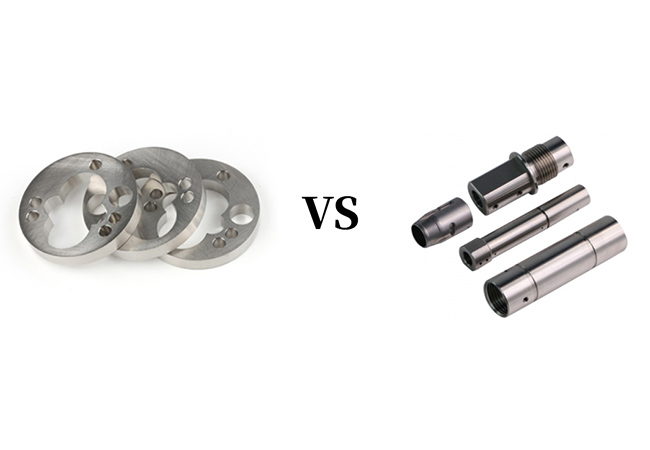

For CNC machined parts made of titanium vs stainless steel, stainless steel offers higher cost-effectiveness, but it has a high density and leads to heavier part weight. Titanium is lightweight, featuring excellent corrosion resistance and biocompatibility, but it is relatively expensive. The cost gap between the two is reflected not only in raw materials but also in the CNC machining process—cutting titanium alloy is relatively more difficult than stainless steel, leading to longer processing cycles and higher per-piece manufacturing costs.
In medical/dental, aerospace, drone industry, and other high-end engineering fields, stainless steel is often used to replace titanium alloy. Both material types possess good corrosion resistance and good strength, and such replacement schemes are mostly driven by cost optimization considerations. However, this replacement depends on the specific context, as differences remain between titanium and stainless steel in core properties and CNC machining performance (and different grades also exist).
This article provides a comprehensive comparison between stainless steel vs titanium, covering material properties, key CNC machining points, and applications, helping you select the right material while simultaneously achieving cost control and machining process optimization. At the end of the article, we will also share a factory case study on how we assisted a client in converting the material of a hydraulic pipeline bracket, successfully achieving a 40% weight reduction while meeting load requirements.
Titanium is a transition metal. Upon contact with oxygen, a stable titanium dioxide passivation film rapidly forms on its surface. Relying on this native oxide film, titanium alloys can resist chloride media, oxidizing acids, and seawater corrosion. This strong oxidation resistance or corrosion resistance is achieved by titanium itself, without requiring additional anti-corrosion coatings. CNC machining factories typically stock titanium raw materials as bars and forgings for titanium CNC machining.
Regarding titanium grades, they are mainly divided into commercially pure titanium grades and titanium alloy grades. The most widely used types of titanium are Grade 5 titanium alloy (Ti-6Al-4V), as well as Grade 1 and Grade 2 commercially pure titanium:
It has the highest purity in the commercially pure titanium series, with the lowest oxygen and iron impurity content, and excellent cold-forming performance. It is suitable for chemical storage tanks, seawater transportation pipelines, and various non-load-bearing medical accessories.
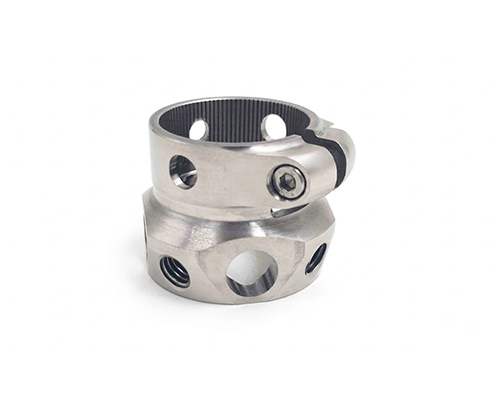
Its oxygen and iron contents are slightly higher than Grade 1 pure titanium, offering higher strength while retaining excellent weldability and corrosion resistance. It is the most commonly used commercially pure titanium material for brackets, housings, and various general-purpose CNC machined parts.
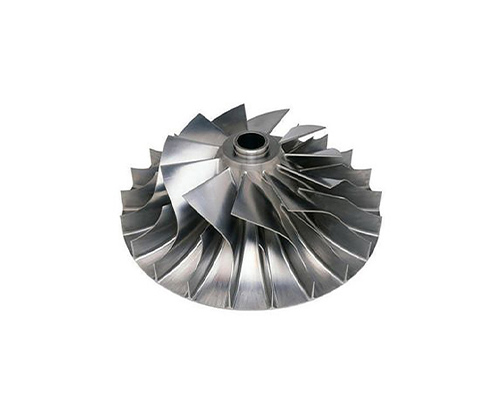
It contains approximately 6% aluminum and 4% vanadium. Its tensile strength is roughly 3.7 times that of Grade 1 pure titanium, and it is extensively used in aerospace structural components, medical implants, and mechanical parts subjected to long-term high loads.
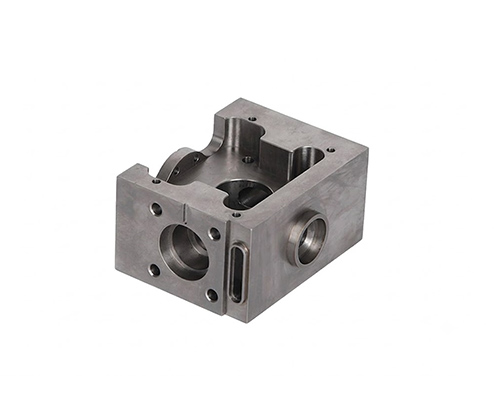
Stainless steel is an iron-based alloy with a minimum chromium content of 10.5%. Generally, the chromium in stainless steel reacts with oxygen to form a dense chromium oxide passivation film—this isolates external corrosive media, protects the base metal from rusting, and resists attack from most chemical media.
Depending on their chemical and metallurgical structures, stainless steels types are mainly divided into five major series: austenitic, ferritic, martensitic, duplex, and precipitation-hardening stainless steels, with over 200 specific grades. Below are examples of the most commonly used stainless steel grades:
With approximately 18% chromium and 8% nickel, it possesses general-grade corrosion resistance and is easy to form and weld. It is widely used in food processing equipment, kitchen and bathroom components, chemical containers, and architectural decorative parts.
With 2%–3% added molybdenum, it effectively enhances resistance to chloride ion corrosion and can withstand long-term exposure to seawater and various chlorine-containing process media. It is often used to manufacture marine pipe fittings, surgical instruments, and pharmaceutical production equipment.
It contains 17% chromium, 4% nickel, and added copper. After low-temperature aging treatment, its yield strength can surpass Grade 5 titanium alloy (approx. 1060 MPa for 17-4 PH H1025 condition vs. approx. 825 MPa for Grade 5 titanium), making it suitable for manufacturing aerospace structural parts, valve bodies, and high-stress drive shafts.
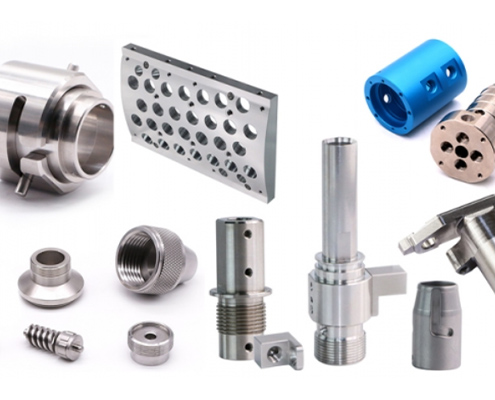
Stainless steel can serve as a lower-cost alternative under specific operating conditions that match some of titanium’s corrosion resistance and strength. When evaluating such a substitution down to specific property values, you need to consider whether the operating conditions of the parts align with the material properties. The table below lists a comparison between common Grade 5 titanium and 304 / 316 stainless steel:
| Property | Titanium (Grade 5 / Ti-6Al-4V) | Stainless Steel (304 / 316) |
| Density | 4.43 g/cm³ (about 56% the weight of stainless) | 8.0 g/cm³ |
| Tensile Strength | ~895 MPa | 515–620 MPa |
| Yield Strength | ~825–880 MPa (annealed) | 215–310 MPa (304) / 250–290 MPa (316) |
| Elongation at Break | 10% | 40–60% |
| Elastic Modulus | 114 GPa | 193–200 GPa |
| Thermal Conductivity | 6.7 W/m·K (heat stays at the cut) | 16–25 W/m·K |
| Machinability Rating (304 SS = 1.0 baseline; higher = easier) | ~0.4 (very difficult) | 0.45–0.50 (304) / 0.40–0.45 (316, work-hardens) |
| Relative Corrosion Resistance | Excellent in chlorides, seawater, oxidizing acids | Excellent in general; 316 needed for chloride service |
| Raw Bar Cost (relative) | 5–10× | Baseline |
| Welding | Possible, needs argon shielding | Standard, no shielding required |
| Cold Forming | Limited — only small deformations | Good to excellent for austenitic grades |
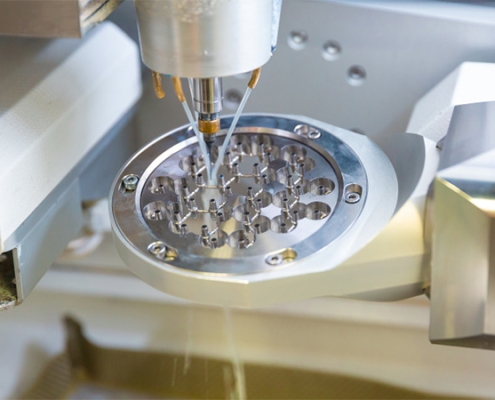
CNC machining of titanium alloys and stainless steel generally involves subtractive manufacturing processes such as turning, milling, drilling, and grinding on bar stock. Due to differences in machinability and thermal conductivity during CNC machining, their machining performance and optimization measures vary:
Taking free-machining carbon steel as the machining performance benchmark, we set its machinability index to 1.0; a lower value indicates greater cutting difficulty.
According to this standard, the machinability index range for various titanium alloys is 0.30–0.60, while the overall index for 304 and 316 austenitic stainless steels is around 0.45.
By comparison, 304 stainless steel is easier to cut and machine than titanium alloys, whereas 316 stainless steel is highly prone to work hardening, making its overall machining difficulty roughly on par with Grade 5 titanium alloy.
| Parameter | Titanium (Grade 5) | Stainless Steel (304 / 316) |
| Recommended Milling Speed (SFM) | 30–60 | 80–150 |
| Tool Material | Sharp carbide, uncoated or DLC | Carbide or coated HSS, TiAlN coating typical |
| Coolant | Through-tool high-pressure (>70 bar) | Flood coolant is usually sufficient |
| Chip Behavior | Long, stringy, hot chips | Stringy for 304, segmented for 316; work-hardens if dwells |
| Biggest Failure Mode | Heat concentration burns tool edge; BUE forms on worn tools | Work-hardening from low speed or dwell |
Taking precision CNC parts with a tolerance requirement of ±0.05 mm and identical geometric structures as an example, we compare the overall manufacturing cost differences between titanium alloy and stainless steel:
Metal raw materials on the market are priced by weight, and the unit price of titanium alloy bar stock is generally 5 to 10 times that of stainless steel bar stock. Even if two finished parts have identical volumes, the basic procurement cost of the raw blank required for titanium alloy is significantly higher.
The allowable cutting speeds for titanium alloy are only 30%–50% of those for stainless steel, tool wear is faster, and tool change frequency is 2 to 3 times higher. For parts with identical external dimensions, the total machining time per piece for titanium alloy is typically 1.5 to 2.5 times that of stainless steel.
Specialized carbide inserts suitable for titanium cutting have single-unit procurement prices 30%–60% higher than tools used for stainless steel. Furthermore, per production shift, tool insert consumption can reach 2 to 3 times that of stainless steel machining conditions, with high tool consumable costs further pushing up overall production expenses.
Stainless steel possesses excellent rigidity, making it less prone to deformation and springback under cutting forces. Titanium alloy is more elastic with prominent machining springback issues; when machining various thin-walled components, dimensional out-of-tolerance issues occur easily, resulting in a noticeably higher scrap rate.
In summary, under the vast majority of operating conditions, the overall machining and manufacturing cost of titanium alloy parts will be higher than that of identical stainless steel parts.
Overall, finish machining for both materials can achieve tolerances of ±0.02 mm, but there are distinct differences in how this is accomplished: stainless steel relies on its own rigidity to maintain machining accuracy, whereas titanium machining requires sharp tools, light cuts, high-pressure cooling, and stress-relief operations scheduled between roughing and finishing.
The table below provides a comparative example of Grade 5 Titanium vs. 304 Stainless Steel:
| Quality Metric | Titanium (Grade 5) | Stainless Steel (304) |
| Achievable Tolerance (finish with stress relief) | ±0.02–0.05 mm | ±0.02–0.05 mm |
| Dimensional Stability Under Cut Force | Needs stress-relief dwell; springback up to 0.05–0.10 mm | Stable — high stiffness suppresses springback |
| Surface Finish As-Machined | 0.8–1.6 µm Ra typical | 0.4–1.6 µm Ra typical |
| Best Surface Route | Electropolish for medical; anodize for color coding | Passivation (nitric or citric acid) for corrosion refresh |
The core advantages of titanium alloys lie in their light weight, high specific strength, top-tier resistance to chloride ion corrosion, and superior human biocompatibility. The core strengths of stainless steel reside in its high cost-effectiveness, good rigidity, lower machining threshold, and balanced general corrosion resistance.
For scenarios with mild corrosive environments, no strict lightweighting demands, and no need for human implantation, stainless steel can mostly replace titanium alloy. However, for applications involving long-term exposure to seawater or high-chloride media, significant weight reduction demands, or human implants, stainless steel cannot be used as a replacement, and titanium alloy must be selected.
In chemical processing, reactors dedicated to chlorine-containing media, heat exchanger tube bundles, and corrosion-resistant valve bodies prioritize the use of titanium alloys. For storage, transport, and processing of regular organic/inorganic chemical materials with conventional acids/alkalis and no chloride ions, corrosion resistance requirements are moderate and expensive titanium alloys are unnecessary.
Titanium alloy seawater transportation pipes and subsea connectors submerged year-round in seawater can maintain an annual corrosion rate below 0.025 mm, offering long service lives. For offshore deck components, non-deep-submerged marine fittings, and seawater pump housings, 316 stainless steel parts (or the more corrosion-resistant, low-carbon 316L variant) can be used.
Titanium alloys feature exceptional biocompatibility, causing no rejection reaction with human bones and soft tissues. For any components that must be implanted inside the human body (e.g., orthopedic implants, dental implants, implantable medical devices), medical regulations only recognize medical-grade titanium alloys; stainless steel cannot replace them. However, for external surgical instruments, routine hospital equipment, sterile cleaning fixtures, operating table accessories, and other non-internal components, 316 stainless steel can be chosen.
In special working conditions such as food sauce pickling, high-salt brine processing, and strong-acid food production, equipment chambers and dedicated processing accessories must be made of titanium alloys to avoid the risk of corrosion contaminating food and pharmaceutical products. For most ambient-temperature food processing lines and complete sets of pharmaceutical equipment, where medium pH is mild and free of high-salt severe corrosion issues, 316 stainless steel is a viable option.
Hydraulic brackets, onboard hydraulic pipelines, and engine perimeter components in aircraft often have stringent requirements for lightweighting, high-temperature resistance, and high strength. Titanium alloys’ light weight, high strength, and stable high-temperature performance fit these requirements perfectly, meaning stainless steel cannot be substituted. For certain structural joints and high-strength fasteners, 17-4 PH precipitation-hardening stainless steel can be considered (offering outstanding strength after aging treatment to replace titanium alloy).
A client commissioned us to machine an aircraft hydraulic pipeline bracket, with the original design specifying 17-4 PH stainless steel. This solution was inherited from a heavy-duty system of another aircraft model and had not been re-optimized for lightweight requirements.
The issue was that the technical specifications for the new airframe required a 40% weight reduction for the entire hydraulic pipeline bracket assembly. If the wall thickness of the original 17-4 PH solution were simply thinned down, the stress safety margin would fail to meet design standards.
After comprehensively evaluating operating conditions such as working temperature, vibration spectrum, and hydraulic pressure, our engineering team concluded that Grade 5 titanium alloy could withstand the same loads while reducing part weight to nearly half the original. Compared to the baseline stainless steel process, the titanium alloy version focused on three key process optimizations:
The brackets were successfully delivered within the customer’s project deadline, with final test results showing:
When the core requirements of a project are part lightweighting, extreme resistance to chloride ions and seawater corrosion, human implant compatibility, or long-term operation in high-temperature environments above 300°C, titanium alloys (typically Grade 5 Ti-6Al-4V or medical pure titanium) become irreplaceable choices. If the project budget is limited, with no strict lightweighting requirements, no human implantation needed, and operating conditions limited to conventional atmosphere or mild acid/alkali media without high-salt seawater corrosion, stainless steel can replace titanium alloy due to its exceptional cost-effectiveness. However, relying solely on empirical judgment for material selection can easily lead to deviations, causing downstream issues such as machining deformation, insufficient service life, and cost overruns.
Whether you need custom CNC machining for stainless steel or titanium precision parts, feel free to contact our CNC machining factory. We offer comprehensive material selection reviews and DFM process optimization tailored to your part structural design, order batch size, and actual service environment.[2D Drawings (PDF files), 3D Drawings (IGS/STP/STEP files)]
 WhatsApp/WeChat/Mobile:
+86-15099911516
WhatsApp/WeChat/Mobile:
+86-15099911516 Tel: 86-150-9991-1516
 QQ: 939020977
 E-Mail: service@vimetal.com.cn


Titanium vs stainless steel: Which material is harder?
In terms of surface hardness, tianinum such as Ti-6Al-4V titanium is generally harder than 304/316 stainless steel. However, precipitation-hardened 17-4 PH stainless steel delivers a much higher hardness level after heat treatment, exceeding conventional titanium alloys. For general industrial parts, titanium offers better hardness; for high-hardness structural components, 17-4 PH stainless steel is the harder option.
Titanium vs stainless steel: Which material is stronger?
Aluminum tends to be more expensive than steel due to its higher production costs, especially in raw material extraction and refining processes. Aluminum also requires more energy for processing and is less abundant compared to steel, contributing to its higher market price.
Can 316L stainless steel completely replace titanium alloy for long-term outdoor coastal equipment parts?
It cannot completely replace titanium alloy. 316L stainless steel can adapt to offshore environments in the short term by increasing wall thickness to allow for corrosion margins. However, under year-round continuous seawater immersion or deep-sea conditions, pitting corrosion will still slowly occur. Titanium alloy’s resistance to chloride ion corrosion far exceeds that of stainless steel, delivering a much longer service life in seawater environments—making it suitable for long-term components like subsea connectors and deep-sea pipelines.
What design and process details can effectively prevent titanium dimensional deviations?
Springback issues during machining can be improved through three process optimizations: using high-pressure through-tool coolant and sharp carbide tools with light depth of cut; adding a stress-relief dwell operation between roughing and finishing; and appropriately adding temporary process ribs to thin-walled structures. Our factory possesses mature titanium machining processes and can perform DFM optimization in advance based on part geometry to ensure final tolerances are met.
In medical applications, which components strictly mandate the use of titanium alloys, where stainless steel cannot be used?
Implantable medical devices that require long-term implantation inside the human body, such as orthopedic plates, dental implants, and bone screws, must use medical-grade titanium alloys (Grade 1 pure titanium or Grade 5 ELI ultra-low interstitial titanium) to leverage superior biocompatibility and avoid body rejection. For external equipment such as scalpels, surgical trays, and hospital sterilization equipment, 316L stainless steel is widely used in the industry to meet standard requirements.
What are the differences between titanium alloys and stainless steel in terms of welding and surface treatment methods?
Titanium alloy welding strictly requires continuous argon gas purging to isolate air and prevent oxidation, whereas standard stainless steel welding processes are simpler and do not require full inert gas shielding. For surface treatments: medical titanium alloys mostly use electropolishing, while industrial parts frequently utilize color anodizing; the primary surface treatment for stainless steel is acid passivation, which restores its native passivation film for corrosion protection.
 Written By JunWen Liu
JunWen Liu holds a Mechanical Engineering degree from Esslingen University of Applied Sciences and spent seven years as a CNC Process Engineer, accumulating extensive hands-on experience. She now shares that knowledge through her writing, drawing from real problems she encountered on actual projects. Outside of work, she enjoys hiking and is always chasing the next summit view.


 Aluminum for Casting: A Complete Guide to Alloys, Casting Processes, and Se...