The Comprehensive Guide to Grade 2 Titanium: Why It’s the Good Option for Your Custom Parts
By JunWen Liu | May. 07, 2026
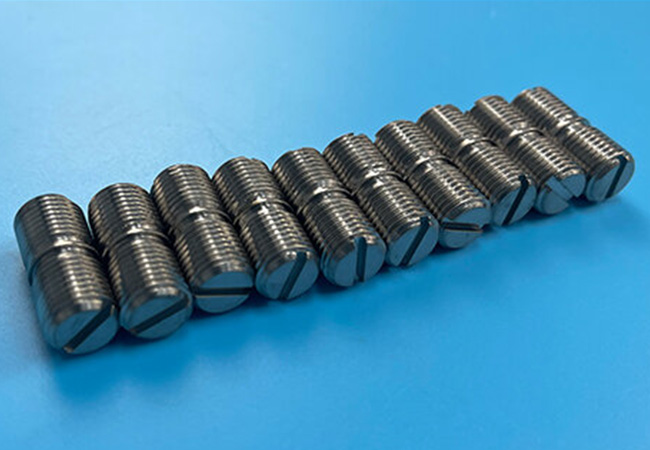

Suppose there is a metal which has a strength similar to steel but with an almost 45% weight reduction—grade 2 titanium is the one. Whether you are now looking forward to high-end watch cases, chemical tube systems, medical implants with biocompatibility, or large batches of screws and fasteners, grade 2 titanium can be the one for good-looking, strong, lightweight, and highly corrosion-resistant performance.
While the above are the rough characteristics of titanium grade 2, you need to dive deeper into this material. It is also important to learn about its key differences from other common titanium families (such as titanium grades 5, 7, and 12). At the very end, we will also share a case of how our CNC machining factory solved the scratch and color fading issues for the custom titanium grade 2 watch cases from our clients.
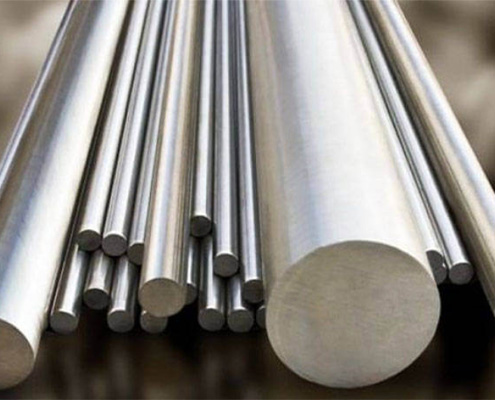
It’s very easy to learn that grade 2 titanium is strong, lightweight, and highly corrosion-resistant, and can provide a good surface for your custom parts. The best manufacturing advantage is that titanium grade 2 has good ductility, as it belongs to the commercially pure titanium family (composition is 99.2% titanium elements, trace of O, Fe, C, N, H). This means you can easily use grade 2 titanium for tubing uses with some of the best corrosion resistance, as the titanium is inert and basically cannot react with corrosive seawater or chemicals.
Besides moderate strength (similar to common carbon steel, but lower than high-strength steel), good ductility, and weldability, the machinability of grade 2 titanium is 40% (based on AISI 1212 as 100%). This relatively low-to-moderate data can result in a slightly higher machining cost(higher cost than common steel but lower than some other titanium alloys) if you need precision parts like watch cases or implants through CNC machining—machining difficulty causes longer machining time (price is calculated by the minute) and damage to cutting tools.
If you occasionally see the following names, they are the equivalents to grade 2 titanium:
| Standard | Region | Equivalent Grade |
| ASTM / ASME | United States (Global) | Grade 2 |
| UNS | Global / US | R50400 |
| GB/T | China | TA2 |
| DIN / EN | Germany / Europe | 3.7035 / Ti2 |
| JIS | Japan | Class 2 / TR340C |
| BS | United Kingdom | IMI 125 / TA2 |
| GOST | Russia | VT1-0 (BT1-0) |
| AMS | United States (Aviation) | AMS 4902 |
Below is a simple showcase of the key physical and mechanical properties of grade 2 titanium for a quick overview:
| Properties | Value |
| Density | 4.51 g/cm3 |
| Tensile Strength | > 345 MPa |
| Yield Strength (0.2%) | 275 -450MPa |
| Elongation | >20% |
| Thermal Conductivity | 21.7W/(m .K) |
| Machinability | 40% (Base:AISI 1212 at100%) |
| Operational Temperature | -253°C to 427°C |
| Elastic Modulus | 105 GPa |
From the clear data, we can see what titanium grade 2 can bring to parts:
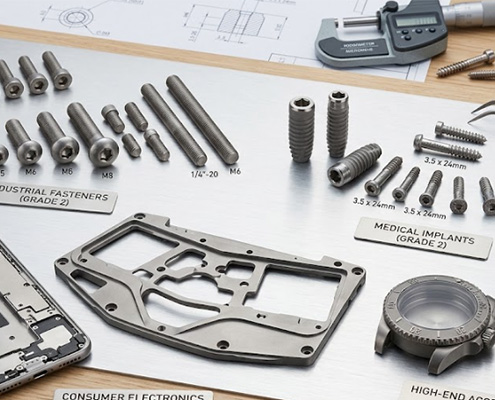
If you choose this versatile material grade 2 titanium, a wide variety of industries which require excepectional corrosion resistance, moderate strength, lightweight, good weldability and ductility, or ability to be CNC machined into precision and premier components. You can find it utilized in the following examples:
Fasteners and Hardware
Industrial and Chemical Processing
Thanks to its excellent formability, various cold and hot forming or welding techniques can be applied to this material. Therefore, you can easily use it for chemical processing equipment and seawater piping systems.
Because of its superb biocompatibility, you can use grade 2 titanium for medical implants and surgical instruments. Through precision CNC machining, it is crafted into bone plates, bone screws, and prosthetic components that are safe for long-term use inside the human body.
Sports Equipment
Such as bicycle frames, golf club heads, and diving equipment, where you need a balance of strength and resistance to sweat or saltwater.
Marine Industry
You can rely on it for underwater connectors and components that face constant exposure to the ocean.
For high-performance vehicles, you might use it in muffler components to reduce weight and withstand heat.
Aerospace Industry
You will see it used in turbine components, as well as frames, supports, and tubing joints.
Oil & Gas Industry
On offshore platforms, you can use it for platform components, fasteners, and piping systems.
Power Generation
It is a good material for heat exchangers and condensers, ensuring long-term durability in low and high temperature environments.
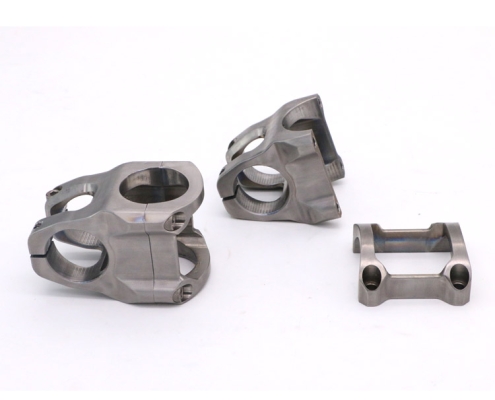
When you are looking to balance performance and budget, choosing grade 2 can reduce the production costs if your custom parts do not need to withstand high-pressure or structural loads.
While grade 5 is much harder to form, more expensive to machine, and less suitable for complex shapes, it is stronger and harder. Therefore, you can choose grade 5 titanium if the parts require high strength, toughness, and surface durability.
Both grade 2 and 5 can be used for fasteners, medical bone screws, parts for high-end bicycles, or premium consumer electronics housings, but this depends on your budget and requirements for performance.
The biggest difference between grade 12 titanium and grade 2 titanium is that small amounts of molybdenum and nickel are added to the specialized alloy, grade 12. This means that if you use grade 12 titanium, parts can resist crevice corrosion at high temperatures much better than grade 2!
But you could think of it as overkill for many projects, even though this sounds impressive.
Therefore, if your customized parts are operating in standard corrosive environments at room or moderate temperatures, grade 2 offers much better cost-effectiveness. You only need to step up to grade 12 if your application involves high-heat industrial processing where crevice corrosion is a proven risk.
Grade 7 titanium is essentially grade 2 titanium with a small amount of palladium added to it, making it even better for resisting extremely strong acids. However, palladium is a precious metal, which makes grade 7 very expensive.
Therefore, unless your product is destined for a laboratory or a chemical plant where it will be in constant contact with strong reducing acids, the corrosion resistance of grade 2 is already incredible enough for almost any marine, medical, or consumer application.
How We Solved Scratches and Fading Issues for Custom Grade 2 Titanium Watch Cases
If you are considering grade 2 titanium for your premium watch line, you might face the same hurdle as one of our Swiss clients. They approached us with a batch of semi-finished cases that were plagued by quality issues.
While commercially pure titanium grade 2 offers incredible biocompatibility and a lightweight feel, its high ductility makes it prone to surface galling and micro-scratches during machining. Furthermore, their previous supplier struggled with inconsistent color during the anodization process, leading to a 30% rejection rate.
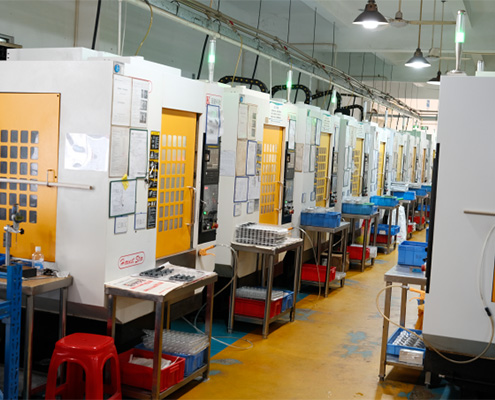
Our engineering team overhauled the production strategy. To combat scratches, we utilized custom-coated carbide tooling and a high-pressure internal cooling system. This allowed us to manage heat dissipation effectively, preventing the “sticky” chips that cause surface tearing—a common issue given titanium’s machinability rating of 40%. To solve the color fading, we implemented a specialized pre-treatment involving precision sandblasting followed by electrolytic polishing. This ensured the surface was perfectly prepared to form a dense, uniform oxide layer, guaranteeing that the final color remained vibrant and consistent across every single piece.
Finally, we increased the production yield from a shaky 70% to a stable 98%+. The final titanium grade 2 watch cases showcased a flawless, silk-like finish that passed rigorous wear-resistance and artificial sweat corrosion tests.
If you are considering Grade 2 titanium, you are looking for strength similar to carbon steel, a weight reduction of nearly 45%, and exceptional corrosion resistance. It offers the most cost-friendly production solution within the titanium family for medical, marine, and high-end consumer electronics. Although its high ductility can lead to challenges such as surface scratches or tool wear during CNC machining, these issues can be effectively resolved through professional process optimization. Still not sure grade 2 titanium is suitable for your custom requirements or not? Upload your CAD drawings, and our VMT CNC machining factory team will provide a quote and manufacturability suggestions within 24 hours.
The technical information and manufacturing advice shared on the VMT website are for general guidance only. While we strive for accuracy, VMT does not guarantee that the processes, tolerances, or material properties mentioned are applicable to every specific project. Any reliance you place on such information is strictly at your own risk. It is the buyer’s responsibility to provide definitive engineering specifications for any production orders. Final specifications and service terms shall be subject to the formal contract or quotation confirmed by both parties.
 WhatsApp/WeChat/Mobile:
+86-15099911516
WhatsApp/WeChat/Mobile:
+86-15099911516 Tel: 86-150-9991-1516
 QQ: 939020977
 E-Mail: service@vimetal.com.cn


Is grade 2 titanium good for watches?
Yes. Especially if you need CNC machined custom watch cases, grade 2 titanium can give the cases lightweight and excellent surface texture. The cases are also hypoallergenic due to their biocompatibility, which is good for people with allergies if they are also your target consumers.
Is grade 2 titanium good?
For most uses needing high corrosion resistance, medium strength, lightweight, good surface finishing, or ductility, yes, it is the economical one among titanium families. But for higher strength needs, you can choose grade 5; for higher corrosion-resistant needs, you can choose grade 12 or grade 7.
Is titanium grade 2 prone to rusting?
No. Actually, the commercially pure titanium grade 2 is chemically inert, and basically doesn’t react with corrosive chlorides in marine environments or some chemicals. Additionally, it can form a protective oxide film on the surface by itself to protect against corrosion.
Why is the machining cost for my grade 2 parts higher than that for aluminum?
This is mainly because most aluminum is softer and easier to machine than grade 2 titanium. Not only is production time for grade 2 longer—fees are accounted for by machining minutes—but there is also more cutting tool damage when machining—which accounts for part of the fees among the total cost.
Can you provide the documentation to prove (MTC)?
Yes. This is one of the strict steps in our factory—the material sources must be traceable and verifiable to ensure the production of reliable components for our clients.


 What is Hybrid Manufacturing and How It Benefit Your Custom Parts