The Ultimate Guide to CNC Machining Grade 1 Titanium: Properties, Deformation Control & Cost Tips
By JunWen Liu | July 24, 2026
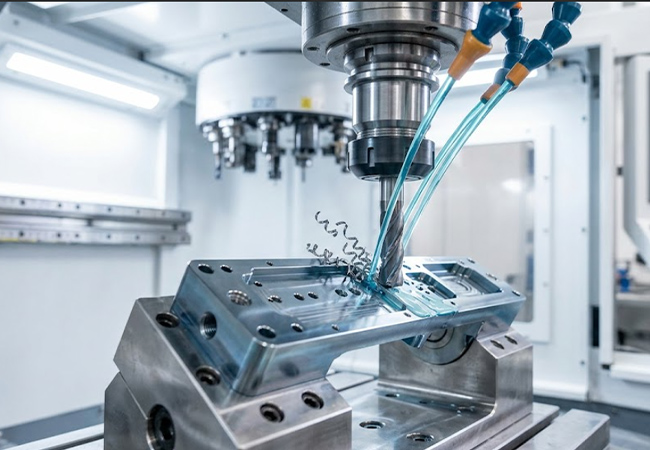

Grade 1 titanium possesses unique characteristics such as work hardening, springback, and poor thermal conductivity. If these are not mitigated during the design stage, risks such as out-of-tolerance parts, scrap rework, and delivery delays may occur. In addition, Grade 1 commercially pure titanium is the commercial titanium material with the highest purity, best toughness, and formability. Its operating conditions, cost-effectiveness, and performance differ significantly from other titanium alloys (such as Grade 2 or Grade 5). For titanium CNC machining, accurately mastering the pros and cons, selection boundaries, and processing key points of Grade 1 titanium can both ensure part operational stability and compress project costs.
This article introduces the properties, and industry applications of titanium grade 1, outlines part deformation avoidance strategies and mass production cost-reduction techniques, and incorporates a real project case study (our factory’s material selection and cost reduction for a customer’s medical device implant cleaning fixture parts) to help you accurately select materials and avoid design and procurement pitfalls.
Grade 1 titanium belongs to unalloyed commercially pure titanium (CP titanium), unified material UNS number R50250. It is the grade with the highest purity, lowest impurity content, and best toughness and cold-forming performance among the four major commercially pure titaniums (Grade 1/2/3/4) on the market. As commercially pure titanium, the base material of Grade 1 titanium is predominantly pure titanium (without artificially added alloying elements like aluminum or vanadium). Its main characteristics are high overall material inertness and excellent corrosion resistance.
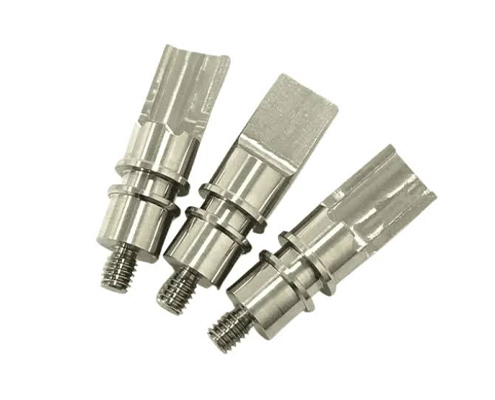
The matrix material of the four major commercially pure titaniums (Grade 1/2/3/4) is completely identical (pure titanium); the only difference lies in their internal trace interstitial impurity contents of oxygen and iron. Lower impurity content results in a softer material, better bending and stretch performance, and a milder work-hardening rate. Higher impurity content leads to higher material rigidity and strength, but the forming difficulty and cutting resistance increase simultaneously. Among them, Grade 1 titanium has the lowest impurity content, while Grade 4 titanium has the highest impurity content.
For your pure titanium part project, drawings that only label “titanium material” without specifying the grade can easily cause errors in material selection and understanding part characteristics. General CNC machined titanium bars on the market are mostly Grade 2 pure titanium and Grade 5 alloy titanium. Grade 1 titanium is a customized specialty material, and most spot service providers do not keep regular inventory. Therefore, you need to verify and confirm before selecting the material.
For Grade 1 titanium, its main industry standards are as follows:
All chemical, physical, and mechanical performance parameters listed below for Grade 1 titanium are standard values in the annealed/softened state, for your reference during material selection:
Grade 1 titanium strictly controls trace impurities of nitrogen, carbon, hydrogen, iron, and oxygen. This is the main reason for guaranteeing its high toughness and easy formability:
Several physical properties determine the processing defects and difficulties of Grade 1 titanium (making CNC machining costs relatively high):
Mechanical properties of Grade 1 titanium, such as springback characteristics and load adaptability, are also reasons why CNC machining of Grade 1 titanium is relatively difficult:
Summary: Low thermal conductivity + low rigidity + easy work hardening are the three root causes for slow machining, frequent out-of-tolerance, and high tool wear in Grade 1 titanium.
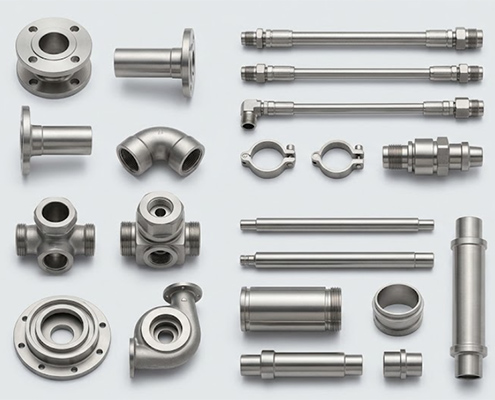
Applications of Grade 1 titanium are not suitable for high-pressure, high-frequency vibration, or high-load structural parts. The best suitable projects for choosing Grade 1 titanium are: corrosion-resistant, lightweight, cold-formed, bio-safe, and low-load operating conditions. Examples of some industries are as follows:
These are just a few examples of what Grade 1 titanium parts look like once machined. Below are some titanium CNC machined components we’ve produced for customers across these industries.
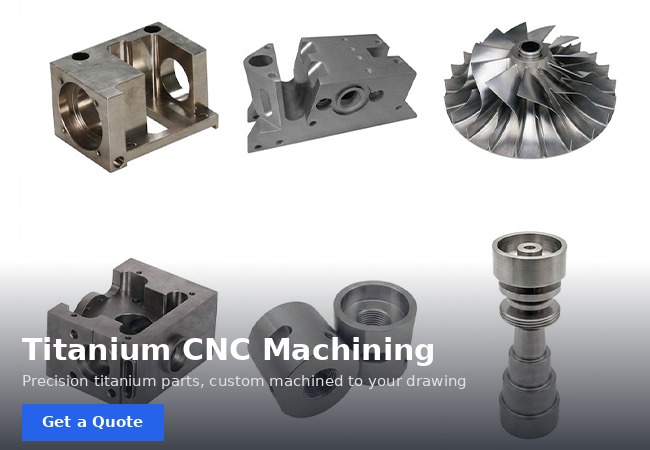
In fact, “titanium alloy” Grade 5 titanium (Ti-6Al-4V) has broader applications than commercially pure Grade 1 titanium, because Grade 5 titanium adds trace alloying elements for better strength, as well as superior performance in rigidity and high-temperature stability. The table below shows the main differences between Grade 5 titanium and Grade 1 titanium for your quick selection:
| Performance Parameter | Grade 1 (Pure Titanium) | Grade 5 (Ti-6Al-4V) |
| Tensile Strength | 240 MPa | 895 MPa |
| Yield Strength | 170 MPa | 825 MPa |
| Elongation after Fracture | 24% | 10% |
| Machinability (304 stainless = 1.0; higher = easier) | 1.5 (easy to machine) | 0.4 (difficult to machine) |
| Cold Formability | Excellent, large-angle bending and deep drawing possible | Poor, only minor deformation |
| Raw Material Unit Price | Inexpensive, high cost performance | Expensive, high premium |
Selection Criteria:
Grade 1 titanium and Grade 2 titanium are both commercially pure titanium, close in appearance, anti-corrosion, and welding performance, making them two easily confused materials. However, subtle differences in composition and characteristics exist, which affect the ultimate workpiece service life and machining yield:
| Parameter | Grade 1 | Grade 2 |
| Max Oxygen Content | 0.18% | 0.25% |
| Max Iron Content | 0.20% | 0.30% |
| Tensile Strength | 240 MPa | 345 MPa |
| Cold Formability | Industry best | Good |
| Applicable Scenarios | Deep drawn parts, bent parts, high-corrosion low-load parts | Thin-walled pressure-bearing, heat exchangers, general machining parts |
Selection Criteria:
Small tip: Grade 1 and Grade 2 titanium cannot be arbitrarily interchanged or replaced without engineering evaluation. Otherwise titanium part cracking, pressure-bearing part creep leakage, and batch dimensional defects may occur.
Deformation in CNC machining of Grade 1 titanium mainly falls into springback deformation, clamping deformation, thermal deformation, and residual stress deformation. However, all out-of-tolerance, warping, and dimensional shift issues can be fully controlled through standardized processes.
| Process | Achievable Tolerance |
| Rough Machining | ±0.10 mm |
| Semi-Finish Machining | ±0.05 mm |
| Finish Machining (With Stress Resting) | ±0.02–0.05 mm |
| Finish Machining (Without Stress Resting) | ±0.05–0.10 mm |
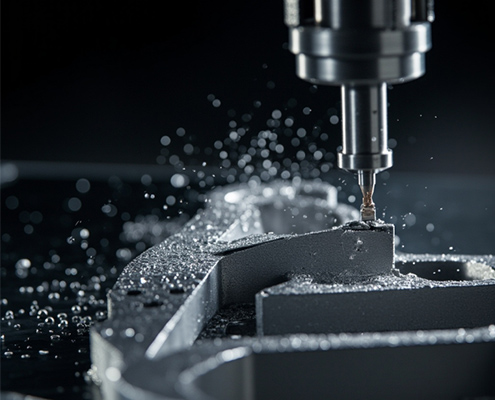
The raw material price of Grade 1 titanium is not considered high among various titanium grades. High project costs mainly stem from machining hours, tool wear, and scrap rework. The following are practical cost-reduction solutions from our factory during CNC machining of Grade 1 titanium for customers:
Material Selection and Cost Reduction for Medical Equipment Implant Cleaning Fixture Parts
A well-known medical equipment enterprise needed to produce an orthopedic implant automatic cleaning line fixture clamp (Fixation Clamp) part. The customer’s design team originally specified using Grade 5 titanium alloy (Ti-6Al-4V / Grade 5) for their previous supplier to perform CNC machining. However, because Grade 5 titanium material is expensive and difficult to cut, the single-piece raw material cost remained high, machining efficiency was low, the procurement budget for the entire batch of fixtures was exceeded, and delivery schedules were delayed.
The customer brought the drawings and budget to our engineering team seeking DFM (Design for Manufacturability) evaluation and cost-reduction support.
After analyzing the actual operating conditions of the part, we found:
To ensure precision tolerances and mass production stability, we formulated a dedicated CNC machining plan:
Final Results — without changing the original design dimensions, assembly standards, or surface electropolishing effects, this plan successfully achieved mass production delivery:
Grade 1 commercially pure titanium is the most cost-effective material choice for anti-corrosion operating conditions, cold-formed structures, low loads, and hygienic equipment. For cnc titanium machining custom part projects, its main value lies in adapting to specific operating conditions and compressing project costs. Its limitation lies in insufficient strength and rigidity, making it unsuitable for load-bearing, high-pressure, or alternating-load structural parts. However, if the above operating conditions do not fit your project, other common titanium options include:Prefer Grade 2 titanium for general lightly pressure-bearing parts; Prefer Grade 5 titanium for high-strength load-bearing structural parts.
Are you currently undergoing titanium part design selection and procurement cost calculation, seeking to accurately match grades, optimize part structures, and cut mass production costs? Feel free to contact our engineering team and submit your part drawings and operating condition parameters. We can provide you with free professional DFM selection reviews, titanium cnc machining services, and quotations to help you avoid selection errors, budget overruns, and mass production defects. [2D Drawings (PDF files), 3D Drawings (IGS/STP/STEP files)]
 WhatsApp/WeChat/Mobile:
+86-15099911516
WhatsApp/WeChat/Mobile:
+86-15099911516 Tel: 86-150-9991-1516
 QQ: 939020977
 E-Mail: service@vimetal.com.cn


What is Grade 1 titanium used for?
Grade 1 titanium is mainly used in chemical anti-corrosion equipment, marine seawater piping, cold-formed housings, medical non-load-bearing accessories, and food/pharmaceutical hygienic equipment. It adapts to all engineering scenarios demanding corrosion resistance, high formability, and low loads, representing the commercially pure titanium grade with the highest overall cost performance.
Is Grade 1 titanium strong enough for regular use?
It is fully sufficient under anti-corrosion, static, and low-vibration operating conditions. The strength of Grade 1 titanium is far lower than Grade 5 titanium, but the vast majority of non-structural parts do not require ultra-high strength. Blindly upgrading to higher-grade titanium materials only causes cost redundancy and waste.
Can Grade 1 titanium be CNC machined precisely?
Absolutely. Paired with sharp carbide tools, high-pressure cooling, multi-pass shallow cutting, and stress release processes, finish machining tolerances of ±0.02–0.05 mm can be stably achieved, with machining difficulty far lower than Grade 5 titanium alloy.
What is the core difference between Grade 1 and Grade 2 titanium?
Both are pure titanium. The core differences lie in impurity content and performance emphasis. Grade 1 titanium has lower oxygen and iron impurities and better formability, suitable for bending and deep drawing processes. Grade 2 titanium has higher strength and rigidity, suitable for general machining and low-pressure thin-walled pressure-bearing parts.
Why is titanium CNC machining cost so high?
The core reasons are titanium’s poor thermal conductivity, heat concentration burning tools, easy work hardening, and large springback deformation. Cutting speeds must be reduced, depths of cut minimized, and tools replaced frequently. Machining hours are 2–4 times those of stainless steel, and tool wear and scrap costs are far higher than conventional metals.
Is Grade 1 titanium medical-grade compliant?
Grade 1 titanium possesses excellent biocompatibility and complies with the medical pure titanium ASTM F67 standard, allowing it to be used for medical instruments and auxiliary accessories. For human body load-bearing implants, high-strength Grade 5 titanium or Grade 23 high-purity titanium is recommended, and original mill material certification reports can be provided upon request.
 Written By JunWen Liu
JunWen Liu holds a Mechanical Engineering degree from Esslingen University of Applied Sciences and spent seven years as a CNC Process Engineer, accumulating extensive hands-on experience. She now shares that knowledge through her writing, drawing from real problems she encountered on actual projects. Outside of work, she enjoys hiking and is always chasing the next summit view.


 How to Choose a China Titanium CNC Machining Factory