HDPE vs. Nylon: Key Properties, Tips, and CNC Machining Performance
By JunWen Liu | July 06, 2026
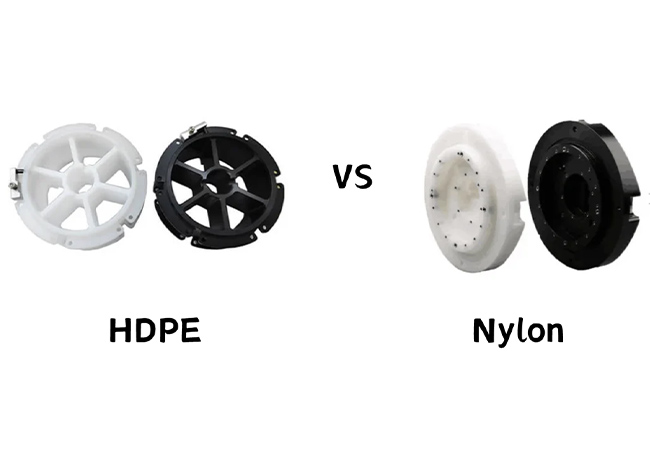

When it comes to choosing between HDPE vs. Nylon for CNC plastic parts, failing to fully evaluate application requirements during the initial design phase can lead to critical failures. For instance, take a conveyor drive gear commonly found in food packaging plants: due to an insufficient assessment of load requirements, HDPE was incorrectly selected, causing the gear to wear out and fail within less than two weeks of operation. But if use the Nylon, this could not happen within one year.
This article will introduce HDPE and Nylon key differences and give some tips for design, and material selection. At the end of the post, we will also share a case study of how our factory produce high-pressure oil line clamps for a client to withstand high-temperature and high-vibration working conditions.
To accurately master these two materials, it is first necessary to understand their microstructure and common industrial applications.
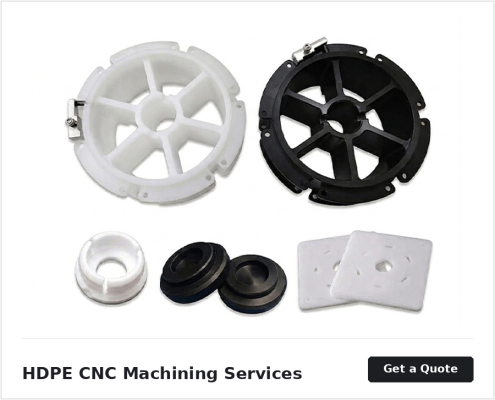
In the industry, HDPE is commonly referred to as High-Density Polyethylene or PE-HD. In terms of microstructure, it is a linear polymer polymerized from ethylene monomers with very few branches on its molecular chains. This linear structure allows the molecules to pack tightly together, resulting in a high degree of crystallinity (typically between 60% and 80%).
Due to its excellent chemical inertness and low water absorption, it is frequently used to manufacture chemical storage tanks, corrosion-resistant piping, food-grade cutting boards, chemical detergent containers, and orthopedic prosthetics in the medical field. In addition, HDPE is also commonly used to manufacture light-duty bushings or guide tracks.
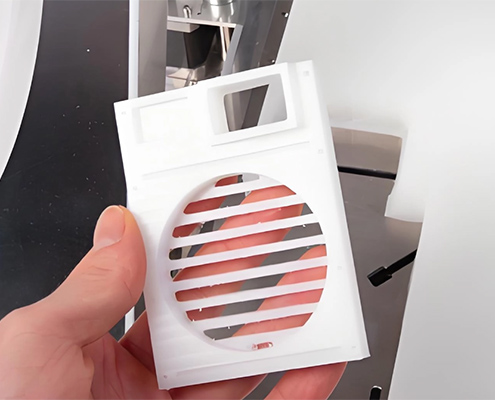
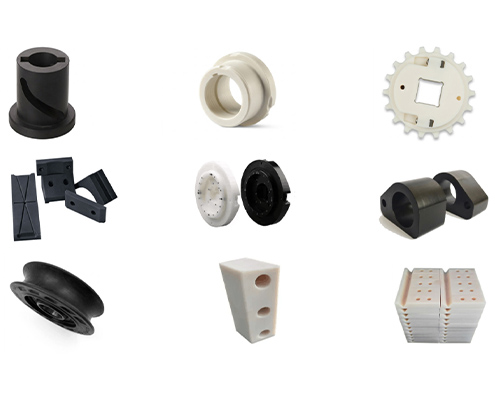
The scientific name for Nylon is Polyamide (PA for short). Common variants in the processing field include PA6, PA66, and MC Nylon produced through casting processes. In terms of microstructure, the molecular chains of Nylon contain repeating amide groups (-CO-NH-). These groups form strong hydrogen bonds between the molecular chains, weaving a high-strength network structure that endows the material with exceptional mechanical rigidity and toughness.
With its outstanding rigidity and wear resistance, Nylon is frequently chosen as the premier material for “replacing steel with plastic.” It is widely applied in heavy-duty gears, mechanical bearings, dynamic friction sliders, heat-resistant components in automotive engine bays, and high-strength fasteners.
The following table provides a comparison of the core physical and mechanical performance of the two materials:
| Properties | HDPE | Nylon (Polyamide) |
| Density | Approx. 0.94 – 0.97 g/cm3 (Floats on water) | Approx. 1.13 – 1.15 g/cm3 (Sinks in water) |
| Burning Odor | Similar to burning candles or paraffin, with a blue flame | Pungent odor similar to burning hair or wool |
| Surface Hardness | Lower (Shore D 60-70), easily scratched by hard objects | Higher (Rockwell R 110-120), hard and scratch-resistant |
| Tactile Feel | Distinctly waxy and greasy | Relatively dry, smooth, and solid |
| Tensile Strength | Lower (Approx. 20 – 30 MPa) | Very high (Approx. 60 – 90 MPa, higher for reinforced types) |
| Wear Resistance | Good (Self-lubricating), but easily scratched by hard objects | Outstanding (Excellent anti-friction and wear-resistant performance) |
| Heat Resistance | Poor (Continuous service temperature less than or equal to 80 degrees Celsius) | Excellent (Continuous service temperature up to 100-120 degrees Celsius) |
| Low-Temp Impact | Excellent, maintains toughness even at -40 degrees Celsius | Becomes brittle at low temperatures, impact strength drops significantly |
| Water Absorption | Extremely low (Less than 0.01%), absorbs almost no water | Very high (Up to 1.5% – 8%), absorbs moisture from the air |
| Acid Resistance | High, extremely inert to most strong acids and alkalis | Poor, easily attacked by strong acids and oxidizing agents |
| Creep/Deformation | Highly prone to creep and cold flow under continuous load | Better creep resistance, but locking force decreases under high humidity |
Based on the parameter comparison above, a summary of the pros and cons for HDPE vs. Nylon is as follows:
In practical mechanical structure design, materials should typically be screened based on specific operating conditions and environmental dimensions:
Nylon is preferred. When a part serves as a load-bearing component, a stressed bracket, or operates near heat sources (where the working temperature is long-term between 80 to 100 degrees Celsius), HDPE will fail due to insufficient rigidity or thermal softening. In these cases, Nylon with stronger mechanical rigidity must be selected.
Nylon is preferred. For high-speed rotating gears, repeatedly sliding machine tool guideways, drive cams, and heavy-duty bushings, Nylon’s service life is significantly higher than that of HDPE due to its high resistance to scratching and high wear characteristics.
HDPE is preferred. If a part is used as a chemical pump body, acid-base chemical pipeline joint, storage tank component, or is submerged under water for long periods, Nylon will easily fail due to water absorption expansion or acid corrosion. HDPE can provide exceptionally long-lasting fluid resistance.
HDPE is preferred. For applications such as winter outdoor operation machinery, cold storage internal transport components, or guards subjected to frequent external impacts, Nylon exhibits noticeable brittleness at low temperatures and cracks easily. HDPE, however, maintains excellent impact toughness at low temperatures.
If a part needs to utilize the material’s inherent flexibility for frequent bending (such as an all-in-one plastic living hinge), HDPE’s flexibility is more suitable. If the part needs to withstand high-frequency, low-amplitude alternating mechanical stresses (such as mechanical link mechanisms), Nylon, with its longer fatigue life, should be chosen.
HDPE is preferred. If mating tolerances require strict precision within plus or minus 0.02 mm and the equipment operates in humid air, highly moisture-absorbent Nylon will cause mating lockup or tolerance failure. HDPE’s water absorption rate is nearly zero, meaning its dimensions remain constant across all humidity environments.
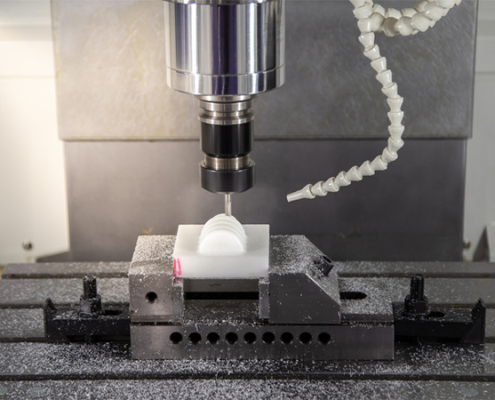
Since the machinability of these two plastics differs greatly, it directly impacts machining costs and final part quality control.
| Item | Machining HDPE | Machining Nylon |
| Cutting Speed | High (Typically 300 – 500 m/min) | Medium to High (Typically 200 – 400 m/min) |
| Feed Rate | Relatively large, needs to quickly remove heat to prevent melting | Medium, prevents excessive feed from causing material stress cracking |
| Tooling Choice | Sharp single-edge or double-edge aluminum milling cutters recommended | Uncoated carbide tools recommended; PCD tools required for glass-filled modified Nylon |
| Coolant | Must use. HDPE has a low melting point; machining without coolant easily causes local melting and tool sticking | Strongly recommended. Besides cooling, it is primarily used to prevent Nylon from absorbing moisture from the coolant (oil-based coolant is recommended) |
| Surface Finish | Difficult to achieve a mirror finish, mostly smooth matte surfaces | Excellent, high-gloss and high-precision surfaces can be obtained through fine finishing |
| Precision | Difficult to control, easily deformed by cutting forces and thermal expansion | High (immediately after machining), but dimensions will drift later with environmental humidity changes |
A construction machinery client approached our factory to mass-produce custom hydraulic line clamps installed on their heavy-duty excavator booms. The component was required to secure high-pressure oil lines and absorb severe structural vibrations during heavy operation. Initially, the client had utilized HDPE clamps to control manufacturing costs. Unfortunately, their previous supplier simply processed the parts according to the drawing without analyzing the application environment or warning the client about the material’s structural limitations. During summer outdoor operations, the oil lines reached nearly 90 degrees Celsius. Under this combined stress of high temperature and high-frequency hydraulic pulses, the HDPE clamps suffered mechanical creep and hardness loss, leading to loose bolts and dangerous hose displacement.
The Solution
Upon receiving the inquiry, our engineering team evaluated the working conditions and advised the client to replace the material with Nylon 66 (Polyamide 66) to handle the 90 degrees Celsius operating temperature and prevent thermal softening. In our CNC machining shop, we optimized the cutting parameters using sharp, uncoated carbide tools with a moderate feed rate to eliminate internal stress and prevent micro-cracking. Because Nylon 66 is abrasive and highly susceptible to moisture absorption, our machinists utilized an oil-based coolant during the milling process to keep the material cool and dry. Post-machining, we performed a controlled annealing and moisture-conditioning treatment on the finished parts to stabilize its structure and ensure optimal mechanical properties before shipping.
Results
The newly machined Nylon 66 clamps were deployed for rigorous field testing. After undergoing over 2000 hours of continuous high-temperature and high-vibration industrial durability tests, data showed that the bolt torque retention rate remained above 95 percent. The clamps exhibited no cracking, deformation, or cold-flow displacement. The high-pressure hydraulic lines also stayed fixed along their original design layout without any friction wear.
When choosing between HDPE and Nylon, the primary focus should be on evaluating the part’s operating environment temperature, stress state, and ambient humidity: When project budgets are limited and the parts operate under low loads, contact with chemicals, high humidity, or highly cold environments, HDPE is the more cost-effective and performance-matched choice. When parts need to withstand continuous heavy loads, high-frequency friction, and high temperatures, and have strict requirements for surface finish and initial machining accuracy, Nylon is the better option for your CNC machined parts.
Need custom plastic parts machined to precise tolerances? Send us your drawings today, or reach out to our engineering team to discuss your project requirements..[2D drawing (PDF file), 3D drawing (IGS/STP/STEP file)]
 WhatsApp/WeChat/Mobile:
+86-15099911516
WhatsApp/WeChat/Mobile:
+86-15099911516 Tel: 86-150-9991-1516
 QQ: 939020977
 E-Mail: service@vimetal.com.cn


What are the disadvantages of HDPE?
The main disadvantages of HDPE include low mechanical strength and hardness (easily scratched); poor heat resistance, softening easily above 80 degrees Celsius; a high susceptibility to creep (cold flow deformation) under continuous high loads; and very low surface energy, making it difficult to bond using conventional adhesives.
What plastic is stronger than HDPE?
Many engineering plastics are stronger than HDPE. The most common include Nylon (Polyamide/PA), POM (Polyoxymethylene/Acetal), PEEK (Polyetheretherketone), and Polycarbonate (PC). These materials far exceed HDPE in tensile strength, hardness, and flexural modulus.
Which is stronger, nylon or polyethylene?
Nylon is significantly stronger than polyethylene (including HDPE). The tensile strength of Nylon is typically 2 to 3 times that of HDPE, and its hardness, rigidity, and wear resistance are also markedly higher than those of polyethylene.
Polyamide vs Nylon: What Are the Differences?
There is no difference. Polyamide is the chemical and scientific name for the material, while Nylon is the commercial trade name originally registered by DuPont for its commercialization, which has now become the common generic term for this class of materials.
HDPE vs. PVC: What Are the Differences?
For HDPE vs. PVC, PVC is harder, more brittle, denser, and self-extinguishing (flame retardant). HDPE is more flexible, has better low-temperature impact resistance, and is lighter.
How long will HDPE last outside?
HDPE has a very long service life outdoors. Because it does not absorb water and does not rot, standard HDPE without UV stabilizers can last several years under direct sunlight. If carbon black or specialized UV stabilizers (anti-UV additives) are blended into the raw material, CNC-machined HDPE outdoor components can easily last more than 20 years.
 Written By JunWen Liu
JunWen Liu holds a Mechanical Engineering degree from Esslingen University of Applied Sciences and spent seven years as a CNC Process Engineer, accumulating extensive hands-on experience. She now shares that knowledge through her writing, drawing from real problems she encountered on actual projects. Outside of work, she enjoys hiking and is always chasing the next summit view.


 HDPE vs. UHMW: Key Differences, Machining Challenges, Alternatives, Costs, and...