ABS vs Polycarbonate(PC): Properties, Uses, Machining, and Pros and Cons
By JunWen Liu | Jun. 23, 2026
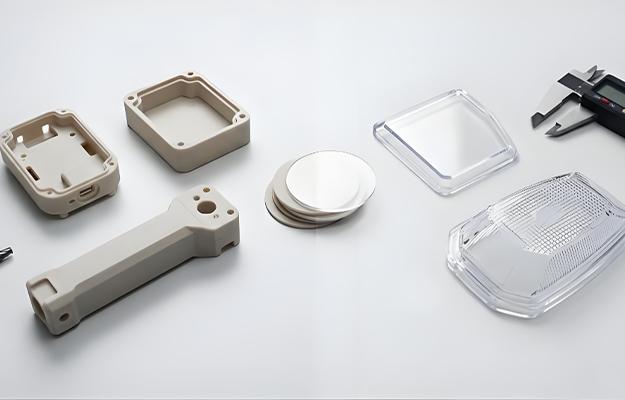

When you need a custom transparent part (window, light cover, display panel), or a drop-resistant, impact-resistant housing (drone, medical device, electronics), ABS and polycarbonate (PC) are the two engineering plastics most often compared in CNC machining.
Visually, one is opaque, the other is transparent — at first glance they don’t seem to be on the same track. But in fact, ABS and PC sit in the same class of engineering plastics — strength, toughness, and machinability are a tier above commodity plastics. This is exactly why PC is often used as the “performance upgrade” of ABS, and ABS is often used as the “cost downgrade” of PC.
This guide systematically compares ABS and PC across six dimensions: material properties, mechanical performance, thermal performance, machinability, application scenarios, and material selection. The goal is that after reading, you can clearly answer three questions: which material fits my part? what should I watch for in CNC machining? when can I mix ABS and PC in one assembly?
If this is your first time specifying ABS or PC for CNC machining, understanding their chemistry and typical grades is the first step in material selection.
ABS is a terpolymer of acrylonitrile (provides rigidity), butadiene (provides toughness), and styrene (provides processability), density 1.04–1.07 g/cm³.
Visually ivory-white opaque; can be dyed, painted, electroplated. Common grades by application:
PC is a linear polyester based on bisphenol A (BPA), density 1.20 g/cm³. Visually transparent (light transmittance 88–92%), close to optical glass. Common grades by application:
ABS and PC are “engineering plastic dual anchors” in CNC machining: strength is a tier above PP, PE, PS; machining difficulty is a tier below PEEK, PPSU. In small-batch, high-quality, surface-critical CNC parts, ABS and PC are the most common choices.
If your part may be dropped, impacted, or carry high-cycle load, impact and tensile strength directly determine how long it lasts.
| Item | Typical Value |
| Tensile strength | 40–50 MPa |
| Flexural strength | 60–80 MPa |
| Notched impact strength | 15–25 kJ/m² |
| Hardness | Rockwell R 100–110 |
| Profile | Medium strength + high toughness, good impact at room temperature |
| Item | Typical Value |
| Tensile strength | 55–75 MPa |
| Flexural strength | 90–100 MPa |
| Notched impact strength | 60–80 kJ/m² (3–4× ABS) |
| Hardness | Rockwell R 120 |
| Profile | High strength + extreme toughness, among the highest-impact engineering plastics |
2.3 Practical Implication
A clean comparison: at equal thickness and load case, PC’s impact resistance is 3–4× ABS. This means drop tests, vibration tests, and break-resistance tests pass far more often on PC. But PC also costs 50–80% more than ABS.
If your operating environment exceeds 80°C, this section helps you decide directly: “PC is mandatory” or “ABS is sufficient”.
3.1 ABS Thermal Properties
| Item | Typical Value |
| Heat deflection temperature (HDT @ 0.45 MPa) | 90–105°C |
| Glass transition temperature (Tg) | ~105°C |
| Continuous use temperature limit | ~80°C |
ABS parts cannot operate continuously above 80°C without softening and deforming.
3.2 PC Thermal Properties
| Item | Typical Value |
| Heat deflection temperature (HDT @ 0.45 MPa) | 130–140°C |
| Glass transition temperature (Tg) | ~150°C |
| Continuous use temperature limit | 115–125°C (glass-fiber grades reach 135°C) |
PC maintains stable mechanical performance at 100°C.
3.3 Application Boundary
The thermal difference defines the application boundary directly: electronics housings, automotive interior trim, office equipment → ABS works; automotive headlamp covers, coffee machine hot parts, medical high-temp sterilization parts → PC is mandatory. If the part works continuously above 80°C, PC is the only option.
If you are evaluating feasibility of CNC machining, this section helps you understand why PC needs drying but ABS does not.
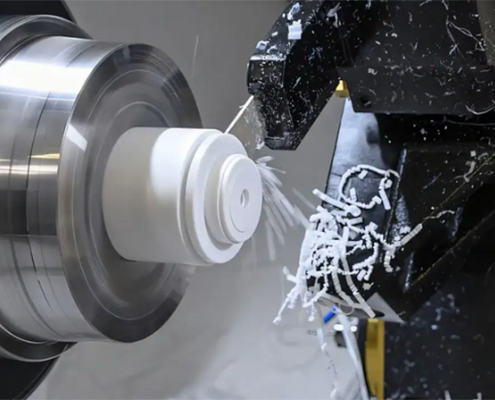
4.3 Workholding and Distortion
ABS elastic modulus ~2.0 GPa, PC ~2.4 GPa — both in the “medium stiffness” range.
In summary: CNC ABS has high tolerance, CNC PC has low tolerance but superior end optical performance.
If your part needs a specific look (metallic, colored, transparent, textured), this section helps you lock in the material.
5.1 ABS Surface Options
5.2 PC Surface Options
5.3 Selection Guidance
The surface treatment difference defines the application split:
If you are not sure which industry your part belongs to, this section gives you a quick reference.
To make your material selection clear at a glance, here is a systematic breakdown of the core pros and cons of ABS and PC:
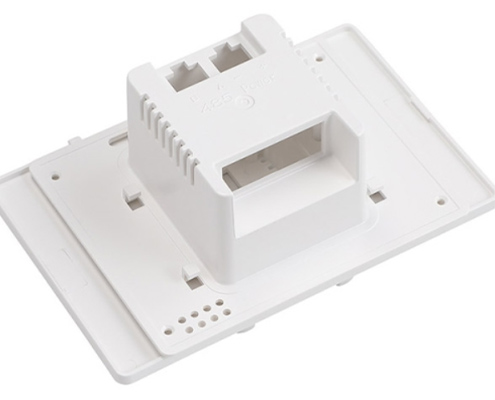
Pros:
Cons:
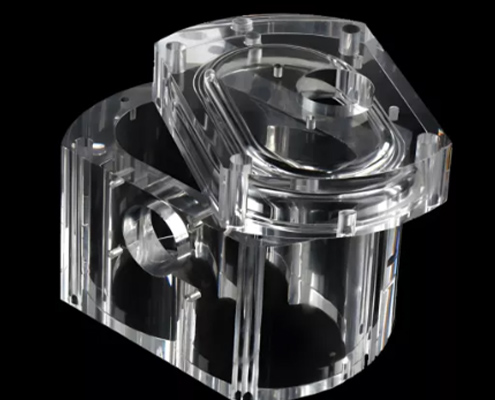
Pros:
Cons:
If you have read this far, you can now walk through the six-step decision tree and lock in your material.
The six dimensions above combine into a direct decision tree:
Walking through these six steps locks in the choice 90% of the time. For the remaining 10% ambiguity, prototype 5 pieces of each in CNC for physical comparison.
When evaluating transparent parts or cosmetic enclosures for CNC machining, Acrylic (PMMA) is often brought up as a third alternative. The core difference between it and ABS/PC can be summed up in one sentence: “If you need it tougher than acrylic, choose PC; if you need it cheaper and easier to machine than acrylic, choose ABS.”
Transparency and Optical Performance: PMMA > PC > ABS
Mechanical Performance (Impact Resistance vs. Brittleness): PC >> ABS >> PMMA
CNC Machining and Post-Processing Difficulty
Customer background. A medical device OEM launched a new-generation portable blood analyzer in H2 2025. The full machine consists of 1 transparent top cover + 1 ABS housing + 1 PC viewing window. Plan: 2000 sets/year, two phases — 50 prototypes + 2000 production.
Core difficulties. First, the transparent top cover must hit optical grade (light transmittance ≥ 88%), with no micro-cracks, stress whitening, or tool marks after CNC. Second, the ABS housing must pass the 1.5 m six-face drop test, no cracking, no functional failure. Third, the PC viewing window is small (30×20×3 mm) and easily stress-cracks from clamping during CNC. Fourth, the 5-week lead time for the full set — normal flow takes 7+ weeks.
Solution
VMT’s process team proposed a “part-specific process” plan:
Results
ABS and PC are not opposing material choices in CNC machining; rather, they are two options selected based on the specific function of the part. Choose PC for transparency, high impact resistance, and high-temperature resistance. Choose ABS for cost sensitivity, diverse aesthetic finishes, and ease of machining. For mixed requirements, a PC+ABS blend is the ideal solution.
If you are evaluating CNC machining options for ABS or PC, feel free to contact VMT to upload your 3D models and operating conditions (transparency requirements, impact resistance requirements, and temperature environments). Our engineering team will provide material selection recommendations, manufacturing process plans, cycle time estimations, and unit price analysis within 24 hours.
 WhatsApp/WeChat/Mobile:
+86-15099911516
WhatsApp/WeChat/Mobile:
+86-15099911516 Tel: 86-150-9991-1516
 QQ: 939020977
 E-Mail: service@vimetal.com.cn


Which is better for transparent parts, ABS or PC?
PC transmittance is 88–92%, close to optical glass. ABS is opaque and cannot be made transparent. If the part must be transparent, PC is the only option; if transparency is not required, ABS has advantages in other dimensions.
Which has better impact resistance, ABS or PC?
PC notched impact strength 60–80 kJ/m², 3–4× ABS (15–25 kJ/m²). Drop tests and break-resistance tests prioritize PC. But ABS toughness at room temperature is already sufficient for ordinary consumer electronics housings.
Why does PC haze after machining?
Three reasons: (1) PC is not dried enough (moisture causes bubbling during machining); (2) cutting heat is too high (dull tool, excessive feed); (3) polishing is insufficient (diamond paste grit too coarse, polishing disc pressure too high). Solution: 120°C × 4h dry + sharp tools + slow cutting + fine diamond paste polish.
Does painted ABS housing peel easily?
Depends on adhesion treatment. ABS painting usually needs surface treatment (IPA clean + plasma treatment or chemical primer); without surface treatment, paint peel rate reaches 30%. VMT standard process is IPA clean + plasma + primer + topcoat, bringing peel rate below 0.1%.
Which is more heat resistant, ABS or PC?
ABS continuous use limit ~80°C, PC ~115–125°C. Automotive headlamps, coffee machine hot parts, medical high-temp sterilization parts — these high-temp environments must use PC. Ordinary consumer electronics housings, office equipment — ABS is fine.
Can ABS and PC be mixed in one assembly?
Yes, and in many cases it is the best solution. Examples: transparent window PC + structural housing ABS, medical device “transparent top cover + opaque bottom cover”, drone “transparent cover + airframe”. Hybrid solutions use PC’s transparency and ABS’s low cost and easy machining at the same time.

 Machining Polycarbonate: A Complete Guide to CNC Machining Polycarbonate Pa...