HWhat Is the Best Material for CNC Earphone Housings? A Guide to Material Properties, Selection, and Machining Risks
By JunWen Liu | Nov. 27, 2026
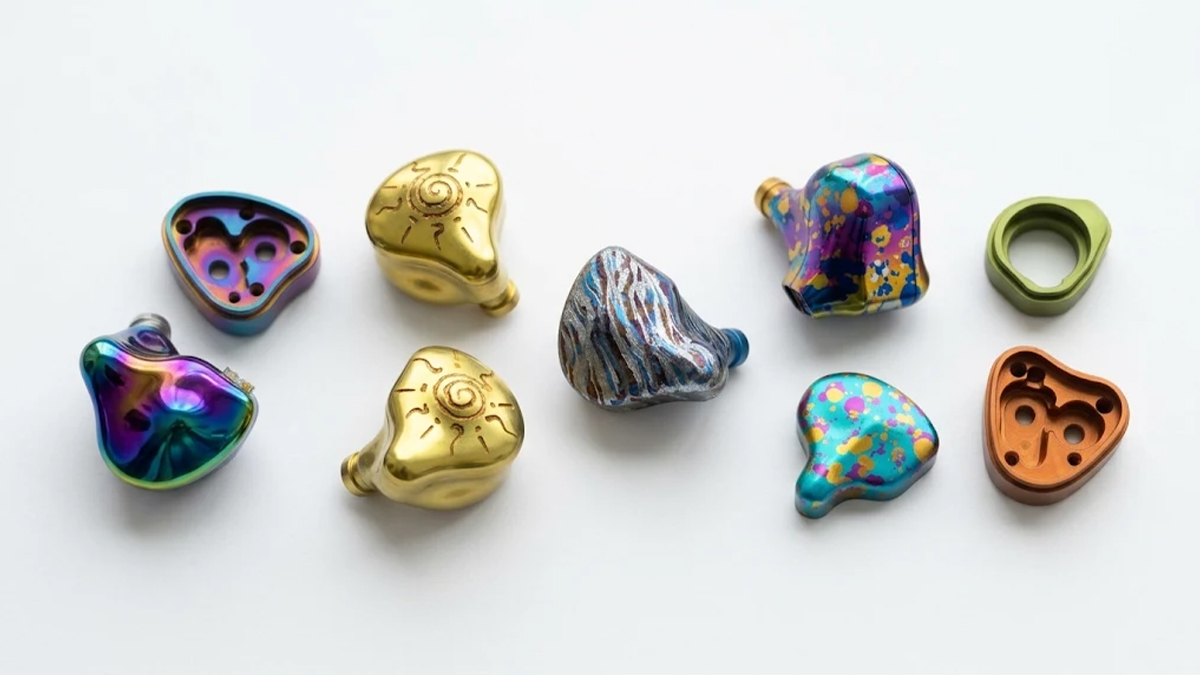

There is no single “best material” for every CNC earphone housing project. If one material must be chosen, 6063-T6 aluminum alloy is the recommended choice for everyday consumer-grade custom CNC earphone housings when the priorities are a metallic appearance, lightweight construction, surface finish, and cost balance, without special RF or strength requirements.
CNC Machined Earphone housings affect not only product appearance and weight but also wearing comfort, wireless signal performance, surface durability, assembly precision, and manufacturing cost. Even among metal housings, a material suitable for wired in-ear earphones is not necessarily suitable for TWS earphones with limited antenna space. Besides the popular 6063-T6, 6061-T6 aluminum is worth considering when CNC machined earphone housings require higher structural strength. Titanium alloys or 316L stainless steel are options for a premium finish, while brass suits components with specific weight or decorative requirements. For applications sensitive to wireless antennas and weight, PC, PC/ABS, or hybrid metal-plastic structures are also worth considering.
The case study at the end part shows how dedicated contour fixtures, five-axis machining parameters, and surface finishing optimization enabled us to deliver the first batch of 6061-T6 aluminum charging case housings within 10 days. Key mating dimensions achieved a 99.8% compliance rate with the ±0.01mm tolerance requirement.
| Project Requirements | Materials to Consider First | Key Considerations |
| Everyday consumer-grade metal housings | 6063-T6 aluminum alloy | Thin-wall deformation and anodizing color variation |
| Aluminum structural components requiring higher strength | 6061-T6 aluminum alloy | Surface appearance needs to be verified through finishing samples |
| Large headphone earcups and formed sheet metal housings | 5052 aluminum alloy | Formability, wall thickness, and surface finishing |
| Premium, lightweight metal housings | Titanium Grade 5 (TC4) | Machining costs and scratch resistance |
| Corrosion-resistant metal housings with complex curved surfaces | Grade 2 titanium (TA2) | Machining costs and moderate strength |
| Mirror finish and higher resistance to sweat corrosion | 316L stainless steel | Weight, nickel release, and surface finishing |
| General-purpose stainless steel housings | 304 / 304L stainless steel | Weight, nickel release, and corrosion resistance |
| Decorative or acoustic components with a substantial feel | Brass: C36000, C27400 (H62) | Lead content, oxidation, and regulatory compliance |
| Copper-colored decorative components | C11000 copper (T2) | Softness, tool adhesion, burrs, and surface scratches |
| Wireless antenna areas and lightweight housings | PC, ABS, PC/ABS | Rigidity, scratch resistance, and structural design |
| Transparent decorative panels | PMMA acrylic | Transparency, tool marks, scratches, and internal cleanliness |
| High-performance engineering plastic components | PEEK | Material cost, machining deformation, and performance validation |
Aluminum alloy is one of the most common materials for custom CNC earphone housings. Its main advantages include low density, good machinability, and the ability to achieve different surface finishes through anodizing, sandblasting, and brushing.
6063-T6 offers good extrusion formability, surface finishing compatibility, and machining cost efficiency. For in-ear earphone housings with relatively simple structures, moderate wall thicknesses, and no particularly high strength requirements, 6063-T6 provides a good overall balance of performance. After anodizing, it can achieve silver, black, and various custom colors, making it suitable for consumer earphones that emphasize consistent appearance and product quality.
6061-T6 offers good overall mechanical properties, machinability, and corrosion resistance. It is suitable for earphone housings with complex internal cavities, threaded holes, locating features, and precision assembly interfaces. Compared with 6063-T6, it is better suited to designs with higher requirements for structural rigidity and mounting position stability.
5052 Aluminum Alloy
5052 is an aluminum-magnesium alloy with good corrosion resistance and formability, making it particularly suitable for sheet metal structures. It is worth considering for over-ear headphone earcups, decorative earcup housings, or structures made from formed sheet metal.
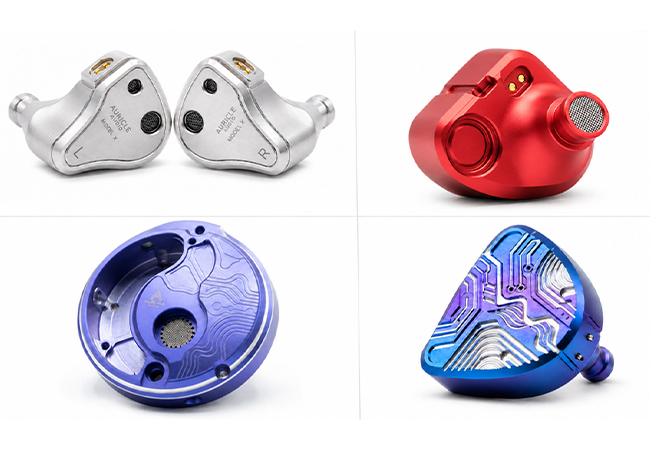
Titanium alloys are suitable for premium earphones with higher requirements for product positioning, strength-to-weight ratio, and corrosion resistance. Compared with aluminum alloys, titanium offer higher material strength but also have greater density, higher material costs, and higher CNC machining costs.
Grade 5 / TC4 Titanium Alloy
Grade 5, also known as Ti-6Al-4V, is a common titanium alloy grade suitable for premium earphone housings requiring high strength and a high-end metallic appearance. Its limitations include poor thermal conductivity, higher machining difficulty, and higher costs. A premium material feel does not necessarily mean better sound quality. The subtle resonance and reflection characteristics introduced by Grade 5 titanium earphone housings need to be verified through complete product testing.
Grade 2 / TA2 Commercially Pure Titanium
Compared with Grade 5 titanium, Grade 2 titanium offers better ductility. It is also suitable for CNC earphone housings with complex curved surfaces, moderate strength requirements, and an emphasis on corrosion resistance and a premium metallic appearance. However, Grade 2 titanium CNC earphone housings also come with higher costs, and their acoustic performance needs to be verified through complete product testing.
Stainless steel is suitable for earphone housings requiring higher surface hardness, durability, and a metallic appearance. Compared with aluminum and titanium alloys, stainless steel has a higher density and greater weight. Its machining difficulty and production costs for earphone housings are moderate.
The corrosion resistance and cost of 304, 304L, 316, and 316L generally increase in that order. For custom earphone housings exposed to sweat over extended periods and with an emphasis on surface appearance, 316L is worth prioritizing among these four grades.
Skin Contact Note: 304, 304L, and 316L all contain nickel. For components in direct and prolonged contact with skin, applicable nickel release limits and testing requirements should be evaluated according to the target market and product contact conditions.
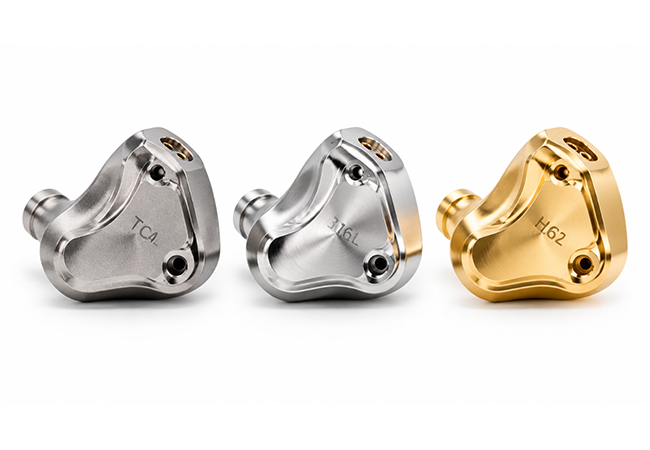
Copper and brass can be used for earphone components requiring distinctive colors, a substantial feel, or decorative metallic effects. Their density is relatively high (slightly higher than stainless steel), so the weight of each earphone needs particular attention when they are used for complete in-ear housings.
C36000 Free-Cutting Brass
C36000 offers excellent machinability and is suitable for machining complex hole patterns, small features, and decorative details. However, its lead content requires particular attention. If the product is intended for markets with strict hazardous substance restrictions, material composition and regulatory compliance need to be verified in advance.
C27400 Brass (H62)
H62 offers good machinability, ductility, and decorative appeal. It is suitable for earphone housings and decorative components with a golden appearance. Different surface finishes can be achieved through polishing, electroplating, or protective coatings.
C11000 Copper (T2)
C11000 offers high electrical conductivity and good ductility, with a natural reddish copper color. It can be used for custom appearance designs and decorative structures. However, because the material is relatively soft, CNC machining requires careful control of cutting conditions to prevent tool sticking, burrs, and surface scratches.
PC, ABS, and PC/ABS
For wireless products, these plastics can serve as candidate materials for non-metallic housings or antenna areas.
PEEK
PEEK is a high-performance engineering plastic worth considering when heat resistance, chemical resistance, or specific mechanical properties are required.
PMMA Acrylic
PMMA is also worth considering when an earphone design requires a transparent decorative panel. It offers good transparency and optical surface quality. However, transparent earphone housings are generally more sensitive to tool marks, scratches, and internal cleanliness.
| Product Type | Materials to Consider First | Key Selection Factors |
| Wired in-ear earphones or IEMs | 6063/6061 aluminum, titanium, 316L stainless steel, localized brass components | Weight per earphone, wearing comfort, acoustic chamber structure, and surface contact |
| True wireless stereo earphones (TWS) | PC, ABS, PC/ABS, or hybrid metal-plastic structures | Antenna performance, weight, touch control areas, and assembly space |
| Over-ear headphones | 6063/6061 aluminum, 5052 sheet metal, localized stainless steel components | Weight of large housing components, appearance, hinge and connection strength |
| TWS charging cases | 6063/6061 aluminum, PC/ABS, localized steel or titanium decorative components | Lid fit, drop resistance, charging method, and wireless functionality |
Wired In-Ear Earphones: Balancing Weight, Appearance, and Acoustic Chamber Design
Wired earphones generally do not require Bluetooth antennas inside the earbud housing, so metal housing designs offer relatively greater flexibility.
6063 or 6061 aluminum alloys are suitable for lightweight metal housings. Titanium and stainless steel can be used for premium appearances or special structures, while brass is suitable for localized decoration or specific components.
True Wireless Earphones: Check the Antenna and Weight of Each Earbud First
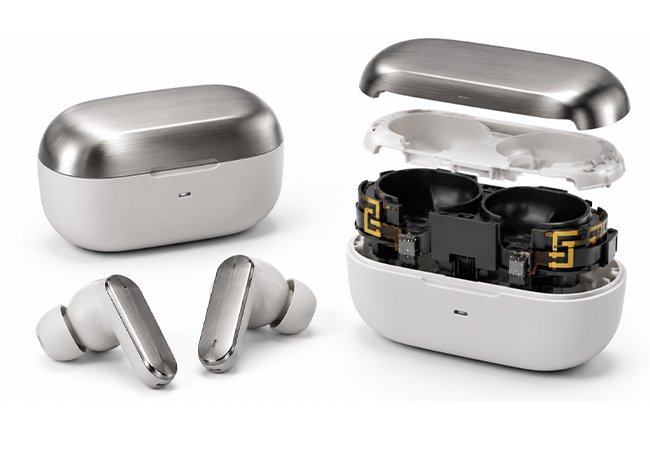
TWS earphones need to accommodate a battery, circuitry, antenna, driver unit, and touch control structure within a limited space. Plastic housings are commonly used to reduce weight and provide greater design flexibility for antenna placement.
When a metallic appearance is preferred, the following structures can be considered:
Over-Ear Headphones: Focus on Large Components and Load-Bearing Areas
Over-ear headphones have relatively large earcups, so material selection has a noticeable impact on overall product weight. Aluminum alloys are suitable for metal-finish earcups, while 5052 sheet metal can be used for large thin-wall shells that require forming.
TWS Charging Cases: Tactile Feel and Wear Resistance
For TWS charging cases, pocket wear resistance and the feel of opening and closing are more important. Anodized 6063/6061 aluminum housings are generally preferred. If wireless charging is supported, a plastic region that allows magnetic field transmission or a PC/ABS structure is required.
Bluetooth Signal vs. Wired Earphone Acoustics
Wireless Bluetooth Earphones: Metal Housings Need to Be Designed Together with the Antenna
Metal affects the electromagnetic field around an antenna. Enclosed or large-area metal structures can shield, absorb, or alter wireless signals and affect antenna matching. For example, a product can combine metallic exterior components with a plastic antenna window or retain a validated non-metallic area.
Wired Earphones: Earphone Housing Structure and Material Do Affect Sound Characteristics, but They Are Not the Only Factors.
For wired earphones, the driver unit, acoustic chamber geometry, sound-guiding structure, leakage control, and wearing seal should all be considered in acoustic design. Housing materials and structures also affect vibration and resonance, but the extent of their influence depends on the specific design and test results.
Earphones are consumer electronics designed for extended wear, so housing weight affects the user experience. This is particularly important for in-ear earphones, where excessively heavy metal housings increase the load on the ear. The density and weight of different materials need to be considered:
| Material | Reference Density (g/cm³) | Weight Characteristics |
| Aluminum alloy | Approx. 2.70 | Lightweight |
| Titanium alloy | Approx. 4.43–4.51 | Medium weight |
| Stainless steel | Approx. 7.9–8.0 | Heavy |
| Brass | Approx. 8.4–8.7 | Heavy |
| Copper | Approx. 8.9 | Heavy |
| PC | Approx. 1.20 | Lightweight |
| ABS | Approx. 1.04 | Lightweight |
| PEEK | Approx. 1.30 | Lightweight |
Anodizing, PVD, and other surface treatments affect wear resistance. The hardness, strength, and rigidity of the base material also matter, depending on the requirements of the earphone housing. (Note: This is generally not a primary selection factor, since earphones are not products with high load-bearing or rigidity requirements. They are primarily everyday consumer electronics.)
CNC earphone housings have relatively high appearance requirements, and different materials vary in their compatibility with surface finishing processes.
| Material | Common Surface Finishes | Appearance Characteristics |
| 6063/6061 aluminum alloy | Anodizing, sandblasting, brushing | Multiple colors and metallic appearance |
| 5052 aluminum alloy | Anodizing, sandblasting | Matte metallic appearance |
| TC4/TA2 | Sandblasting, polishing, PVD | Premium metallic appearance |
| 316L/304 | Mirror polishing, brushing, PVD | Silver, black, and other finishes |
| C36000/H62 | Polishing, electroplating, protective coatings | Golden decorative finish |
| C11000 | Polishing, electroplating, protective coatings | Reddish copper finish |
| PC/ABS | Spray painting, texturing, surface coatings | Various appearance options |
| PEEK | Machined surface finishing | Natural engineering plastic appearance and custom finishes |
For CNC earphone housings in direct contact with skin, the following factors should be evaluated together:
Overall, the materials recommended in this article are suitable for skin-contact earphone housings. However, no material is guaranteed to be non-allergenic for everyone.
As consumer electronics products, earphones require housing material selection that also considers the regulatory requirements of their target markets.
Pay attention to:
Final costs generally include raw materials, material utilization, machining time, fixturing, surface finishing, inspection, yield, and production volume. The following cost comparison can serve as a reference (excluding yield, surface finishing, and complex geometry):
| Material Category | Grade | Overall Machining Cost (Including Material + CNC Machining Time) | Key Cost Drivers |
| Engineering plastics | PC/ABS | Low (very low if injection molding is used) | Inexpensive raw materials and fast cutting |
| Aluminum alloy | 6063-T6 / 6061-T6 | Relatively low | Highest cutting efficiency and low tool wear |
| Brass | C36000 / H62 | Medium | Relatively expensive raw materials but excellent machinability (free-cutting brass) |
| Stainless steel | 304 / 304L | Medium | Moderately priced raw materials, significant work hardening, and slower toolpaths |
| Stainless steel | 316L | Medium to high | More expensive molybdenum-containing raw materials and greater toughness, making machining more difficult |
| Copper | C11000 | Medium to high | Expensive raw materials, soft material prone to tool sticking, and slower finishing |
| Commercially pure titanium | TA2 | Medium to high | Expensive raw materials and poor thermal conductivity, but lower cutting resistance than TC4 |
| Specialty plastics | PEEK | High | Extremely expensive raw materials and the need to prevent machining deformation |
| Titanium alloy | TC4 (Ti-6Al-4V) | High | Expensive raw materials, extremely poor thermal conductivity, rapid tool wear, and the longest machining time |
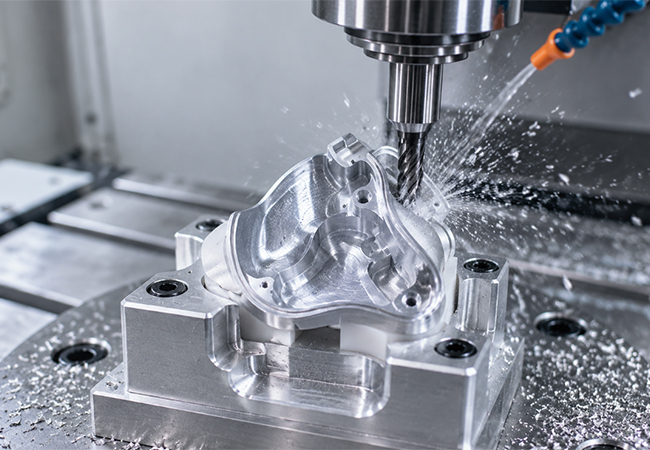
Different materials have different cutting characteristics. Thin-wall earphone housings and components with high appearance requirements place greater demands on machining processes and quality control. Understanding the machining risks associated with earphone housing materials and their solutions helps determine whether a supplier has the relevant experience:
| Material | Potential CNC Machining Risks for Earphone Housings | Manufacturer’s Machining Control Measures |
| Aluminum alloy | Surface waviness and tool marks, thin-wall deformation, and localized surface tearing | Design dedicated support fixtures based on the part geometry; optimize finishing toolpaths and cutting parameters; control pretreatment before sandblasting and anodizing, and confirm the final appearance through sample inspection |
| Titanium alloy | Localized discoloration, tool marks, or unstable thin-wall dimensions | Optimize cutting parameters and cooling methods; control tool wear; arrange fixturing positions and machining sequences appropriately; conduct precision dimensional inspections on critical mating surfaces |
| Stainless steel | Dimensional variations after machining, exposed tool marks after polishing, or material surface defects | Control cutting loads to reduce work-hardening effects; perform rough machining, finishing, and polishing in stages; strengthen incoming material inspections and post-machining appearance inspections |
| Copper and brass | Copper sticking to tools, burrs around holes, thin-wall tearing, or edge chipping | Select suitable tools and cutting parameters according to the material grade; optimize machining paths and fixturing methods for thin-wall areas; carefully deburr sound-guiding holes, edges, and small features |
| Engineering plastics | Burrs, localized melting, and clamping deformation; transparent PC may develop stress whitening or microcracks | Use sharp tools designed for plastics and control machining heat; adopt low-stress fixturing methods; control the use of cleaning agents and assembly stress; conduct dimensional inspections in a temperature-stable environment |
—Case Study from VMT CNC Prototyping Machining Factory
A well-known audio brand commissioned a lightweight 6061-T6 aluminum alloy earphone charging case housing while developing a new premium earphone product line. The housing featured a sleek 0.5 mm thin-wall design, with a compact internal layout for the PCB, magnetic closure components, and seamless hinge structure. Critical mating tolerances had to be maintained within ±0.01mm, while the exterior required a flawless anodized finish.
However, during initial trial production with other suppliers, the thin walls frequently deformed under clamping and cutting forces. Visible tool marks and surface defects also remained on the exterior, making complete product assembly difficult and forcing delays to the new product launch.
Solutions
After reviewing the drawings, our engineering team identified the main causes as excessive localized clamping force from conventional fixtures and minor high-frequency chatter in unsupported thin-wall areas during finish milling. To address these issues, the team redesigned dedicated contour support fixtures to match the internal cavity profile, distributing clamping stress evenly and supporting the thin-wall areas. We also restructured the roughing and finishing sequence and optimized the five-axis cutting parameters. High spindle speeds and shallow depths of cut reduced cutting heat and lateral cutting forces, while strict surface control standards were established for the pretreatment processes before sandblasting and anodizing. In addition, our engineers designated critical thin-wall areas and assembly datum surfaces as key inspection points, monitoring dimensional changes at different machining stages and adjusting cutting parameters when necessary. After the first article was completed, we conducted comprehensive verification of appearance, critical dimensions, and assembly fit to ensure a stable process for subsequent mass production.
Results
Through coordinated optimization of the fixture design and machining parameters, our CNC machining factory successfully delivered the first batch of custom aluminum housing prototypes within the strict 10-day lead time. Full dimensional and appearance inspections showed that 99.8% of all housing mating dimensions met the ±0.01mm tolerance requirement. The parts achieved zero thin-wall deformation and a fine, uniform anodized finish, helping the customer pass internal electronic component, magnetic closure, and hinge opening and closing tests on the first attempt. This earned the customer’s trust, and subsequent mass production orders were entrusted to our factory.
Selecting materials for CNC earphone housings requires a comprehensive evaluation of material properties, earphone type, structural design, wearing weight, wireless signal requirements, surface finishing, and manufacturing costs, rather than simply pursuing higher strength or more expensive materials. For most everyday consumer-grade earphone housing components without special requirements, 6063-T6 aluminum alloy is a reliable choice thanks to its lightweight durability, wide range of anodized colors, and excellent machining cost efficiency. Depending on product positioning, you can also switch to 6061-T6 for greater structural strength, titanium alloys and 316L stainless steel for premium wear-resistant finishes, copper alloys for added weight and damping characteristics, or PC/ABS and hybrid metal-plastic structures for better compatibility with Bluetooth antennas.
Concerned about deformation when machining 0.4–0.5 mm thin-wall structures, unsure about color variations between different metal grades after anodizing or mirror polishing, or looking to reduce CNC mass production costs without sacrificing assembly precision? Upload your 2D drawings (PDF) or 3D files (IGS/STP/STEP files) and specific project requirements to receive a free DFM manufacturability assessment, custom CNC machining solutions, and a fast quotation.
| Material Category | Common Grade | U.S. Standard (ASTM / SAE / UNS) | Japanese Standard (JIS) | European Standard (EN) | Korean Standard (KS) | British Standard (BS) | German Standard (DIN / Werkstoff No.) | Russian Standard (GOST) | Chinese Standard (GB/T) |
| Aluminum Alloy | 6063 | AA 6063 / UNS A96063 | A6063 | EN AW-6063 | A6063 | 6063 | EN AW-6063 / 3.3206 | AD31 (АД31) | 6063 |
| Aluminum Alloy | 6061 | AA 6061 / UNS A96061 | A6061 | EN AW-6061 | A6061 | 6061 | EN AW-6061 / 3.3211 | AD33 (АД33) | 6061 |
| Aluminum Alloy | 5052 | AA 5052 / UNS A95052 | A5052 | EN AW-5052 | A5052 | 5052 | EN AW-5052 / 3.3523 | AMg2.5 (АМг2,5) | 5052 |
| Titanium Alloy | TC4 (Grade 5) | Grade 5 / Ti-6Al-4V / UNS R56400 | Ti-6Al-4V | Ti-6Al-4V / 3.7165 | — | 2TA10 / 2TA13 | TiAl6V4 / 3.7165 | VT6 (ВТ6) | TC4 |
| Titanium Alloy | TA2 (Grade 2) | Grade 2 / UNS R50400 | TP340 | Ti Grade 2 / 3.7035 | — | — | 3.7035 | VT1-0 (ВТ1-0) | TA2 |
| Stainless Steel | 316L | AISI 316L / UNS S31603 | SUS316L | X2CrNiMo17-12-2 / 1.4404 | STS316L | 316S12 | X2CrNiMo17-12-2 / 1.4404 | — | 022Cr17Ni12Mo2 |
| Stainless Steel | 304 | AISI 304 / UNS S30400 | SUS304 | X5CrNi18-10 / 1.4301 | STS304 | 304S15 | X5CrNi18-10 / 1.4301 | 08Kh18N10 (08Х18Н10) | 06Cr19Ni10 |
| Stainless Steel | 304L | AISI 304L / UNS S30403 | SUS304L | X2CrNi19-11 / 1.4307 | STS304L | 304S12 | X2CrNi19-11 / 1.4307 | 03Kh18N11 (03Х18Н11) | 022Cr19Ni10 |
| Brass | C36000 | UNS C36000 / Free-Cutting Brass | C3604 | CuZn39Pb3 / CW614N | C3604 | CZ121 | CuZn39Pb3 / CW614N | LS59-3 (ЛС59-3) | HPb59-1 |
| Brass | H62 | UNS C27400 / C27200 | C2720 | CuZn37 / CW508L | — | — | — | — | H62 |
| Copper | T2 | UNS C11000 / ETP Copper | C1100 | Cu-ETP / CW004A | — | — | Cu-ETP / CW004A | M1 (М1) | T2 |
This table provides a general reference for cross-regional metal grade designations. Equivalent grades may differ very slightly in chemical composition and mechanical properties. Verify if this slight change is important to you.
Engineering plastics such as PC, ABS, PC/ABS, PEEK, and PMMA generally retain the same material names across these regions and are therefore not listed separately.
 WhatsApp/WeChat/Mobile:
+86-15099911516
 Tel: 86-150-9991-1516
 QQ: 939020977
 E-Mail: service@vimetal.com.cn


1. Which Is Better for CNC Earphone Housings, 6061 or 6063 Aluminum Alloy?
When CNC earphone housings prioritize a fine colored anodized finish, lightweight construction, and machining cost efficiency, 6063-T6 is the better choice. If the housing contains fine internal threaded holes, precision snap-fit interfaces, or load-bearing hinge structures, 6061-T6 should be selected for its higher mechanical strength and rigidity.
2. Do CNC Earphone Housing Materials Really Affect Sound Quality?
They have a subtle influence, but the main factors determining sound quality remain the driver unit, acoustic chamber volume and geometry, sound-guiding structure, and wearing airtightness. Materials such as brass, stainless steel, and titanium alloys mainly fine-tune the listening experience by changing cavity resonance and damping through their different densities and rigidities. Actual material selection should still be based on acoustic testing of the complete product.
3. Can True Wireless Bluetooth Earphones (TWS) Use Fully Metal CNC Housings?
Fully enclosed all-metal housings are not suitable because enclosed metal structures create electromagnetic shielding, significantly attenuating 2.4 GHz Bluetooth signals and causing connection dropouts. To balance a metallic appearance with stable connectivity, established solutions include a “PC/ABS plastic main body + CNC metal decorative cover” or a plastic RF-transparent antenna window validated through RF testing in the metal housing.
4. Which CNC Earphone Housing Material Offers Better Sweat Corrosion Resistance and Is More Suitable for Sensitive Skin?
With a sufficient budget, titanium alloy (TC4 / TA2) is the preferred choice. It offers excellent sweat corrosion resistance and contains no nickel, providing the highest skin compatibility. Among engineering plastics, PEEK and PC are also lightweight and safe. If stainless steel is selected, 316L is recommended for its better sweat corrosion resistance, combined with passivation treatment or PVD coating to keep nickel release within regulatory limits.
5. Why Does C36000 Brass Require Special Attention to Regulatory Compliance When Used for Earphone Housings?
C36000 free-cutting brass contains a small amount of lead to improve machinability and chip breaking performance. When exporting to European and American markets, it is directly subject to RoHS and REACH regulations. It is recommended for non-skin-contact internal acoustic components or with fully enclosed electroplated protection. The applicable copper alloy exemptions in the target market should be verified at the project planning stage. If necessary, switch to other lead-free, environmentally compliant materials.
6. How Can You Reduce the Cost of Titanium or Stainless Steel Earphone Housings While Retaining a Premium Appearance?
The most practical approach is to use a hybrid structure consisting of a “6063/6061 aluminum alloy main housing + titanium or stainless steel decorative faceplate.” This avoids time-consuming deep-cavity machining of high-hardness metals. In addition, avoid designing thin walls below 0.5 mm whenever possible, and apply tight tolerances only to critical mating surfaces such as front and rear cover joints and driver mounting positions. This also effectively reduces machining time and scrap costs.