Acrylic vs. Polycarbonate CNC Machining: How to Choose the Right Clear Plastic
By JunWen Liu | Jun. 15, 2026
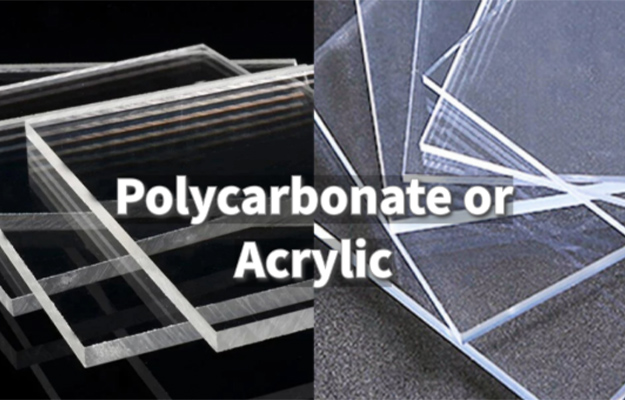

Imagine you need a custom drone camera housing flying at 60 km/h under direct sunlight, with strict specifications: four M3 threaded holes, a 1.5 mm thin wall, and a 0.1 mm flatness tolerance.
When the machine shop asks, “Acrylic (PMMA) or Polycarbonate (PC)?”, how should you choose?
PMMA and PC are two popular plastics in CNC machining for transparent parts. Acrylic offers superior optical clarity but is brittle and prone to thread cracking; polycarbonate is highly impact-resistant but has lower hardness and tends to yellow under prolonged sun exposure. There are no good or bad plastics, only right or wrong applications. Mischoosing acrylic could cause the M3 threaded holes to snap during assembly, while mischoosing polycarbonate might lead to the housing yellowing over time. Furthermore, the CNC machining approach must be carefully tailored to the specific material and part characteristics.
This article will break down both regarding key properties, machining, applications, and selection suggestions. At the end, we will share a practical case study of how our factory helped a client select and machine the perfect plastic for their specific part.
Acrylic, also called PMMA (polymethyl methacrylate), is the clearer and harder of the two transparent plastics. It transmits up to 92% of visible light — more than glass at 90% — which is why it has been the standard material for display cases, signage, lenses, and optical components for decades. Trade names include Plexiglas and Perspex.
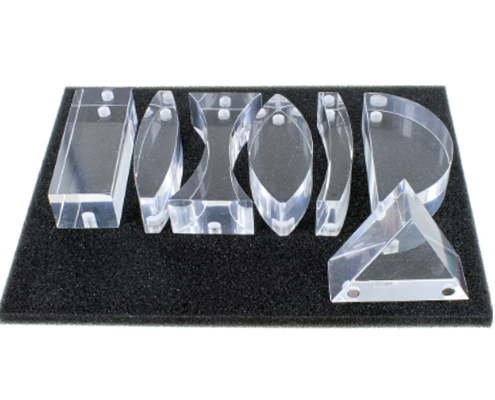
For acrylic CNC machining, there are two acrylic types:
Key Acrylic characteristics that matter for machined parts:
Polycarbonate(PC) is the tougher, more heat-resistant transparent plastic. It transmits 88–90% of visible light—slightly less than acrylic, but the difference is virtually invisible in most applications. Its defining characteristic is extreme impact resistance, making it the choice material for bulletproof windows and safety guards. Common trade names include Lexan and Makrolon.
Unlike acrylic, polycarbonate is ductile and bends before it breaks, allowing it to be drilled, tapped, and bolted without cracking. However, its softness makes it more scratch-prone and requires exceptionally sharp cutting tools.
Key Polycarbonate characteristics that matter for machined parts:
| Property | Acrylic (PMMA) | Polycarbonate (PC) | What It Means for the Parts |
| Light transmission | 92% | 88–90% | Acrylic wins on pure clarity; the gap is invisible in most applications |
| Impact resistance | ~17× glass (brittle) | ~250× glass (ductile) | Polycarbonate absorbs shock; acrylic cracks |
| Tensile strength | 65–83 MPa | 55–75 MPa | Acrylic is stronger in tension but also more brittle |
| Scratch resistance | High | Low (coatings available) | Acrylic stays clear longer when handled or cleaned |
| Max service temperature | 100 °C | 150 °C | Polycarbonate survives environments that soften acrylic |
| UV resistance | Excellent (no yellowing) | Poor (yellows; stabilizers needed) | Acrylic for outdoors; PC needs UV-stabilized grades |
| Flammability | Burns | Self-extinguishing (UL 94 V-0/V-2) | Polycarbonate for electronics and aerospace |
| Chemical resistance (alcohols) | Poor (crazes/cracks) | Better (tolerates short exposure) | Avoid alcohol cleaning on acrylic; PC handles it |
| Chemical resistance (hydrocarbons) | Good | May swell or soften | Acrylic near fuels/oils; PC away from them |
| Density | 1.19 g/cm³ | 1.20 g/cm³ | Nearly identical; no weight advantage either way |
| Cost (sheet, relative) | Lower (baseline) | 1.3–1.8× higher | Acrylic is cheaper by the blank; machining yield can flip this |
| BPA-free | Yes | No (BPA-free grades available) | Acrylic for food/medical contact by default |
Material properties dictate how a part performs in service, but machining behavior determines whether it can be successfully manufactured—and at what cost.
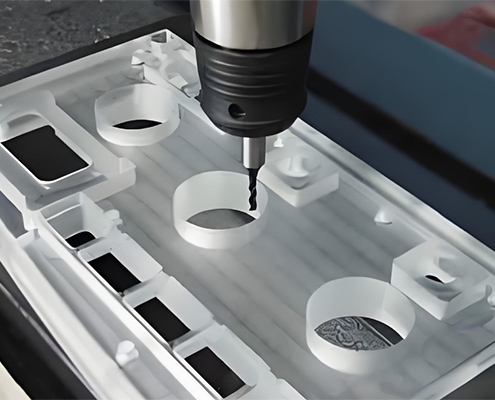
The primary challenge when machining both acrylic and polycarbonate is thermal management. Dull tools cause friction, melting the surface and leaving a cloudy finish that cannot be recovered by polishing. For maximum clarity, sharp carbide or PCD (polycrystalline diamond) tooling is essential.
Both materials tolerate high spindle speeds and fast feed rates, but their failure modes differ when parameters are sub-optimal:
Both plastics flex under clamping pressure, which can lead to part spring-back and dimensional inaccuracies once released. This elasticity is more pronounced in polycarbonate.
High optical clarity and scratch resistance maintain a pristine appearance through years of handling and cleaning. Acrylic’s brittleness is acceptable here since these components remain stationary and protected.
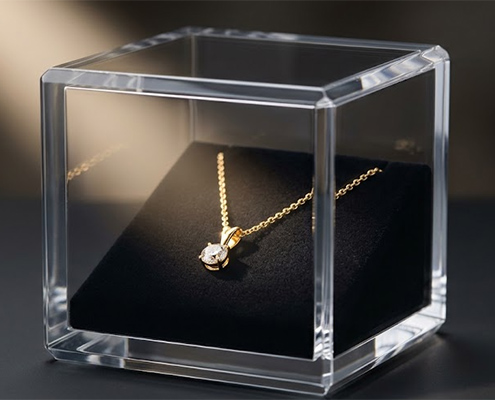
A 92% light transmission rate combined with inherent UV stability makes acrylic the standard choice for light throughput functions. CNC-machined acrylic lenses achieve superior surface finishes that injection molding cannot replicate without secondary polishing.
Acrylic’s edge-lighting properties—the ability to guide light across a sheet and emit it evenly at machined features—are superior to those of polycarbonate. CNC-routed lettering and edge-lit signs represent a standard industry application.
Native UV stability ensures acrylic housings do not yellow after years of solar exposure, whereas polycarbonate requires specialized UV-stabilized grades to survive identical conditions.
The combination of optical clarity and low water absorption (when properly annealed post-machining) makes acrylic ideal for large viewing panels where polycarbonate’s scratch sensitivity is a disqualifier.
Impact resistance is the definitive requirement for industrial safety. A polycarbonate guard absorbs energy from flying debris or broken tooling without shattering, whereas acrylic would fail catastrophically into sharp fragments.
The combination of flame resistance (UL 94 V-0), electrical insulation, and continuous heat resistance up to 150 °C makes polycarbonate the default transparent plastic for housing live electronics.
Polycarbonate withstands autoclave sterilization cycles (121 °C saturated steam) that would distort acrylic. Additionally, specialized BPA-free grades fulfill regulatory requirements for medical and food-contact compliance.
Drone camera covers and structural components must survive impact, vibration, and rapid temperature transitions. Polycarbonate’s mechanical toughness accommodates all three. For outdoor operations, a UV-stabilized grade must be specified.
Offering 250 times the impact resistance of glass, polycarbonate serves as the core layer in laminated security glass for financial institutions and tactical vehicles.
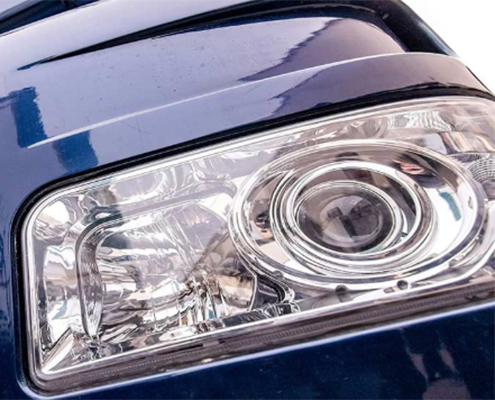
Headlight covers demand a material that resists bulb-generated heat, solar UV, and road debris impact. Polycarbonate—enhanced with a hard coating for scratch resistance and UV stabilizers—is the industry standard.
If after five questions both materials still work, the tiebreaker is optics vs. toughness: acrylic for maximum clarity and scratch resistance, polycarbonate for maximum durability.
Although the per-kilogram price of acrylic (PMMA) sheet stock is lower than that of polycarbonate (PC)—roughly $1.50–$2.00/kg for acrylic versus $2.50–$3.50/kg for PC—this straightforward price advantage often leads people to favor acrylic at first glance. For parts with simple geometries, the math can indeed be that simple.
However, raw material cost is only half the ledger; the other half is the actual yield rate of the finished parts.
Acrylic has a narrower processing window, meaning it carries a much higher scrap risk, particularly when machining thin walls, deep pockets, or tapped holes. If a part design pushes acrylic close to its chipping threshold, the machining yield might top out at 85%, whereas switching to PC could achieve a 97% yield. During the prototyping phase (1–10 parts), a few scrapped blanks might seem negligible. In mass production (500+ parts), however, this 12% gap in yield directly dictates the project’s profit margin.
It is precisely this difference in scrap rates that offsets PC’s higher raw material cost. Polycarbonate’s forgiving machining behavior—characterized by a wider parameter window, lower chipping risk, and fewer instances of operational stress-cracking—means that a much higher percentage of the raw material you purchase successfully becomes shippable product. Consequently, for complex 3D geometries with fine features, the total cost per accepted part actually tilts in favor of PC.
A Practical Rule for Material Selection:
For simple 2.5D parts (such as flat plates with through-holes and perimeter profiles), acrylic’s material cost advantage still holds true. However, for 3D parts involving pockets, threads, thin walls, or tight tolerances, always run a comprehensive cost evaluation for both materials before finalizing your decision.
A medical device startup approached VMT with a design for a transparent diagnostic housing (180 × 120 × 40 mm). It required integrated sample wells, four M4 threaded inserts, and an optical window that had to maintain 90%+ light transmission after 1,000 autoclave cycles.
Previously, the client had chosen to machine the prototype from acrylic with another supplier, purely to achieve a better cosmetic finish. While it looked acceptable on the bench, the prototype quickly failed during 121 °C steam autoclaving: the insert bosses cracked by the fourth cycle, and the optical window distorted by 0.3 mm by cycle 12. Facing these quality failures, the startup turned to VMT.
VMT’s engineering team analyzed the failed parts and identified three critical factors that had been overlooked in the initial material choice:
The Decision and Result
Following VMT’s analysis, the startup chose PC for the housing body, which was then precision-machined at VMT’s CNC machining facility. They retained acrylic only for a non-structural internal light pipe shielded from steam, and added a hard coating to the PC window for scratch resistance.
This hybrid approach yielded excellent results: the first production batch of 200 units successfully passed the 1,000-cycle validation. While the switch added 18% to per-unit material costs, it avoided a field failure mode that would have triggered a recall.
Acrylic and polycarbonate serve distinct operating conditions defined by different application requirements: acrylic represents the optimal solution when the primary design drivers are maximum optical clarity and scratch resistance, whereas polycarbonate is specified when the overriding criteria are high impact strength and thermal resistance. Ultimately, defining the exact material based on the component’s functional requirements rather than leaving a vague “clear plastic” callout on a drawing is essential to ensuring part reliability.
VMT provides CNC machining services for acrylic, polycarbonate, and engineering plastics across prototype and production volumes. Sharp carbide tooling, process parameters tuned for optical plastics, and experience with both materials from display cases to machine guards. Submit your clear plastic part design for a DFM review.
 WhatsApp/WeChat/Mobile:
+86-15099911516
WhatsApp/WeChat/Mobile:
+86-15099911516 Tel: 86-150-9991-1516
 QQ: 939020977
 E-Mail: service@vimetal.com.cn


Can you CNC machine acrylic without it melting?
Yes, with the right parameters. Use sharp single-flute carbide tooling, high spindle speed (12,000–18,000 RPM), and a feed rate fast enough that the tool cuts rather than rubs. Compressed air cooling is sufficient for most operations. The most common cause of melting is a dull tool or a feed rate that is too conservative.
Is polycarbonate harder to machine than acrylic?
No. Polycarbonate is generally easier to machine than acrylic because it has a higher melting point (295 °C vs. 160 °C), giving it more tolerance for heat buildup during cutting. It is less prone to chipping and cracking. The main machining risk with polycarbonate is coolant compatibility: amine-based coolants can cause delayed stress cracking.
Does polycarbonate turn yellow over time?
Standard polycarbonate yellows under prolonged UV exposure. UV-stabilized grades are available and effective for outdoor use. Acrylic is inherently UV-stable and does not yellow, which is why it is preferred for outdoor signage and enclosures.
Can you polish CNC-machined acrylic and polycarbonate?
Yes, both can be polished after machining to restore optical clarity on cut surfaces. Flame polishing works on acrylic (a brief pass with a hydrogen-oxygen flame melts the surface smooth) but is not recommended for polycarbonate, which absorbs moisture and can bubble. Mechanical polishing with progressively finer abrasives, or vapor polishing with a suitable solvent, works for both materials.
Which is cheaper: CNC machining acrylic or polycarbonate?
Acrylic sheet stock costs less than polycarbonate. However, for complex parts with thin features, acrylic’s higher scrap rate during machining can make the total cost per accepted part higher than polycarbonate. For simple profiles, acrylic wins on total cost. For complex 3D geometries, get a quote for both materials before deciding.
Can acrylic be tapped for threads?
Yes, but with caution. Acrylic’s brittleness makes it prone to cracking around threaded holes, especially at small diameters (M3 and below). Use coarse threads rather than fine threads to distribute load over more material. Threaded inserts (heat-stake or press-in) are a more reliable solution for acrylic parts that need to be repeatedly assembled and disassembled. Polycarbonate handles tapped threads more predictably.

 Plastic Extrusion: A Complete Guide to Process, Materials, Design, and Sele...