CNC Robotics: Role and Benefits in Automated CNC Machining
By JunWen Liu | Oct. 06, 2026
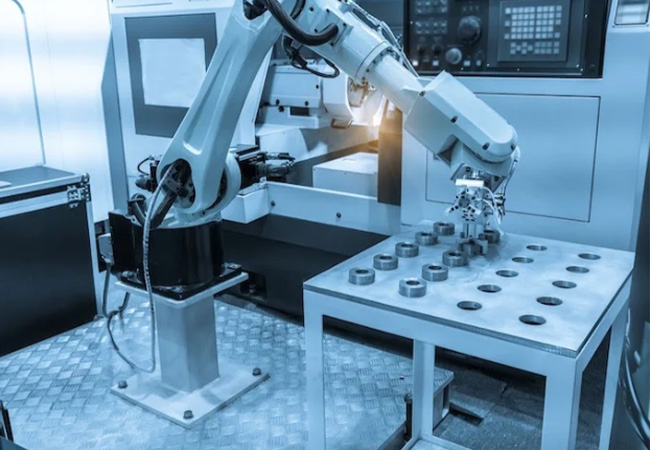
When you hear the term “CNC robotics,” don’t mistake it for using CNC machining to produce robot parts. In today’s industrial manufacturing, especially in the CNC machining industry, this technology refers to robotic arms participating in CNC machining operations and material handling to boost production efficiency. Consequently, this helps shorten your product lead times and lower volume costs.
However, a common misconception is that some manufacturers claim to have highly advanced “CNC robotics” that can machine ultra-precision parts. But can a robotic arm really cut parts directly with micron-level precision? This article will break down the real role of automation, its benefits in production, and how to evaluate a custom manufacturing partner that genuinely possesses automated machining capabilities. At the end, we will also share a case study of how we used automation machining to achieve 28% faster cycle times and 22% cost savings for precision stainless steel housings for one of our medical clients.
There is a clear distinction between machining robotics components and utilizing robotics in CNC production. The former refers to using CNC equipment to fabricate high-precision structural parts for robots, such as arm joints, gearboxes, or housings. The latter, what we focus on here, refers to deploying robotic automation within the CNC machining process itself.
A common myth is that modern robotic arms have evolved to replace traditional high-precision cutting tools. In reality, articulate robotic arms lack the heavy structural rigidity and thermal stability required for micron-level metal cutting.
Instead, their true strength lies in material handling and machine tending. In an automated machining cell, robotic arms handle raw material loading, finished part unloading, fixture clamping, and secondary operations like automated deburring or part washing. By letting robotics manage repetitive physical tasks while multi-axis CNC machines handle precision cutting, you get the best of both worlds: uncompromised accuracy and maximized efficiency.
CNC robotics not only bring advantages such as increased efficiency and reduced labor costs to CNC machining manufacturers, but they also benefit you by enabling suppliers to offer more competitive quotes, faster lead times, and quality-assured products.
This is mainly due to:
CNC robotics offer higher flexibility. For example, a factory can configure or reconfigure robotic arms or automation equipment according to different phases and task requirements. This flexibility, combined with the high efficiency mentioned in Point 1, lowers the manufacturer’s labor costs. This essentially reduces the hidden labor costs when you place part orders, allowing you to receive relatively more advantageous quotes.
Certain dangerous, physically demanding, and repetitive handling tasks are handled more safely and efficiently through robotics and automation. This avoids employee safety incidents as well as delivery delays. In addition, for quality-maintaining repetitive operations, such as precise, programmable positioning, using robotic arms can lower scrap rates and manufacturing errors.
No. Robotic arms, other CNC robotics, or automation equipment are primarily meant to improve production efficiency and the accuracy of repetitive tasks. They indeed provide great help in improving product yield rates and reducing accidents. However, for achieving high precision, such as tolerances of ±0.01 mm, robotic arms and similar tools offer no help. Precision is achieved through the mechanical rigidity, high-precision spindle, thermal stability, and advanced feedback systems of the advanced CNC machining equipment itself.
Below is one of the equipment’s in our factory, and this is what we use to offer high precision components CNC machining services rather than the robotic arms used in production:
Furthermore, robotic arms or other CNC robotics cannot replace many human roles. For instance, achieving high precision requires DFM optimization and programming setup by an engineering team, and operating CNC robotics also requires humans to set up or change configurations.
When sourcing custom CNC machined parts, understanding the type of automation setup your manufacturing partner uses helps you gauge their capability, capacity, and suitability for your specific order. In modern machining facilities, CNC robotics and automation generally fall into four main operational setups:
Machine tending is the most common application of robotic arms in a CNC shop. In this setup, an articulated robotic arm is positioned next to one or more CNC machines to perform repetitive loading and unloading of raw materials and finished parts.
For large-scale, high-precision manufacturing, automation goes beyond standalone robotic arms. Automated pallet changers (APCs) and overhead gantry loaders work in tandem with multi-axis CNC machines to manage workpiece transport seamlessly.
CNC robotics and automation are increasingly paired with auxiliary post-processing equipment, such as automatic deburring spindles, automatic part washers, laser marking machines, and optical inspection stations, to handle some repetitive post-processing tasks after machining.
In high-volume manufacturing environments, automation extends to the logistics surrounding the CNC machines. Vision-guided robotic arms and automated guided vehicles (AGVs) are used for bin picking, conveyor sorting, and transferring parts between different processing stations.
Partnering with a machining supplier that effectively integrates CNC robotics can significantly lower your sourcing costs and accelerate time-to-market. However, not all facilities utilizing automation offer the same level of technical expertise or quality control.
To ensure you choose a reliable supplier that delivers quality, cost, and lead time value, use these key criteria to evaluate a potential CNC machining partner:
Automation cannot fix a weak or imprecise machine. Evaluate whether the supplier’s core shop floor features high-performance multi-axis CNC machines (such as 5-axis machining centers) paired with appropriate automation.
Fast, continuous 24/7 production is only valuable if every single part meets your specifications. High-speed automated cells require equally robust quality assurance processes to prevent scrap from accumulating silently.
Ensure the partner utilizes automated in-process probing (on-machine measurement) and modern Coordinate Measuring Machines (CMM). Ask if they have certified quality management systems in place (such as ISO 9001 or ISO 13485) and can provide full inspection reports with your shipment.
Robotic arms and CNC machines need skilled people to set up. Achieving ultra-high precision and high yield requires a skilled engineering team behind the scenes to optimize tool paths, design custom grippers, and refine fixture clamping.
A strong partner should offer thorough Design for Manufacturability (DFM) feedbackduring the quoting stage. They should be able to analyze your 3D CAD files and advise on features (like clamping datum points or radii) that facilitate automated production and reduce unit costs.
An automated machining supplier should reflect its operational efficiency in its customer service and turnaround times. Test their responsiveness. Can they provide rapid digital quoting alongside realistic lead-time projections? Furthermore, evaluate if their shop setup can smoothly scale your order, from initial prototype batches to lights-out, high-volume production.
Achieving 28% Faster Cycle Times and 22% Cost Savings for Precision Stainless Steel Housings
A medical equipment client required a batch of 2,000 custom stainless steel housing components within a tight three-week window. Their previous supplier relied on manual machine tending, which resulted in extended cycle times, high labor overhead, and minor part-to-part clamping variations.
To meet their assembly schedule without compromising quality, the client needed a machining partner capable of maintaining consistent ± 0.012 mm tolerances while reducing unit costs and accelerating delivery. Then, they found and approached us VMT CNC Prototyping Machining Factory.
Upon evaluating the 3D CAD models, our engineering team conducted a thorough Design for Manufacturability (DFM) review to optimize tool paths and standardize clamping datum points. Based on the production volume, we configured an automated machining cell consisting of high-rigidity multi-axis CNC mills, an integrated robotic machine-tending arm, and automated pallet changers tailored for raw material handling.
During production, the high-rigidity CNC machines executed the precision cutting operations, while the automatic system managed continuous workpiece loading, finished part unloading, and post-machining air cleaning. This synchronized setup allowed the machining cell to operate continuously through planned night shifts and weekends with minimal supervision.
The implementation of automated machine tending reduced overall cycle times by 28% and virtually avoided manual loading errors, achieving a 99.8% first pass yield rate verified by both on-machine probing and CMM inspection. Furthermore, the decrease in direct labor hours enabled us to reduce the per-part price, offering the client a 22% cost savings compared to their previous vendor’s quote.
CNC robotics and automation are not about replacing the craftsmanship and engineering required for precision machining. Instead, they assist and enhance it, delivering faster turnaround times, superior batch consistency, and lower hidden labor costs. When choosing a manufacturing partner, look beyond the promise of “automation” and select a facility that combines high-rigidity multi-axis CNC equipment, rigorous CMM quality control, and experienced engineering support. Looking to lower your unit costs without sacrificing precision? Don’t let unoptimized designs or manual handling inflate your component prices. Send us your 2D and 3D drawings today, and our engineering team will provide a complimentary DFM assessment to identify automation-friendly features, optimize tool paths, and deliver an instant, cost-effective quote for your project. [2D Drawings (PDF files), 3D Drawings (IGS/STP/STEP files)].
 WhatsApp/WeChat/Mobile:
+86-15099911516
WhatsApp/WeChat/Mobile:
+86-15099911516 Tel: 86-150-9991-1516
 QQ: 939020977
 E-Mail: service@vimetal.com.cn


Does sourcing parts from an automated CNC supplier increase my per-part cost?
No, it typically reduces your unit cost for production orders. The high efficiency and reduced direct labor hours of automated machining cells allow the factory to lower processing costs and pass those savings to your product team in the part quotation.
Is automated CNC machining suitable for small-batch or low-volume orders?
Yes. While high-volume runs benefit most from continuous operation, modern robotic setups with quick-change grippers allow fast retooling. This flexibility makes automated machining cost-effective and practical even for mid-to-low volume recurring part orders.
Does CNC robotics impact the dimensional tolerance or accuracy of my parts?
A little bit. The accuracy of your parts (±0.01 mm or tighter) is governed mainly by the high mechanical rigidity, spindle precision, and thermal stability of the CNC machine tool itself, and the skills of the operator. Robotic arms can handle material positioning, which primarily improves batch consistency by reducing manual clamping variations.
How is quality controlled during unattended "lights-out" shifts?
Automated cells rely on integrated quality controls, including in-process tool breakage detection, automated on-machine probing, and adaptive sensor monitoring. If there’s dimension drifts or a tool wears out, the cell automatically pauses operation, ensuring nearly zero scrap accumulation before final CMM inspection.


 What Is the Most Important Part of a Robot? The Hardware Truth and Cases