CNC Machining vs. Injection Molding: Key Differences and How to Choose
By JunWen Liu | Sept. 18, 2026
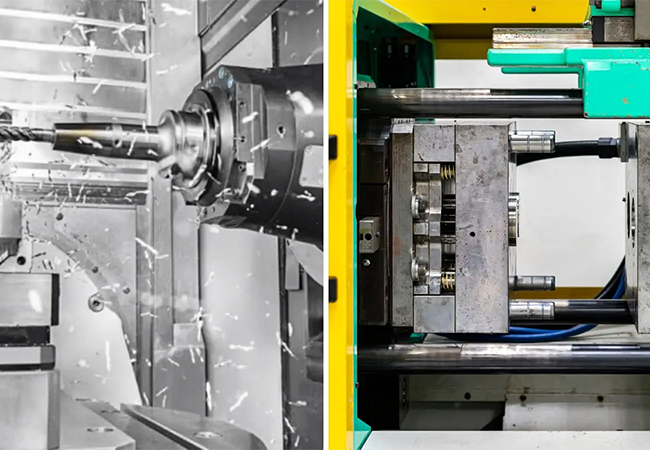

CNC machining and injection molding are two of the popular manufacturing processes widely utilized across the automotive, electronics, and medical industries although they differ significantly in working principles, costs, lead times, and design flexibility. Understanding their detailed differences and practical applications will help advance your project with high quality, optimized budgets, and rapid execution.
As a computer-controlled process that uses various cutting tools to shape solid materials into precise parts, CNC machining offers a solution featuring high precision, excellent structural strength, design flexibility, and rapid prototyping and delivery for small-batch metal and plastic component manufacturing. On the other hand, injection molding primarily provides an exceptionally cost-effective solution for mass production of tens of thousands of thermoplastic parts, delivering superior surface finishes and massive economies of scale.
Read this article to explore the key differences between CNC machining and injection molding, their applications, pros and cons, and guidance on how to choose the right process. At the end, we will also share a case study on how our factory combined rapid injection molding with secondary CNC machining to cost-effectively produce bulk electronic enclosures featuring side holes perpendicular to the mold-opening direction, deep grooves, and undercuts.
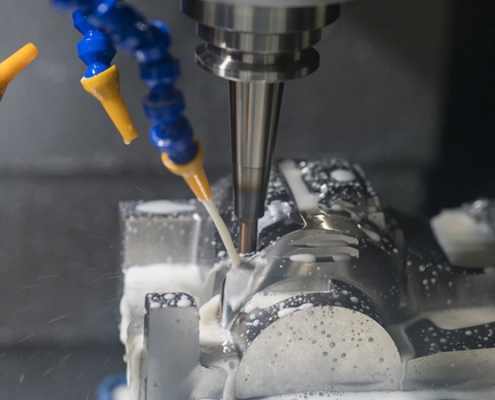
CNC machining is a subtractive manufacturing process that uses lathes or various milling tools to cut a solid block of metal (forged alloys) or plastic material (primarily engineering plastics) from different angles along pre-set toolpaths to achieve precise final shapes. During this process, the design of the toolpaths—where a computer translates CAD design files into G-code/CNC language recognized by CNC machines, is exceptionally accurate, repeatable, and capable of handling complex geometries. Subsequent finishing operations can also utilize CNC grinders, CNC polishing machines, and other equipment to achieve the desired surface quality, though this inevitably increases total costs.
Generally, injection molding refers to the conventional process of manufacturing durable, high-precision molds out of hardened steel, into which molten plastic (only the thermoplastics) is injected to mass-produce finished plastic products. Achieving production volumes over tens of thousands of units unlocks significant cost advantages through economies of scale.
You may also have heard of other two related processes: rapid injection molding and metal injection molding. Rapid injection molding and conventional injection molding both inject molten plastic into a mold; however, to prioritize speed, rapid injection molding uses temporary molds made of aluminum or soft steel, making it ideal for low-volume runs of hundreds to thousands of parts, beyond which the temporary tooling loses accuracy. Metal injection molding (MIM) differs entirely from the first two: it mixes metal powder with a binder to create a feedstock, which is then injected into a mold under high pressure to manufacture metal components.
To help you quickly evaluate both manufacturing processes based on your specific project requirements, the table below summarizes their core differences:
| Dimension | CNC Machining | Injection Molding |
| Optimal Production Volume | Prototypes to Low/Mid-Volume (1–5,000+ pcs) | High-Volume Mass Production (5,000–100,000+ pcs) |
| Initial Tooling Cost | Low (programming and setup fees only) | High (requires custom steel or aluminum molds) |
| Per-Unit Machining Cost | Higher; scales linearly with volume | Lower once mold costs are amortized |
| Material Choice | Broad (metals, alloys, engineering plastics) | Primarily thermoplastics, elastomers, and silicone |
| Manufacturing Tolerances | Tight (down to ±0.01 mm to ±0.05 mm) | Standard to high (typically ±0.1 mm to ±0.2 mm) |
| Design Flexibility | High; modify CAD files anytime | Low; mold modifications are costly and time-consuming |
| Initial Lead Time | Fast (hours to a few days) | Moderate to Slow (2–6 weeks for tooling fabrication) |
Prototyping and Ultra-Low Volume (1–100 pcs): CNC machining is the default choice. With zero upfront mold fees, fast setups, and immediate execution, it allows you to test iterations without high capital risk.
Low-to-Medium Volume (100–5,000 pcs): CNC machining and Rapid Tooling overlap.
Mass Production (5,000 / 10,000+ pcs): Conventional injection molding is preferred. High upfront steel tooling investments are quickly offset by minimal unit costs and massive economies of scale across tens of thousands of units.
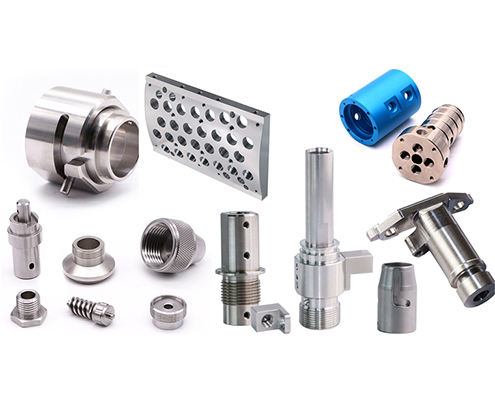
CNC Machining: Material options are virtually unlimited. It supports aluminum alloys, stainless steel, titanium, brass, and copper, alongside engineering plastics such as POM, ABS, PEEK, PC, and Nylon.
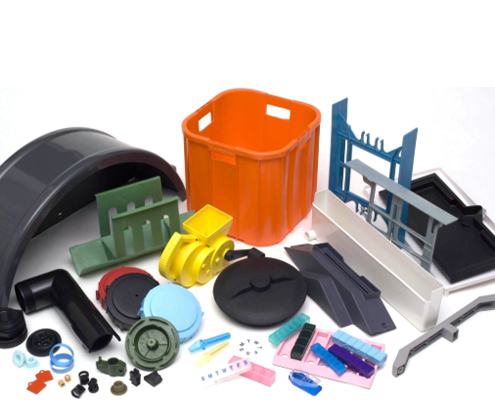
Injection Molding: Primarily designed for thermoplastics (e.g., ABS, PC, PP, PA, PET) and elastomeric materials (TPE, liquid silicone). While Metal Injection Molding (MIM) exists, its workflow differs significantly from standard plastic injection molding.
Special Performance Requirements: When the project calls for specific high-strength metals or high-temperature engineering plastics, CNC machining is frequently the only feasible choice.
Precision Control: Guided by computer programming and sharp cutting tools, CNC machining reliably achieves tolerances of ±0.025 mm (0.001 in) or tighter, making it ideal for precision-mated components.
Shrinkage and Warpage: Injection molded parts experience volumetric shrinkage and warpage during thermal cooling, holding tolerances closer to ±0.1 mm to ±0.2 mm.
Surface Textures: Machined parts retain subtle tool marks that require secondary post-processing (polishing, bead blasting, anodizing). Injection molded parts can produce textured or mirror-like surfaces straight out of the cavity based on mold polishing or etching.
Isotropic Properties: CNC components are cut from solid extruded or forged billets. The raw material is dense and free of internal gas pockets, yielding uniform physical strength across all axes.
Internal Stress and Weld Lines: As molten resin flows through a mold, weld lines and localized residual stress can develop. Non-uniform wall thicknesses can also create sink marks or internal voids, reducing mechanical integrity.
CNC Machining Limits: The main restriction is tool accessibility. Deep narrow channels, sharp internal corners (due to cutter radii), and fully enclosed cavities are challenging to reach, though uniform wall thickness is not required.
Injection Molding Limits: Bound by part ejection and cooling behavior, designs must feature draft angles and maintain uniform wall thickness (typically 1.5 mm–4 mm) to prevent sink marks, warpage, or short shots.
Prototyping Stage: CNC machining needs only CAD modeling and CAM setup, enabling physical test samples to be delivered within 24–72 hours.
Mass Production Stage: Fabricating and qualifying an injection mold takes 2–6 weeks. Once automated injection cycle runs begin, production speed accelerates to seconds per part, delivering large batches far faster than machining.
Subtractive Waste: CNC machining cuts away excess material from a solid block, creating metal or plastic chips that lower material utilization. Waste material must be collected and sent for recycling or remelting.
Forming Efficiency: Injection molding is a near-net-shape process with high material utilization. Waste from sprues and runners, as well as off-spec parts, can often be reground and blended back into raw batches.
CNC Tooling Costs: CNC machining utilizes standard, off-the-shelf cutting tools. The cost of routine tool wear during cutting is already factored into the base machining hourly rate. Even when specialized custom tools are required and experience wear while cutting hard metals, their replacement cost remains negligible compared to the high price of injection molds. Choosing CNC machining for your parts allows your project to avoid high upfront investments of tens of thousands of dollars in injection tooling.
Hidden Costs of Injection Molds: An injection mold is a high-value, dedicated asset. While a hardened steel mold can last between 500,000 and 1,000,000 shots, it requires routine maintenance, rust prevention, cleaning, and replacement of wearable components (such as ejector pins and seals). Soft aluminum molds have a shorter lifespan (approximately 5,000–10,000 shots) and are susceptible to flash if improperly maintained. Consequently, beyond the steep initial mold fabrication fees, the factory’s ongoing routine maintenance, periodic servicing, and component replacements are ultimately factored into your overall production expenses as amortized or hidden costs. Furthermore, if a mold reaches the end of its service life and requires re-tooling, you will need to absorb both the financial and lead-time costs once again.
Every manufacturing method involves trade-offs between speed, cost, and design freedom. Evaluating the strengths and limitations of CNC machining and injection molding side by side makes it easier to pinpoint which process aligns with your project goals.
| Manufacturing Process | Key Advantages (Pros) | Key Disadvantages (Cons) |
| CNC Machining | • Low Tooling Costs: Avoids upfront mold costs, lowering financial risk. • High Design Flexibility: Update designs simply by modifying CAD/CAM files. • Broad Material Selection: Supports various metals, alloys, and most engineering plastics. • Exceptional Tolerances and Precision: Ideal for high-precision components with uniform physical properties. | • Higher Unit Costs at Scale: Fixed cycle times prevent drastic price drops for large batches. • Lower Material Efficiency: Subtractive manufacturing creates material chips and scrap. • Internal Geometry Limits: Restricted by cutting tool reach and radii. |
| Injection Molding | • Ultra-Low Unit Cost at Scale: Per-unit costs drop significantly once mold expenses are amortized. • High Production Efficiency: Seconds-long cycle times make it ideal for mass production. • Complex Geometry Support: Easily handles thin walls, intricate features, and surface textures. • Minimal Waste: Near-net-shape process with recyclable runners and scrap. | • High Upfront Investment: Custom steel/aluminum tooling involves heavy capital outlay. • Long Initial Lead Times: Tool design, machining, and sampling take several weeks. • Difficult Design Revisions: Modifying a finished mold is extremely costly and time-consuming. |
From high-precision aerospace components to mass-produced consumer electronics, the choice between CNC machining and injection molding often depends on the specific demands of your sector. Here is how both technologies are utilized across key manufacturing industries.
Electronics and Telecom
Aerospace
Evaluate your project across these key dimensions to select the right process:
CNC machining is the prefered choice when:
Choose injection molding when:
Bridging Rapid Injection Molding and Secondary CNC Machining for Complex Electronic Enclosures
A leading electronics client approached our factory with a critical challenge: producing a batch of 8,000 custom protective enclosures using flame-retardant PC/ABS alloy. The design featured deep internal grooves, undercut locking tabs, and side holes perpendicular to the main mold-opening direction. Standard injection molding for such intricate geometries typically requires complex multi-slide, angle-lift steel tooling, pushing the initial tooling cost beyond the client’s budget and adding weeks to the delivery timeline. Conversely, fully CNC machining all 8,000 units from solid plastic blocks would have resulted in excessively high per-unit cycle times and material waste.
To resolve this tradeoff, our engineering team implemented a hybrid manufacturing strategy combining rapid aluminum injection molding with secondary multi-axis CNC machining. We used a simplified 2-plate rapid aluminum mold to produce the primary enclosure shell from the PC/ABS resin, establishing the core thin-wall geometry, internal ribbing, and overall footprint in seconds per cycle. Rather than building expensive side-action cams into the mold for the perpendicular side holes, undercuts, and deep grooves, we molded these sections solid or semi-formed, intentionally leaving them for post-process precision machining.
Once the base PC/ABS shells were molded and cooled, they were transferred to our automated CNC milling stations using custom-designed soft-jaw vacuum fixtures. Guided by specialized CAM programming, high-speed 5-axis CNC mills quickly cut the precise perpendicular side ports, cleared the deep internal cable grooves, and trimmed the undercut features with zero tool deflection. By offloading these complex features from the mold to the CNC mill, we maintained a rapid 25-second injection molding cycle while preventing stress concentration around delicate cutouts.
This dual-process approach delivered exceptional efficiency. By bypassing complex mold mechanisms, we cut initial tooling costs by 40% and reduced the prototype-to-production lead time from six weeks down to 16 days. Crucially, secondary CNC machining achieved tight tolerances of ±0.01 mm on all critical interface holes while leaving a clean, burr-free surface finish (Ra 0.8 μm) across machined features.
Both CNC machining and injection molding are indispensable pillars of modern manufacturing, each serving distinct purposes. CNC machining provides unmatched flexibility, tight tolerances, and zero tooling costs, making it the ideal solution for prototyping, low-volume runs, and complex metal or high-performance plastic components. Conversely, injection molding delivers unbeatable speed and minimal unit costs once you transition to mid-to-high-volume mass production. In many cases, as demonstrated in our hybrid enclosure case study, combining both processes allows you to bypass design limitations and optimize your overall production budget. Ready to bring your hardware project to life with optimized costs and lead times? Our engineering team is here to help you choose the best process for your budget and timeline. [Upload Your File Today] for a free, instant Manufacturability (DFM) analysis and competitive quote! [2D Drawings (PDF files), 3D Drawings (IGS/STP/STEP files)].
 WhatsApp/WeChat/Mobile:
+86-15099911516
WhatsApp/WeChat/Mobile:
+86-15099911516 Tel: 86-150-9991-1516
 QQ: 939020977
 E-Mail: service@vimetal.com.cn


Is CNC machining more expensive than injection molding?
It depends on your production volume when compare cost of injection molding vs cnc machining. For prototypes and low-volume runs (under 1,000–5,000 units), CNC machining is usually much cheaper because it avoids the high upfront cost of building custom molds. However, for large production runs (5,000+ units), injection molding becomes significantly cheaper per unit once the initial mold cost is amortized across the batch.
Can plastic parts be CNC machined instead of injection molded?
Yes, absolutely. Engineering plastics such as ABS, PC, POM (Delrin), PEEK, Nylon, and PMMA are frequently CNC machined. Machining plastic is ideal when you need low quantities, extremely tight tolerances, thick-walled parts that would sink during molding, or when testing functional prototypes before investing in injection mold tooling.
What is rapid tooling, and how does it bridge CNC and traditional molding?
Rapid tooling uses softer materials like aluminum or semi-hardened steel to produce lower-cost molds much faster than standard hardened steel tooling. It is designed for low-to-medium volumes (500 to 5,000+ parts), offering a bridge between zero-tooling CNC machining and high-volume mass production molding.
Why would a factory combine injection molding with secondary CNC machining?
Combining both processes allows you to leverage the strengths of each. A factory can quickly mold the core geometry using a simplified, low-cost mold, and then use high-speed multi-axis CNC mills to add complex features, such as side holes, undercuts, or tight-tolerance interface threads, that would otherwise make the mold excessively expensive or slow to run


 The Ultimate Guide to Metal Prototyping: Processes, Materials, and Design R...