1. What’s the difference between 2024 and 7075 aluminum?
2024 and 7075 are both high-strength aluminum alloys favored in aerospace applications, but they’re optimized for different priorities. 2024 offers excellent fatigue resistance, making it well suited to parts under repeated or cyclic stress over long service life. 7075 has a higher overall tensile and yield strength, making it the better choice for parts that need to withstand the highest possible loads without adding weight.
| Grade | Tensile Strength | Yield Strength | Why Choose It |
|---|
| 2024 | 483 MPa | 345 MPa | Best fatigue resistance, ideal for cyclic loading |
| 7075 | 560 MPa | 480 MPa | Highest overall strength-to-weight ratio |
Neither grade responds well to anodizing or is recommended for conventional welding, and both typically require a protective surface treatment for corrosion resistance. If your part needs to survive millions of load cycles, 2024 is generally the stronger candidate; if raw strength is the priority, 7075 is usually the better fit.
2. What’s the difference between 2024-T3 and other 2024 tempers?
2024-T3 is solution heat treated and cold worked, giving it a good balance of strength and fatigue resistance while remaining machinable. Other common tempers trade some of this machinability for improved dimensional stability during machining.
| Temper | Why Choose It | Best For |
|---|
| T3 | Standard option, good balance of strength and machinability | General-purpose 2024 parts |
| T4 | Similar to T3 without the cold working step | Parts where slightly different strength characteristics are acceptable |
| T351 | T3 plus stress-relief stretching, lower residual stress | Parts with tight flatness or straightness requirements |
For CNC machined parts where flatness or straightness matters, T351 is often a better starting material than standard T3, since the stress-relief step reduces the risk of distortion as material is removed.
3. What is the most common temper used for CNC machining 2024?
2024-t3 aluminum cnc machining is the most common combination, offering the best overall balance of strength, fatigue resistance, and machinability for general-purpose applications. For parts with strict flatness or straightness requirements, T351 is a common alternative, since its added stress-relief step reduces the risk of distortion as material is removed during machining.
4. What are the advantages of using 2024 for CNC machining?
2024’s standout advantage is fatigue resistance — it holds up well under repeated or cyclic stress in ways that many general-purpose aluminum grades don’t, which is why it remains a standard choice for aircraft structures decades after its introduction. Its high strength-to-weight ratio also makes it a strong option when reducing part weight matters without giving up load-bearing performance.
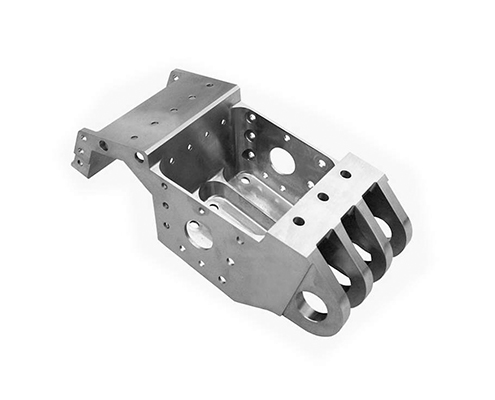
For 2024 cnc aluminum machining parts with complex geometries, 2024 can be machined to tight tolerances when cutting parameters, tooling, and workholding are properly controlled, though its lower machinability compared to grades like 6061 means cycle times and cost may run higher for demanding designs.
5. Are there any limitations to using 2024 aluminum?
2024’s strengths come with a few trade-offs worth knowing before you finalize your material choice.
- Weaker corrosion resistance than more common grades like 6061, mainly due to its higher copper content. Parts exposed to moisture or outdoor conditions typically need a protective surface treatment such as Chem Film or a coating.
- Not readily suited to anodizing, which limits color and cosmetic finishing options compared to grades like 6061.
- Lower machinability than 6061 or similar general-purpose grades, which can mean longer cycle times and higher cost for complex parts.
- Not recommended for conventional welding, since welding can significantly reduce strength around the weld and heat-affected zone.
VMT can help you weigh these trade-offs during a free DFM review for your aluminum 2024 cnc machined parts project.
6. Can 2024 aluminum be welded?
Conventional welding is generally not recommended for 2024. Welding creates a heat-affected zone where the heat treatment and resulting strength are compromised, and 2024’s higher copper content makes it more prone to weld cracking than grades like 6061.
If your design requires welded joints, 6061 is generally a better material choice, or you can use mechanical fasteners, press fits, or adhesive bonding to join 2024 components instead.
7. Is 2024 aluminum corrosion resistant?
2024’s corrosion resistance is weaker than more common grades like 6061 or 6063, mainly due to its higher copper content. In dry indoor environments, this usually isn’t a concern. For parts exposed to moisture, outdoor conditions, or coastal environments, a protective surface treatment — such as Chem Film, powder coating, or plating — can improve corrosion protection.
Historically, aircraft-grade 2024 sheet is often clad with a thin layer of pure aluminum (Alclad) to improve corrosion resistance, though this isn’t typically an option for machined parts cut from solid stock. For cnc 2024 aluminum parts headed for corrosive environments, it’s worth discussing surface treatment options upfront to make sure the part is adequately protected.
8. Why isn’t 2024 aluminum recommended for anodizing?
2024’s higher copper content interferes with the anodizing process, resulting in a weaker, less consistent oxide layer than grades like 6061 or 7075 typically produce. The finish can appear patchy or discolored, and the resulting layer offers less corrosion and wear protection than a properly formed oxide layer on other grades.
For 2024 cnc aluminum machining factory projects needing corrosion protection or a cosmetic finish, Chem Film, powder coating, or plating are generally more reliable choices for 2024 than anodizing.