Austenitic Stainless Steel: Types, Properties and Uses
By Luca Xie | Dec .03, 2025
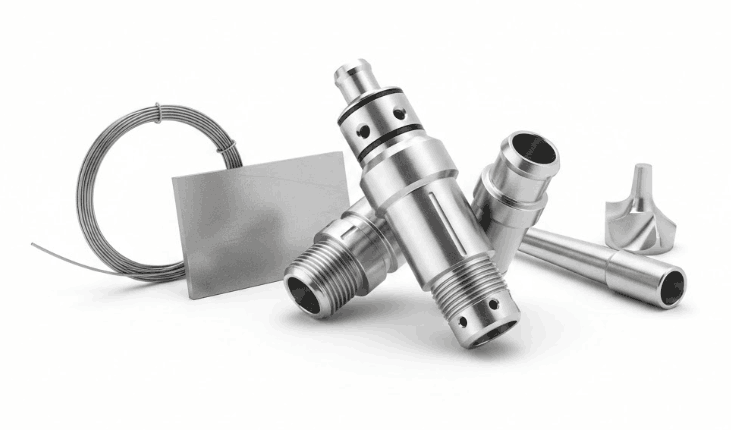

You may often see austenitic stainless steel, yet the terms, structures, and alloy groups feel unclear. This lack of clarity makes it hard to understand how these steels work and why they dominate many industries. This guide gives you a simple and structured overview.
Austenitic stainless steel is a group of chromium-nickel alloys known for corrosion resistance, non magnetic behavior, and good formability. This article explains austenitic meaning, austenitic stainless steel composition, austenitic stainless steel grades, machining tips, austenitic stainless steel price, and common applications, helping you understand these alloys in CNC machining and industrial contexts.

Austenitic stainless steel refers to steels with a face-centered cubic structure. This structure makes them stable at room temperature and gives them excellent corrosion resistance. The austenitic meaning comes from the FCC crystal phase called austenite. These steels are mostly non magnetic, easy to weld, and can maintain strength at both high and low temperatures. Commonly, aus stainless steel includes grades like 304, 316, 321, and 347. Understanding what is austenitic steel helps you select the right alloy for CNC machining and industrial use.
The composition of austenitic stainless steel mainly includes chromium, nickel, and sometimes molybdenum or nitrogen. Chromium improves corrosion resistance, while nickel stabilizes the austenitic structure and enhances toughness. Nitrogen increases strength without reducing ductility.
Knowing the austenitic stainless steel composition helps you predict corrosion resistance, weldability, and how the material behaves in CNC machining.The following table lists some common austenitic stainless steel grades and their typical chemical compositions.
| Grade | Chromium (%) | Nickel (%) | Molybdenum (%) | Carbon (%) |
| 304 | 18-20 | 8-10 | 0 | 0.08 |
| 304L | 18-20 | 8-12 | 0 | 0.03 |
| 316 | 16-18 | 10-14 | 2-3 | 0.08 |
| 316L | 16-18 | 10-14 | 2-3 | 0.03 |
| 321 | 17-19 | 9-12 | 0 | 0.08 |
| 347 | 17-19 | 9-13 | 0 | 0.08 |
| 309 | 22-23 | 12-14 | 0 | 0.20 |
| 310 | 24-26 | 19-22 | 0 | 0.25 |
In this section, you will learn about the main austenitic stainless steel grades and how they are categorized. We will explain the 200 series and 300 series, including their key features, and typical applications
The 200 series austenitic stainless steel contains higher manganese and lower nickel compared to the 300 series. This composition makes it more cost-effective while still offering good corrosion resistance. These alloys are slightly harder and can become magnetic after cold working. They provide good formability and stable mechanical performance, making them suitable for household appliances, kitchen equipment, architectural components, decorative parts, and non-critical structural applications where moderate corrosion resistance is sufficient.
| Grade | Key Feature | Typical Applications |
| 201 (UNS S20100) | Cost-effective, moderate corrosion resistance | Kitchen equipment, railings, decorative parts |
| 202 (UNS S20200) | Improved strength, slightly better corrosion resistance | Household appliances, architectural components |
| 204Cu (UNS S20430) | High copper content, antibacterial properties | Food handling, medical surfaces |
The 300 series austenitic stainless steel contains higher nickel and chromium, giving it superior corrosion resistance, excellent formability, and mostly non magnetic behavior. These alloys maintain strength across a wide temperature range and resist oxidation in harsh environments. Common grades include 304, 304L, 316, 316L, 321, and 347. They are widely used in food processing equipment, chemical tanks, marine and offshore structures, medical instruments, aircraft components, and high-temperature industrial parts. The austenitic stainless steel properties of these grades make them ideal for demanding applications requiring durability, hygiene, and long-term stability.
| Grade | Key Feature | Typical Applications |
|---|---|---|
| 304 (UNS S30400) | General-purpose, good corrosion resistance | Food equipment, chemical tanks, kitchen appliances |
| 304L (UNS S30403) | Low carbon, reduced sensitization | Welded piping systems, structural components |
| 316 (UNS S31600) | Molybdenum added, excellent corrosion resistance | Marine equipment, chemical processing |
| 316L (UNS S31603) | Low carbon, prevents carbide precipitation | Medical instruments, offshore structures |
| 321 (UNS S32100) | Titanium stabilized, high temperature resistance | Aircraft components, exhaust systems |
| 347 (UNS S34700) | Niobium stabilized, resists intergranular corrosion | High-temperature chemical plants, boiler parts |
| 309 (UNS S30900) | High Cr-Ni, strong at high temperatures | Furnace parts, heat exchangers |
| 310 (UNS S31000) | Excellent high-temperature resistance | Kilns, power plants, high-temperature processing |
Austenitic stainless steels have key properties such as corrosion resistance, formability and ductility, weldability, temperature resistance, magnetic behavior, aesthetics, and hygienic performance. The following sections explain each property and its typical applications.
The austenitic stainless steel properties provide excellent corrosion resistance in acidic, alkaline, and chloride-rich environments. They resist rust, pitting, and stress corrosion cracking. This makes them ideal for chemical tanks, marine equipment, food processing, and medical instruments where exposure to harsh environments is frequent.
These alloys have outstanding formability and ductility. You can bend, stamp, or deep-draw them into complex shapes without cracking. They maintain toughness during forming and machining. This property is especially valuable for architectural panels, automotive components, and intricate CNC-machined parts.
Austenitic stainless steels are highly weldable. Low-carbon grades like 304L and 316L minimize sensitization and reduce intergranular corrosion after welding. This allows for strong, durable welded structures in pipelines, medical devices, and high-quality structural assemblies.
These steels retain strength at high temperatures and maintain toughness at cryogenic temperatures. Grades like 321 and 347 are suitable for exhaust systems, furnaces, and chemical reactors. This temperature stability ensures consistent performance in extreme industrial conditions.
Most grades are non magnetic in the annealed state. However, some may become weakly magnetic after heavy cold working. Understanding austenitic stainless steel magnetic behavior is important for applications requiring minimal magnetic interference, such as optical or electronic equipment.
These alloys have a smooth, shiny, and attractive surface that resists tarnishing. They are widely used for visible applications like kitchen appliances, decorative panels, railings, and consumer electronics, providing both durability and visual appeal.
Their smooth, non-porous surfaces are easy to clean, resist bacterial growth, and maintain hygienic conditions. This property makes them ideal for food processing equipment, medical instruments, surgical tools, and laboratory surfaces.
Austenitic stainless steels offer excellent corrosion resistance, strength, and temperature stability. These properties enable engineers and manufacturers to use them across a wide range of applications, from food processing and chemical plants to medical devices, automotive components, consumer goods, and high-temperature industrial equipment.
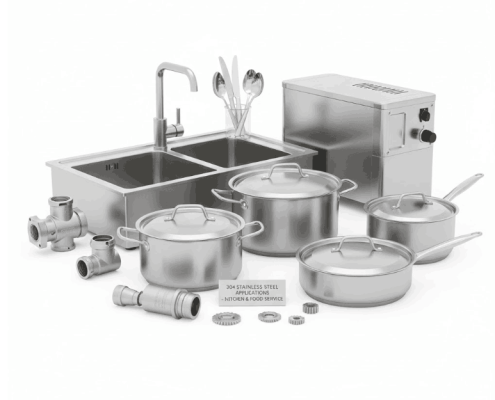
Austenitic stainless steel is widely used in countertops, pipes, tanks, and appliances. Its excellent corrosion resistance and non-porous surface prevent contamination, making it ideal for safe, hygienic food and beverage equipment. It also withstands frequent cleaning and exposure to acids and salts.
These steels are used for reactors, heat exchangers, and piping systems that must endure aggressive chemicals and high pressures. The austenitic stainless steel properties allow them to resist pitting and stress corrosion, ensuring long-term reliability in chemical plants and refineries.
You find austenitic steel in exhaust systems, fuel rails, landing gears, and jet engine components. Its combination of strength, corrosion resistance, and temperature stability makes it suitable for extreme conditions and vibrations in automotive and aerospace applications.
Austenitic alloys are common in surgical instruments, implants, and hypodermic needles. Their biocompatibility, corrosion resistance, and smooth finish make them safe for medical use. The materials also maintain mechanical integrity during sterilization and repeated use.
They are widely used in cookware, cutlery, and household appliances. The combination of durability, aesthetic appeal, and corrosion resistance ensures long-lasting and visually attractive products. Their smooth surface also simplifies cleaning and maintenance.
Grades like 321 and 347 are used in furnaces, boilers, and other high-temperature equipment. The austenitic stainless steel properties allow these alloys to retain strength, hardness, and oxidation resistance at elevated temperatures, making them ideal for industrial processing and heat-intensive applications.
The austenitic stainless steel price varies depending on grade, composition, and market conditions. Grades with higher nickel or molybdenum content, such as 316 or 316L, cost more than 304 or 304L.Global factors like nickel prices, demand, and regional production costs affect pricing. For example, Chinese suppliers often offer competitive rates compared to Europe or the US.
Processing also influences cost. Cold-rolled sheets, polished surfaces, or custom CNC machining parts increase the total price. The following table shows reference prices for common austenitic stainless steel grades,Prices are updated as of November 2025. Market fluctuations may affect material costs. For real-time pricing, contact VMT for a free quote.
| Grade (UNS) | China Price (USD/ton) | International Price (USD/ton) |
| 304 (S30400) | 2,100 – 2,500 | 2,400 – 2,800 |
| 304L (S30403) | 2,200 – 2,600 | 2,500 – 2,900 |
| 316 (S31600) | 2,700 – 3,200 | 3,000 – 3,600 |
| 316L (S31603) | 2,800 – 3,300 | 3,100 – 3,700 |
| 321 (S32100) | 2,500 – 2,900 | 2,800 – 3,200 |
| 347 (S34700) | 2,600 – 3,000 | 2,900 – 3,300 |
Machining austenitic stainless steel requires proper handling to maintain its strength, ductility, and corrosion resistance. The following sections explain key processes like cold working, hot working, annealing, CNC machining, and surface finishing.
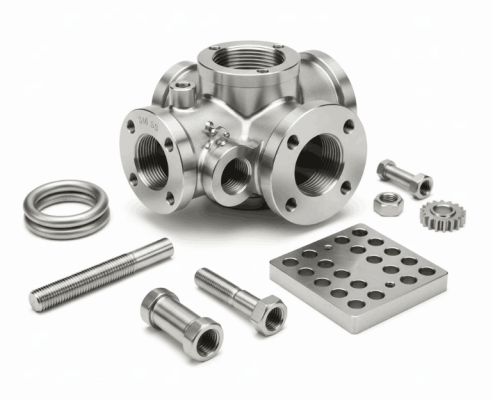
Machining austenitic stainless steel requires controlling work-hardening and toughness. At VMT, turning, milling, and drilling are performed on 4- and 5-axis CNC centers with precise toolpaths. We use sharp carbide and coated tools to minimize heat generation and prevent surface galling.
Cutting parameters are optimized for feed, speed, and depth to balance material removal and surface finish. High-pressure coolant ensures proper chip evacuation and reduces tool wear. Finishing passes achieve tolerances within 0.01 mm while maintaining austenitic stainless steel properties.
For complex geometries, multi-axis machining allows accurate contours and uniform surface integrity. Threading, pocketing, and deep drilling are programmed to reduce vibration and stress, ensuring dimensional stability and consistent performance.
During cold working, austenitic stainless steel hardens rapidly and becomes slightly magnetic in some grades. It maintains high ductility but may require careful deformation to avoid surface cracking. Work-hardening improves strength but reduces formability.
When hot worked above its recrystallization temperature, the steel softens and maintains excellent ductility. Grain structure becomes uniform, reducing internal stresses. Austenitic stainless steel can be formed into complex shapes without significant work-hardening.
During annealing, austenitic stainless steel softens and restores its ductility. Internal stresses from prior machining or forming are reduced, and the material regains uniform toughness. Its corrosion resistance improves, and the structure stabilizes, maintaining austenitic stainless steel properties with minimal distortion.
Austenitic stainless steel responds well to polishing, brushing, and chemical passivation. Its smooth surface resists corrosion and staining. Surface treatments enhance reflectivity and maintain non-porous characteristics, important for hygienic and aesthetic applications.
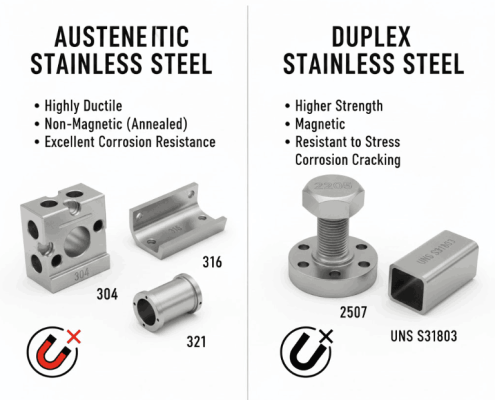
Austenitic stainless steel is highly ductile and non-magnetic in the annealed state. It offers excellent corrosion resistance, good formability, and performs well in both high and low temperatures. Work-hardening occurs during machining or forming, slightly increasing strength.
Duplex stainless steel combines austenitic and ferritic structures. It is stronger than austenitic grades, with improved resistance to stress corrosion cracking. Magnetic properties are higher, and it has lower ductility but better toughness than ferritic steels.
In chemical and marine environments, austenitic stainless steel provides uniform corrosion resistance, while duplex grades are preferred where higher strength and chloride stress corrosion resistance are required. Both materials respond differently to machining, forming, and heat treatment, affecting design and fabrication choices.
An Italian automotive manufacturer previously used 304 stainless steel for custom fuel injector components. They experienced surface defects and premature wear due to insufficient corrosion resistance and lower strength for high-pressure engine environments.
VMT analyzed the design and selected 316L and 321 stainless steel as the suitable austenitic stainless steel grades. Using advanced 4- and 5-axis CNC machining, we controlled cutting parameters to prevent work-hardening and maintain dimensional accuracy. Surface finishing and passivation ensured corrosion resistance and smooth surfaces. Cold and hot working behaviors were considered to preserve material properties throughout fabrication.
The client reported that the new parts met all specifications, delivering excellent surface finish and mechanical performance. Production was completed on schedule, improving assembly efficiency. If you need high-precision austenitic stainless steel components that combine durability and precise tolerances, Contact VMT now can provide customized solutions and free design support.
Austenitic stainless steel offers excellent corrosion resistance, high ductility, and reliable mechanical performance across a wide range of applications. Understanding its behavior during machining, forming, and heat treatment ensures components meet strict dimensional and functional requirements. Proper selection of grades and processing methods allows consistent performance in automotive, medical, industrial, and consumer applications.
 WhatsApp/WeChat/Mobile:
+86-15099911516
WhatsApp/WeChat/Mobile:
+86-15099911516 Tel: 86-150-9991-1516
 QQ: 939020977
 E-Mail: service@vimetal.com.cn


Is austenitic stainless steel safe for cooking?
Yes, austenitic stainless steel such as 304 or 316 is safe for cooking. Its non-porous, corrosion-resistant surface prevents leaching of harmful substances, maintains food hygiene, and withstands acidic or alkaline ingredients without affecting taste or safety.
What are the disadvantages of austenitic stainless steel?
Austenitic stainless steel has excellent corrosion resistance and ductility, but it has some drawbacks. It is relatively expensive due to high nickel content, work-hardens quickly during machining, and has lower thermal conductivity. It is non-magnetic in the annealed state, which can be a limitation in applications requiring magnetic properties.
Is 316 stainless steel austenitic or martensitic?
316 stainless steel is austenitic, meaning it has a face-centered cubic structure. It is non-magnetic in the annealed state, offers excellent corrosion resistance, and maintains high ductility and toughness, making it suitable for harsh chemical, marine, and high-temperature environments.
What are the 4 types of stainless steel?
The four main types of stainless steel are austenitic, ferritic, martensitic, and duplex. Austenitic is corrosion-resistant and ductile, ferritic is magnetic and heat-resistant, martensitic is hardenable, and duplex combines austenitic and ferritic structures for higher strength and corrosion resistance.


 316h stainless steel UNS S31609: The Ultimate Guide