1018 vs 1045 steel:Which One Should You Choose
By Luca Xie | Dec .24, 2025
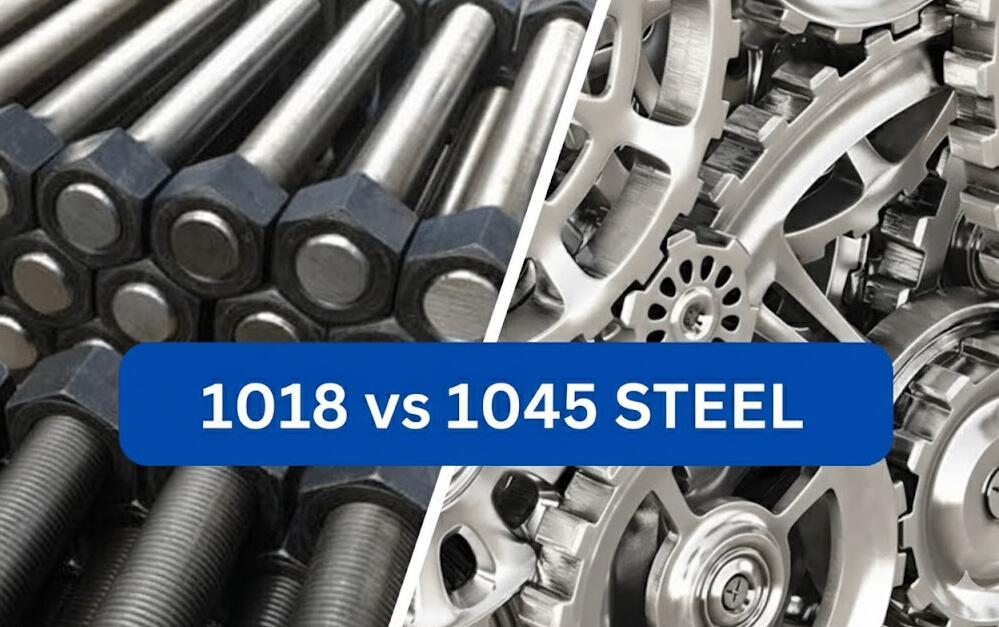

Choosing between 1018 vs 1045 carbon steel affects strength, cost, and CNC machining. You may face issues like poor welds, tool wear, or over-engineered parts. Clear knowledge of material behavior helps you avoid redesigns, control tolerances, and select steel that matches real load and manufacturing needs.
The difference between 1045 and 1018 steel mainly comes from carbon content. 1045 offers higher strength and heat treatment potential, while 1018 delivers better weldability and machining stability. This article helps you compare 1018 vs 1045 steel properties, processing behavior, so you can select the right material, avoid overdesign, and control total project cost.
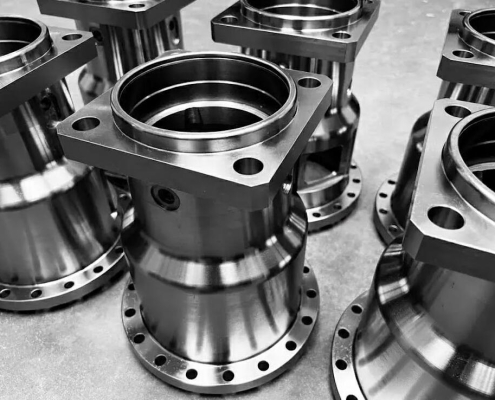
1018 steel is a low-carbon carbon steel defined under AISI and SAE standards. It typically contains around 0.18 percent carbon, which places it in the mild steel category. Because of its low carbon content, 1018 is balanced strength and good formability. This material is commonly referred to as AISI 1018 or SAE 1018 in engineering and CNC machining contexts.
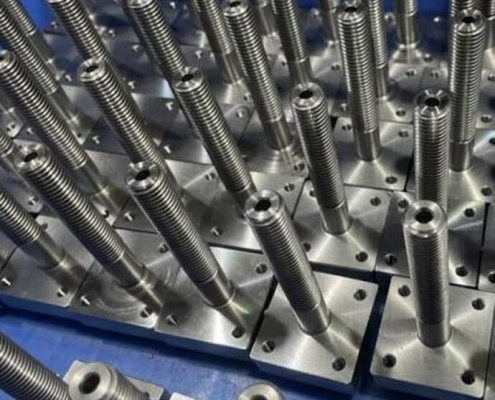
1045 steel is a medium-carbon steel classified under AISI and SAE standards. It typically contains about 0.45 percent carbon, 1045 steel carbon content allows effective heat treatment,which gives it higher strength and hardness than low-carbon steels. In industry, it is commonly known as AISI 1045 or SAE 1045.
Equivalent materials are steels in different standards that match chemical composition and performance. knowing their equivalents helps avoid selection mistakes and ensures proper material choice for CNC machining and engineering applications.
| Material System | Country | Equivalent Grade |
| ASTM | USA | 1018 |
| EN | Europe | C22 |
| JIS | Japan | S20C |
| DIN | Germany | 1.1141 |
| GB | China | Q215 |
| ISO | International | C22 |
| UNS | USA | G10180 |
| NORSOK | Norway | MDS 1018 |
| Material System | Country | Equivalent Grade |
| ASTM | USA | 1045 |
| EN | Europe | C45 |
| JIS | Japan | S45C |
| DIN | Germany | 1.1191 |
| GB | China | 45# |
| ISO | International | C45 |
| UNS | USA | G10450 |
| NORSOK | Norway | MDS 1045 |
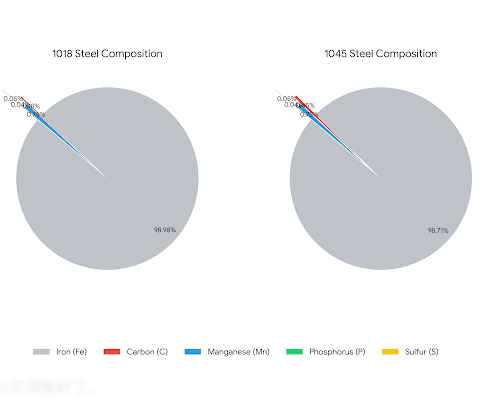
The key difference between 1018 vs 1045 carbon steel lies in carbon content. 1018 contains about 0.18 percent carbon, while 1045 has roughly 0.45 percent. This difference directly affects hardness, tensile strength, and yield strength. Higher carbon in 1045 increases strength but reduces ductility, making parts stiffer but less flexible. Lower carbon in 1018 improves formability, welding performance, and reduces the risk of cracking during machining or fabrication.
Other alloy elements are similar, including small amounts of manganese, phosphorus, and sulfur. The table below summarizes the main chemical differences:
| Element | 1018 Steel | 1045 Steel |
| Iron (Fe) | 98.81 – 99.26% | 98.51 – 98.98% |
| Carbon (C) | 0.18% | 0.45% |
| Manganese (Mn) | 0.60 – 0.90% | 0.60 – 0.90% |
| Phosphorus (P) (max) | 0.04% | 0.04% |
| Sulfur (S) (max) | 0.05% | 0.05% |
The mechanical properties of steel depend heavily on whether the steel is cold drawn (CD) or hot rolled (HR). Most 1018 and 1045 steel used in CNC applications comes in the cold drawn (CD) state across various shapes and sizes. Key properties include tensile strength, yield strength, elongation, reduction in area, and hardness. These properties determine how the material behaves during machining, forming, and in-service loading.
The table below compares key mechanical properties of 1018 vs 1045 steel (cold drawn):
| Mechanical Property | 1018 Steel (CD) | 1045 Steel (CD) |
| Tensile Strength | 64,000 psi | 91,000 psi |
| Yield Strength | 54,000 psi | 77,000 psi |
| Elongation in 2” | 15% | 12% |
| Reduction in Area | 40% | 35% |
| Brinell Hardness | 126 | 179 |
Understanding the process differences between 1018 vs 1045 steel is crucial for fabrication. Carbon content and hardness affect machining, heat treatment, and welding behavior.
1018 steel machines easily with lower tool wear and produces smoother finishes. Its low hardness allows faster cutting and drilling. 1045 steel is harder and stronger, which increases tool wear and requires slower feed rates. Engineers must plan cutting parameters carefully to maintain tight tolerances. Using 1045 steel vs 1018 in CNC milling or turning demands high-quality carbide tools and proper cooling.
1045 steel can undergo heat treatment to increase hardness and strength, making it suitable for high-load CNC parts. 1018 steel has limited heat treatment potential and cannot achieve the same hardness. When strength is critical, 1045 steel carbon content allows quenching and tempering to meet engineering requirements. Heat treatment also affects machinability, so planning the process sequence is important.
1018 steel offers excellent weldability with minimal preheating. Parts can be welded with standard methods without cracking or distortion. 1045 steel requires preheating and controlled cooling to avoid welding defects. Choosing between welding 1045 steel and 1018 depends on the complexity of the assembly and post-weld performance needs.
1018 steel is a low-carbon choice for easy welding, machining, and forming. It is ideal for general parts, fasteners, and low-stress structural components.
1045 steel is a medium-carbon option with higher strength, suited for axles, gears, and shafts. It is harder to weld and requires careful heat treatment for maximum performance.
Cost is an important factor when choosing between 1018 vs 1045 steel. The total cost includes raw material, machining, heat treatment, and regional price differences.
1018 steel is less expensive due to its low carbon content and wide availability. It machines easily, welds well, and often requires no heat treatment. These advantages lower both production and fabrication costs.
1045 steel is stronger and harder, so its raw material price is higher. Machining takes longer, tools wear faster, and heat treatment is often required to achieve desired strength. These factors increase total production cost.
The prices in the table were updated in December 2025, and prices may change due to market fluctuations. For the latest pricing, please contact VMT for a free quote.
| Region | 1018 Steel (USD/kg) | 1045 Steel (USD/kg) |
| China | 0.80 – 1.10 | 1.20 – 1.50 |
| United States | 1.00 – 1.30 | 1.50 – 1.80 |
| Europe | 1.10 – 1.40 | 1.60 – 1.90 |
Making the right material choice requires balancing strength, machinability, cost, and production requirements. Here’s a decision guide for 1018 vs 1045 steel:
A U.S.-based medical equipment manufacturer needed custom shafts and brackets for diagnostic machines. They struggled to choose between 1018 vs 1045 steel. Some components required high strength and wear resistance, while others needed excellent machinability and surface finish. Tight tolerances and fast delivery added further challenges, and prior suppliers faced issues with inconsistent hardness and surface quality.
VMT Solutions:
The result exceeded expectations. Shafts and brackets met design tolerances, showed improved durability, and were delivered on schedule. The customer praised VMT’s precision, fast turnaround, and technical guidance. If you are facing similar challenges or want your parts to achieve the same quality, Contact us get your free quote and CNC solutions.
Selecting between 1018 vs 1045 steel depends on carbon content, mechanical properties, and application needs. 1018 is suited for low-stress, easily machined parts, while 1045 is ideal for high-strength, wear-resistant components. Proper material choice ensures parts perform reliably and meet design and manufacturing requirements.
 WhatsApp/WeChat/Mobile:
+86-15099911516
WhatsApp/WeChat/Mobile:
+86-15099911516 Tel: 86-150-9991-1516
 QQ: 939020977
 E-Mail: service@vimetal.com.cn


What are the disadvantages of using 1045 steel?
1045 steel is harder to weld and machine compared to low-carbon steel. It often requires heat treatment to achieve desired strength, increasing production time and cost. Its higher carbon content reduces ductility, making it more prone to cracking under improper processing.
Does 1045 steel rust easily?
Yes, 1045 steel is prone to rusting if left uncoated, as it is a plain carbon steel. Proper surface treatments, like plating, painting, or oiling, are required to prevent corrosion.
Which steel is harder, 1045 or 1018?
1045 steel is harder due to its higher carbon content. It achieves greater hardness, strength, and wear resistance than 1018, which is softer and more ductile.
Does 1018 steel rust easily?
Yes, 1018 steel can rust if unprotected because it is low-carbon plain steel. Surface treatments like painting, plating, or oil coating help prevent corrosion.
What are the disadvantages of cold rolled steel?
Cold rolled steel can be more expensive than hot rolled steel and may have residual stresses from the rolling process. It can also be less ductile and may require annealing for certain forming operations.


 Ferritic Stainless Steel: Everything You Need to Know