Martensitic Stainless Steel : Grades, Characteristics, Machining
By Luca Xie | Dec .11, 2025
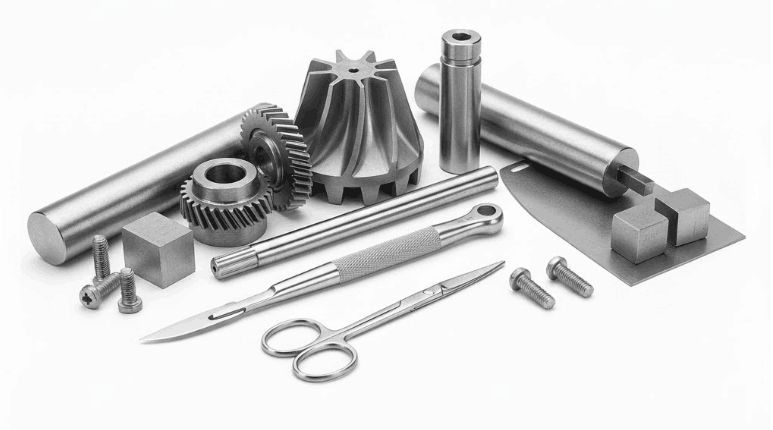

People often struggle to understand why some stainless steels stay tough while others deform, rust, or break under stress. Questions appear again and again: why does hardness vary so much, what creates sudden brittleness, and why do some steels respond strongly to heat treatment? Martensitic stainless steel sits at the center of this confusion because its behavior changes with even small shifts in composition and temperature.
Martensitic stainless steel is a hardenable, high-strength alloy defined by a martensitic structure formed through controlled heating and cooling. This guide explains its meaning, structure, grades, properties, machining behavior, costs, and real-world uses so you can choose materials with confidence.
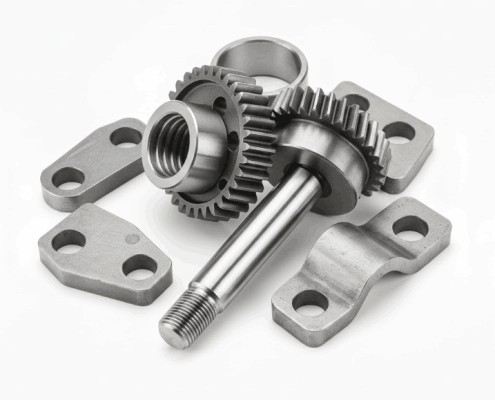
Martensitic stainless steel belongs to the family of hardenable alloys built on a unique martensitic structure. When heated and rapidly cooled, the steel transforms into a high-strength phase that delivers toughness and wear resistance.The martensitic stainless steel structure also produces clear magnetic response, often searched as martensitic stainless steel magnetic. This family of steels reaches high hardness with proper heat treatment and supports demanding parts that face abrasion, impact, or repeated mechanical load.
Martensitic stainless steel relies on a balanced mix of chromium and carbon to form its strong martensitic stainless steel structure. Chromium usually ranges from 11.5 to 18 percent, while carbon can reach up to 1.2 percent. The lower nickel content reduces corrosion resistance when compared with other stainless families, but the higher carbon builds a more robust lattice that supports hardening and strength. This link also explains its similarity to martensitic carbon steel in behavior.
Martensitic stainless steel includes a broad range of alloys built for strength, hardness, and wear resistance. These martensitic stainless steel grades vary in carbon level, chromium content, and heat-treat response, which shapes their uses and performance. Below is an expanded and accurate list , covering the most common Martensitic Stainless Steel grades used worldwide.
Manganese, nickel, and molybdenum appear as supporting alloying elements. They stabilize the material, refine grain size, and adjust toughness. Together, these elements create predictable strength and stability under heat treatment, which is a key part of martensitic stainless steel composition.
| Grade | Equivalent Grade | Description | Typical Uses |
| 403 | EN 1.4003 / UNS S40300 | Controlled composition with about 12 percent chromium for stable performance under high stress and heat. | Steam turbine parts, compressors, high-temp blades |
| 410 | EN 1.4006 / UNS S41000 | Base martensitic stainless steel with moderate corrosion resistance and good hardness after heat treatment. | Fasteners, turbine blades, cutlery, valve parts |
| 416 | EN 1.4005 / UNS S41600 | Free-machining grade with added sulfur that improves chip breaking and reduces tool wear. | Gears, shafts, axles, screws |
| 416Se | AISI 416Se | Selenium-enhanced free-machining grade that improves surface finish during high-speed machining. | Screws, bolts, nuts, valve seats |
| 420 | EN 1.4021 / UNS S42000 | High-carbon grade that reaches higher hardness and wear resistance after heat treatment. | Surgical tools, cutlery, gears, valve parts |
| 420F | EN 1.4028 + S / UNS S42020 | Free-machining form of 420 with added phosphorus and sulfur for faster CNC machining. | Pump parts, machined fittings, valve components |
| 420J2 | JIS SUS420J2 | Low-carbon, high-chromium steel offering good corrosion resistance with moderate hardness. | Kitchen blades, scissors, decorative parts |
| 420HC | Common commercial grade | Higher carbon than 420J2 for improved edge retention and strength. | Knife blades, cutting tools |
| 431 | EN 1.4057 / UNS S43100 | Nickel-bearing martensitic grade with improved corrosion resistance and high strength. | Marine shafts, aircraft parts, bolts |
| 431F | AISI 431F | Free-machining version of 431 with added sulfur or selenium. | Valve components, pump shafts |
| 440A | EN 1.4109 / UNS S44002 | Lower carbon than 440B and 440C with better toughness but lower hardness. | Hunting knives, surgical scalpels, bearings |
| 440B | EN 1.4112 / UNS S44003 | Balanced option between hardness and toughness within the 440 family. | Knife blades, chisels, industrial valves |
| 440C | EN 1.4125 / UNS S44004 | High-carbon grade offering maximum hardness and wear resistance. | Bearings, molds, precision cutting tools |
| 440F | EN 1.4104 / AISI 440F | Free-machining form of 440A with sulfur added for smoother cutting action. | Surgical tools, knives, wearable parts |
| 422 | EN 1.4935 / UNS S42200 | Alloyed with molybdenum, vanadium, and tungsten for superior high-temperature strength. | Turbine blades, aerospace fasteners |
| 17-4 PH | EN 1.4542 / UNS S17400 | Precipitation-hardening steel with a martensitic structure offering high strength and moderate corrosion resistance. | Aerospace components, turbine blades, high-performance machinery |
Martensitic stainless steel properties include very high strength and hardness, achievable through heat treatment. Chromium content usually ranges from 12 to 18 percent, while carbon varies from moderate to high levels. Lower carbon grades, such as 410, offer better toughness, weldability, and moderate corrosion resistance, while higher carbon grades, like 440, deliver maximum hardness and strength but are more brittle. This balance allows adjustment between toughness and strength for different applications.
The steel shows clear magnetic behavior, often referred to as martensitic stainless steel magnetic, thanks to its body-centered cubic or tetragonal martensitic structure. Corrosion resistance is moderate, lower than austenitic or ferritic types, but reaches its best performance when fully hardened. Weldability is limited and typically requires preheating and post-heat treatment.
Key characteristics summarized:
| Feature | Description |
| Hardness/Strength | Very high, hardenable via heat treatment, excellent wear resistance |
| Corrosion Resistance | Moderate, improves when fully hardened |
| Magnetism | Magnetic due to martensitic structure |
| Composition | 12-18% Chromium, 0.1-1.2%+ Carbon, may include Nickel and Molybdenum |
| Toughness | Better in lower carbon grades, lower in high-carbon grades |
| Weldability | Limited, requires controlled pre/post-heat treatment |
This section explains how martensitic stainless steel behaves during CNC machining, cold and hot working, heat treatment, hardening, welding, and forming, helping you manage its hardness and strength effectively.
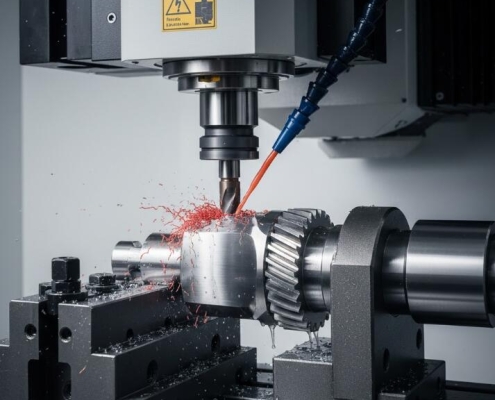
Based on VMT’s CNC machining experience, handling martensitic stainless steel requires careful planning. High-carbon grades like 440C increase tool wear and heat generation, while lower carbon grades, such as 410, cut more easily and produce smoother surfaces. Using coated carbide or ceramic tools helps maintain precision and prolong tool life. Proper spindle speeds, feed rates, and rigid fixturing reduce vibration and improve surface finish. Martensitic stainless steel hardness directly affects chip formation and cutting forces.
Cold working, including bending, drawing, or rolling, increases strength but also raises internal stress. Lower carbon martensitic grades can tolerate more deformation, while high-carbon grades may crack if overworked. Proper lubrication and gradual deformation reduce risk.
Hot working allows higher plasticity, making it possible to shape complex parts. Temperature control is crucial: too low can cause cracking, too high can reduce hardness after cooling. Grades like 403 or 17-4 PH respond well to controlled hot forging. After hot working, subsequent heat treatment ensures desired martensitic structure and mechanical properties.
Annealing softens the steel for easier machining and forming, while tempering after quenching adjusts toughness and reduces brittleness. Controlled heating and cooling cycles refine the martensitic stainless steel structure, balancing hardness and ductility. Lower carbon grades require less aggressive treatment, while high-carbon grades benefit from precise tempering to avoid cracking.
In the hardened state, martensitic stainless steel hardness reaches its maximum. This high hardness improves wear resistance but challenges machining and forming. CNC tools wear faster, and surface finish requires careful control. Pre-machining in annealed condition followed by final hardening is often recommended. Magnetic properties remain strong, which can affect certain assembly processes.
Welding martensitic stainless steel is limited. High-carbon grades crack easily, and distortion is common. Preheating and post-weld tempering help reduce stress. Lower carbon grades, like 410, weld more reliably but still need careful temperature control.
Forming parts from martensitic stainless steel depends on carbon content and heat treatment. Annealed lower-carbon grades bend or stretch more easily, while hardened high-carbon grades resist deformation. Correct forming techniques and proper tooling prevent cracking or springback.
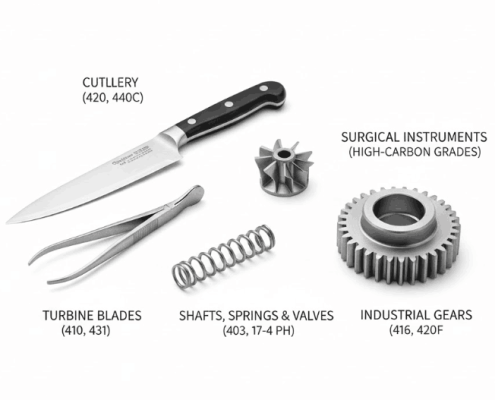
Martensitic stainless steel uses cover a wide range of demanding applications due to its hardness, strength, and moderate corrosion resistance:
The martensitic stainless steel price depends on several factors. Carbon content, chromium percentage, and additional alloying elements like nickel or molybdenum influence cost. Higher carbon grades, such as 440C, are more expensive due to harder machining and specialized heat treatment requirements. For example, 440C round bars typically range from USD 3.50 to 5.20 per kilogram, while cold-rolled plates cost about USD 5.50 to 6.80 per kilogram.
Other price factors include global supply, form—whether bars, sheets, or finished parts—and grade availability. Lower carbon grades like 410 are generally cheaper, around USD 2.50 to 3.50 per kilogram, and easier to source.
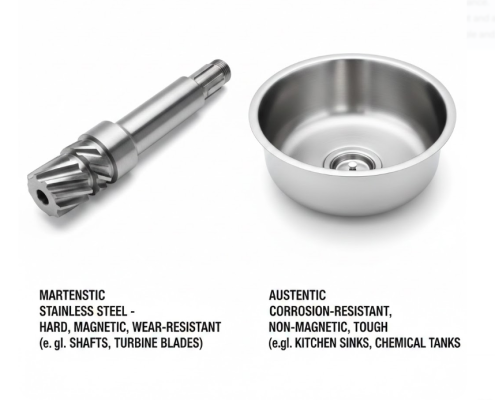
Martensitic stainless steel and austenitic stainless steel differ in composition, structure, and performance. Martensitic types have higher carbon content and a martensitic structure, making them hardenable and magnetic. They excel in applications requiring high hardness and wear resistance, such as cutlery, surgical tools, shafts, and turbine blades.
Austenitic stainless steels contain more nickel and lower carbon, forming a face-centered cubic structure that is generally non-magnetic. They offer excellent corrosion resistance and toughness, suitable for kitchen equipment, chemical tanks, and architectural components.
Seeing the table below helps understand the difference between austenitic and martensitic stainless steel.
| Feature | Martensitic Stainless Steel | Austenitic Stainless Steel |
| Carbon Content | Moderate to high | Low |
| Chromium | 12–18% | 16–26% |
| Nickel | Low or none | 8–10% or higher |
| Structure | Martensitic structure, body-centered | Face-centered cubic, non-magnetic |
| Hardness | High, hardenable via heat treatment | Moderate, generally softer |
| Magnetic | Yes | Generally non-magnetic |
| Corrosion Resistance | Moderate | Excellent |
| Machinability | Harder to machine, tool wear higher | Easier to machine, more ductile |
| Typical Uses | Cutlery, surgical tools, shafts, turbine blades | Kitchen equipment, chemical tanks, architectural components |
A client from the German automotive components industry needed high-precision shafts and blades made from 440C martensitic stainless steel. The high carbon content caused severe tool wear, difficult chip control, and surface finish issues. Achieving tight dimensional tolerances per 0.01 mm was challenging, and previous suppliers struggled with repeatability and consistency.
VMT addressed these challenges with a combination of process strategies:
The final parts met all dimensional tolerances, with smooth surfaces and consistent hardness. High-carbon shafts and blades were produced efficiently without excessive tool wear. The client reported improved reliability and repeatable quality across production runs. For customized martensitic stainless steel parts with tight tolerances and demanding surfaces, contact VMT to get an accurate quote for customized martensitic stainless steel parts..
Martensitic stainless steel offers high hardness, strength, and moderate corrosion resistance, making it suitable for cutlery, surgical instruments, shafts, valves, and turbine components. Understanding its composition, grades, machining behavior, and comparison with austenitic types helps achieve precise dimensions, smooth surfaces, and reliable performance. Proper selection of grade and process ensures consistent results across applications.
 WhatsApp/WeChat/Mobile:
+86-15099911516
WhatsApp/WeChat/Mobile:
+86-15099911516 Tel: 86-150-9991-1516
 QQ: 939020977
 E-Mail: service@vimetal.com.cn


Is martensitic stainless steel magnetic?
Yes, martensitic stainless steel is magnetic due to its martensitic structure. Its body-centered cubic or tetragonal crystal structure gives it clear magnetic properties, unlike austenitic stainless steel, which is generally non-magnetic. Magnetism remains strong even after heat treatment or hardening, making it suitable for applications where magnetic behavior is required.
What is martensitic stainless steel best known for?
Martensitic stainless steel is best known for its high hardness and strength. It can be hardened through heat treatment, providing excellent wear resistance. Its toughness and moderate corrosion resistance make it ideal for cutlery, surgical instruments, turbine blades, shafts, and other components requiring durability under stress.
What are the advantages of using martensitic steel?
The main advantages of martensitic steel include high hardness, wear resistance, and the ability to achieve precise tolerances through heat treatment. It is magnetic, maintains strength under load, and can be tailored for toughness versus hardness. This makes it ideal for demanding mechanical parts and applications where durability and dimensional stability are critical.

 Austenitic vs Martensitic Stainless Steel: Key Differences