What Are the Properties of 304 Stainless Steel?
By Luca Xie | Nov 15, 2025


304 stainless steel often causes unexpected issues during CNC machining when its strength, ductility, or magnetic response behave differently than you assumed. This leads to tolerance deviation, premature wear, or unstable finishes. You want stable performance, but the wide range of properties across sheets, plates, and bars makes it hard to predict results. Understanding these variations gives you back control.
304 stainless steel material properties cover mechanical, physical, chemical, corrosion, and thermal behaviors that directly affect your CNC machining accuracy, forming success, weld stability, and long-term durability. This article walks you through every property category and explains how different product forms behave during manufacturing.
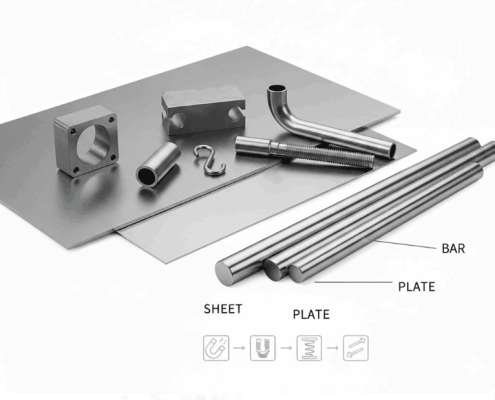
This section summarizes the main mechanical properties of 304 stainless steel, including tensile strength, yield strength, elongation, hardness, elasticity and magnetic behavior. It also explains how these properties change with different product forms such as sheet, plate and bar due to variations in thickness, cold work and grain structure.
304 stainless steel comes in three closely related variations: the standard 304 stainless steel, the low-carbon 304L stainless steel, which improves weldability and minimizes carbide precipitation, and the high-carbon 304H stainless steel, which delivers superior strength at elevated temperatures. Their different carbon levels actively shape meaningful shifts in mechanical behavior, even though all three belong to the same alloy family.
Performance also changes with product form — sheet, plate, and bar — because thickness, manufacturing strain, and grain structure directly influence strength, ductility, and magnetic response.
304 stainless steel has an ultimate tensile strength typically ranging from 500 to 750 MPa, depending on product form. Thin sheet (up to 8 mm) usually falls in the 540–750 MPa range because of higher cold-work levels, while plate (8–75 mm) ranges from 520–720 MPa. Bars and sections show 500–700 MPa. These values allow 304 to perform reliably in housings, brackets, pressure components, and structural parts.
The yield strength of 304 stainless steel starts at 190–230 MPa, depending on thickness and product type. Sheets up to 8 mm usually show 230 MPa minimum, plates show 210 MPa minimum, and bars typically show 190 MPa. Forming history and grain structure can lower the yield point in sheet materials compared with thicker plate or bar.
304 stainless steel offers a typical elongation of 45% minimum for sheet, plate, and most bar products, with 304H bar showing 40% minimum. This high ductility allows substantial bending and deformation before fracture. Cold-worked thin sheet may drop slightly below the typical elongation range.
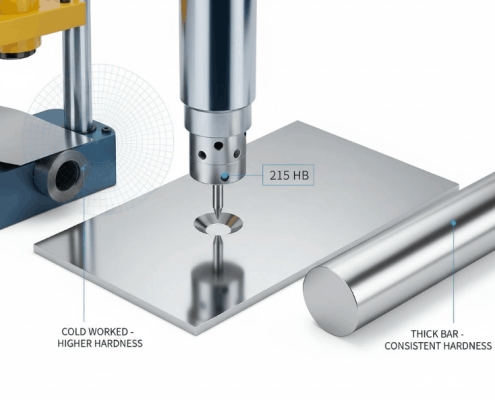
The hardness of 304 stainless steel is limited to 215 HB maximum across sheet, plate, and bar. Cold-worked sheet can approach the upper limit, while thicker plates and bars typically remain closer to the mid-range because they experience less work hardening during processing.
The modulus of elasticity of 304 stainless steel is consistently 193 GPa for all forms of 304, 304L, and 304H stainless steel. This stiffness determines dimensional stability, vibration control, and deflection behavior in structural applications.
304 stainless steel is non-magnetic in the annealed condition, but cold working can introduce slight magnetism. Thin sheet, which undergoes more deformation, tends to show the strongest magnetic response after forming, while plate and bar generally remain weakly magnetic or nearly non-magnetic.
| Mechanical Properties | 304 | 304L | 304H |
| Tensile Strength MPa | 540 – 750 | 520 – 700 | – |
| Yield Strength MPa | 230 Min | 220 Min | – |
| Elongation percent | 45 Min | 45 Min | – |
| Hardness HB | 215 Max | 215 Max | – |
| Modulus of Elasticity GPa | 193 | 193 | 193 |
| Density g per cm³ | 8.0 | 8.0 | 8.0 |
| Magnetism | Non magnetic | Non magnetic | Non magnetic |
| Mechanical Properties | 304 | 304L | 304H |
| Tensile Strength MPa | 520 – 720 | 500 – 700 | – |
| Yield Strength MPa | 210 Min | 200 Min | – |
| Elongation percent | 45 Min | 45 Min | – |
| Hardness HB | 215 Max | 215 Max | – |
| Modulus of Elasticity GPa | 193 | 193 | 193 |
| Density g per cm³ | 8.0 | 8.0 | 8.0 |
| Magnetism | Non magnetic | Non magnetic | Non magnetic |
| Mechanical Properties | 304 | 304L | 304H |
| Tensile Strength MPa | 500 – 700 | 500 – 700 | 500 – 700 |
| Yield Strength MPa | 190 | 175 Min | 185 Min |
| Elongation percent | 45 Min | 45 Min | 40 Min |
| Hardness HB | 215 Max | 215 Max | 215 Max |
| Modulus of Elasticity GPa | 193 | 193 | 193 |
| Density g per cm³ | 8.0 | 8.0 | 8.0 |
| Magnetism | Non magnetic | Non magnetic | Slightly magnetic |
This section outlines the main physical properties of 304 stainless steel, explaining its austenitic structure, workability, surface finish behavior, formability, density, and electrical resistivity.
| Property | Typical Value | Notes |
|---|---|---|
| Crystal Structure | Austenitic (FCC) | Provides high toughness and corrosion resistance |
| Density | 8.0 g/cm³ | Consistent across sheet, plate, and bar |
| Electrical Resistivity | 0.72 µΩ·m at 20°C | Higher than copper (0.017) and aluminum (0.028) |
| Formability | High ductility; elongation typically ≈45% | Suitable for bending, deep drawing, and stamping |
| Surface Finish | Smooth on thin sheet; more textured on thick plate/bar | Finish depends on manufacturing and cold work |
| Workability | Excellent weldability, machinability, and formability | Handles punching, bending, and forming without cracking |
The structure of 304 stainless steel is primarily austenitic, meaning it has a face-centered cubic (FCC) crystal structure. This gives it excellent toughness and high resistance to corrosion, making it ideal for a variety of industries, including automotive, medical, and food processing. The austenitic structure ensures that 304 stainless steel maintains a consistent and stable material performance across temperature variations, helping to maintain strength and durability even in challenging environments.
304 stainless steel is known for its excellent workability, meaning it can be easily formed, welded, and machined into complex shapes without compromising its integrity. This makes it a popular choice in industries where intricate designs are required, such as in the production of medical instruments or kitchen appliances. Its workability is largely due to its high ductility and formability, allowing it to withstand mechanical stress during manufacturing processes like punching, shearing, and bending without cracking or breaking.
The surface finish of 304 stainless steel varies depending on the manufacturing process and product form. Thin sheet materials typically show a smoother finish, which makes them ideal for applications where aesthetic appearance matters, such as architectural finishes, kitchen equipment, and decorative applications. In contrast, thicker plates and bars develop a more textured finish because fabrication steps and cold-worked surfaces directly shape their appearance. Despite these differences, 304 stainless steel maintains strong corrosion resistance across all finish types, making it suitable for both industrial and aesthetic applications.
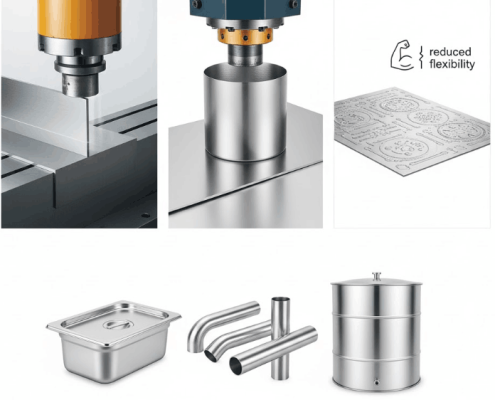
The formability of 304 stainless steel refers to its ability to be shaped or deformed without fracturing. This is one of its most important characteristics, particularly for applications that require bending, stamping, or deep drawing. Its high ductility ensures that it can be easily formed into various shapes and sizes, which is essential for products like food containers, pipes, and tanks. However, formability can be slightly affected by cold work, which may result in increased strength but slightly reduced flexibility, especially in thinner sheets.
The density of 304 stainless steel is relatively consistent across different forms, such as sheet, plate, or bar. Typically, it has a density of 8.0 g/cm³, making it dense enough to provide substantial strength while not being overly heavy. This property ensures that 304 stainless steel remains stable and durable, even in structural applications that require both strength and weight balance, such as in frame construction or industrial machinery components. Its consistent density also helps maintain predictable behavior during machining and processing.
Electrical resistivity of 304 stainless steel is approximately 0.72 µΩ·m at 20°C, which is much higher than conductive metals such as copper (around 0.017 µΩ·m) and aluminum (around 0.028 µΩ·m). This higher resistance makes 304 suitable for applications where controlled electrical resistivity is required, such as structural components in electrical systems or environments where insulation and reduced current flow are beneficial. It also helps minimize risks of electrical erosion or performance loss under demanding operating conditions.
This section covers the composition, corrosion resistance, weldability, and thermal characteristics of 304 stainless steel. It explains how chromium and nickel improve corrosion performance, how the alloy behaves during welding, and how its melting point, thermal conductivity, expansion, and oxidation resistance influence reliability in demanding environments.
| Property | Typical Value / Range | Notes |
|---|---|---|
| Chemical Composition | Cr: 18–20%; Ni: 8–10.5% | Chromium forms a passive film for corrosion resistance; nickel improves corrosion and oxidation resistance |
| Melting Point | ≈1400°C (2552°F) | Suitable for high-temperature service |
| Thermal Conductivity | 16.2 W/m·K | Lower than copper and aluminum, useful for heat retention |
| Thermal Expansion | 17.2 × 10⁻⁶/K | Helps maintain dimensional stability under temperature change |
| Oxidation Behavior | Forms a self-healing chromium oxide layer | Protects against scale formation and surface degradation |
| Corrosion Behavior | Good resistance in wet and chemical environments | Risk of pitting increases in high-chloride conditions |
| Weldability | Compatible with TIG/MIG; sensitization risk in 304 | 304L preferred to minimize carbide precipitation |

304 stainless steel is an alloy primarily composed of iron, chromium (18-20%), nickel (8-10.5%), and small amounts of other elements such as manganese, silicon, and carbon. This specific combination of elements is classified under AISI 304 and corresponds to the SAE 304 grade. The AISI and SAE designations are widely accepted standards in the industry for identifying and classifying stainless steel alloys. The high nickel content, in particular, enhances the material’s ability to resist oxidation, while the chromium content plays a crucial role in forming a passive oxide layer that protects the steel from rust and corrosion. The composition of 304 stainless steel ensures that it performs well in both wet and dry environments, making it a popular choice in applications like food processing, medical devices, and marine equipment.
This alloy is known for its excellent corrosion resistance, toughness, and ability to withstand high temperatures, making it a versatile material in numerous industries. The AISI 304 and SAE 304 classifications ensure that the material meets specific standards for performance and reliability, making it an ideal choice for many demanding applications.
One of the key attributes of 304 stainless steel is its exceptional corrosion resistance, thanks to its high chromium content. It forms a passive chromium oxide layer that protects the material from rust, staining, and general corrosion, making it suitable for environments that contain moisture or chemicals. Industries like food processing, marine applications, and outdoor structures frequently rely on this property to ensure long-lasting durability. While 304 stainless steel resists corrosion well, high-chloride environments such as seawater can cause pitting and crevice corrosion. In such cases, engineers often choose 304L stainless steel or 304H stainless steel for enhanced resistance.
Weldability is another significant feature of 304 stainless steel, and engineers often choose it for applications that require strong, reliable joints. You can weld it using various methods like TIG, MIG, and stick welding without much difficulty. However, the standard 304 stainless steel can develop issues like weld cracking or sensitization because its carbon content reacts under high temperatures during welding. To prevent these problems, engineers often choose 304L stainless steel because its lower carbon content helps reduce carbide precipitation and lowers the risk of weld-related issues. For high-temperature welding, many industries prefer 304H stainless steel because its higher carbon content helps the material maintain strength and durability after welding, making it suitable for pressure vessels, tanks, and heat exchangers.
This section explains the key thermal properties of 304 stainless steel, including melting point, thermal conductivity, thermal expansion, and oxidation behavior. These characteristics determine how the material performs under heat, mechanical stress, and demanding service environments.
| Property | Typical Value / Range | Notes |
|---|---|---|
| Melting Point | ≈1400°C (2552°F) | Supports use in high-temperature applications |
| Thermal Conductivity | 16.2 W/m·K | Lower heat transfer compared to copper or aluminum, useful for heat retention |
| Thermal Expansion | 17.2 × 10⁻⁶/K | Helps maintain dimensional stability during temperature changes |
| Oxidation Resistance | Forms protective oxide film | Self-healing layer prevents scale and surface degradation at high heat |
The melting point of 304 stainless steel is approximately 1400°C (2552°F). This high melting point is one of the reasons why 304 stainless steel is so well-suited for high-temperature applications. Its ability to withstand elevated temperatures without losing structural integrity makes it ideal for components exposed to heat, such as in industrial equipment, heat exchangers, and cooking appliances. It maintains its shape and strength under thermal stress, which is essential for ensuring longevity and reliable performance in demanding environments.
Thermal conductivity refers to the material’s ability to conduct heat, and for 304 stainless steel, it is relatively low at 16.2 W/m·K. This low thermal conductivity means that 304 stainless steel does not transfer heat quickly, which can be beneficial in situations where insulation or heat retention is needed. For example, in kitchen equipment such as pots and pans, 304 stainless steel helps maintain an even temperature across the surface while preventing heat loss. In contrast, metals like copper or aluminum have much higher thermal conductivity, which is why they are chosen for applications requiring rapid heat transfer.
The thermal expansion of 304 stainless steel is 17.2 x 10^-6/K, a property that describes how much the material will expand when subjected to temperature changes. This relatively moderate thermal expansion rate ensures that the material will not warp or crack under thermal stress. For applications that involve rapid temperature fluctuations, such as heat exchangers or pressure vessels, the stability of 304 stainless steel is crucial. Its controlled expansion ensures that the material will maintain its dimensions and integrity even in environments where temperature variations are extreme.
One of the standout features of 304 stainless steel is its oxidation resistance. When exposed to air, 304 stainless steel forms a thin oxide layer on its surface, which protects it from further oxidation and corrosion. This passive oxide layer is self-healing, meaning that if it is damaged, it will reform as long as oxygen is present. This is particularly important for high-temperature applications, where oxidation could otherwise degrade the material over time. The ability to resist oxidation makes 304 stainless steel an excellent choice for industries where the material is exposed to harsh environmental conditions, such as in chemical processing or food manufacturing.
At VMT, with over 15 years of experience in precision parts manufacturing, we utilize advanced processes and expert engineering to evaluate the suitability of 304 stainless steel for a wide range of applications. Our engineers assess the mechanical, chemical, and thermal properties of 304 stainless steel to ensure the selected material meets your specific project requirements.
Through precise material testing and analysis, we can determine the response of 304 stainless steel under stress, corrosion, temperature variations, and welding conditions. For example, when you need a material with high corrosion resistance for marine environments or food-grade applications, the VMT team can evaluate specific grades of 304 stainless steel—whether standard 304, 304L, or 304H—to ensure optimal performance under specific conditions.
Furthermore, we consider the product form—plate, bar, or sheet—as this affects performance characteristics such as yield strength, elongation, and tensile strength. Our engineers utilize detailed data from actual testing and simulations to recommend the optimal 304 stainless steel form and grade for your specific project, ensuring long-term reliability and performance. Are you still unsure if 304 stainless steel is right for your project? Contact us today for a free material performance analysis.
In conclusion, 304 stainless steel is a highly versatile material offering excellent mechanical properties, corrosion resistance, and ease of fabrication. Its performance is reliable for a wide range of applications, and understanding its key properties such as tensile strength, yield strength, hardness, and weldability ensures its suitability for different engineering and manufacturing needs.
How long does 304 stainless steel last?
The lifespan of 304 stainless steel depends on the application and environmental conditions. In general, it can last for several decades, especially when exposed to mild environments. In corrosive environments, like marine settings, its lifespan may be reduced unless properly maintained or coated.
What makes 304 stainless steel corrosion-resistant?
304 stainless steel is corrosion-resistant due to its high chromium content, which forms a protective chromium oxide layer on its surface. This layer shields the material from environmental factors such as moisture, chemicals, and oxygen, preventing rust and degradation in most conditions.
How does 304 stainless steel perform in high temperatures?
304 stainless steel can withstand moderate heat, with a maximum continuous service temperature of about 870°C (1600°F). While it maintains its strength at high temperatures, it is more suitable for moderate heat applications. For higher temperature environments, other grades like 304H are more appropriate.
 WhatsApp/WeChat/Mobile:
+86-15099911516
WhatsApp/WeChat/Mobile:
+86-15099911516
 Tel: 86-150-9991-1516
 QQ: 939020977
 E-Mail: service@vimetal.com.cn




 what is 316 stainless steel: Grades, properties and uses