5 types of stainless steel:grades and characteristics
By Luca Xie | Dec .09, 2025
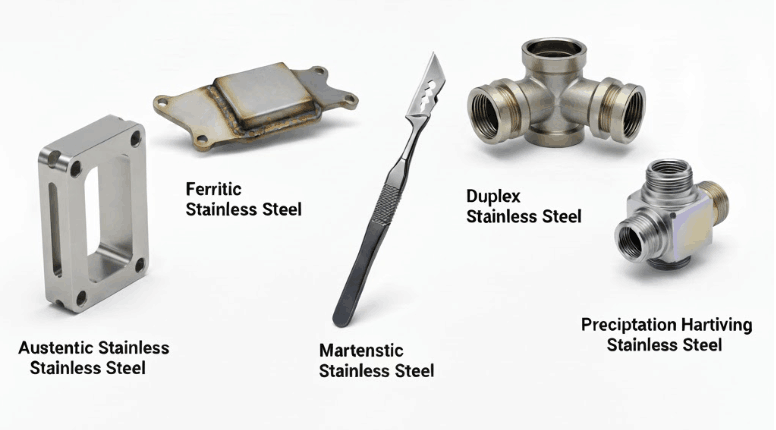

Many engineers face constant headaches when choosing the right material stainless steel for performance-critical parts. Selecting the wrong alloy leads to corrosion, cracking, high scrap rates, and unexpected CNC machining delays. These issues grow worse when a design demands tight tolerances, cosmetic finishes, or long-term durability.
This guide gives you a practical understanding of stainless steel material, and the five core types of stainless steel used across modern manufacturing. You will learn how each stainless steel alloy behaves, how the classes of stainless steel differ. After reading, you will confidently select the best alloy for your parts and avoid costly material mistakes.
There are five main types of stainless steel used in industry: Austenitic Stainless Steel, Ferritic Stainless Steel, Martensitic Stainless Steel, Duplex Stainless Steel, and Precipitation Hardening Stainless Steel. These five groups cover all common stainless steel grades, stainless alloys, and ss material types you will encounter in CNC machining and manufacturing.
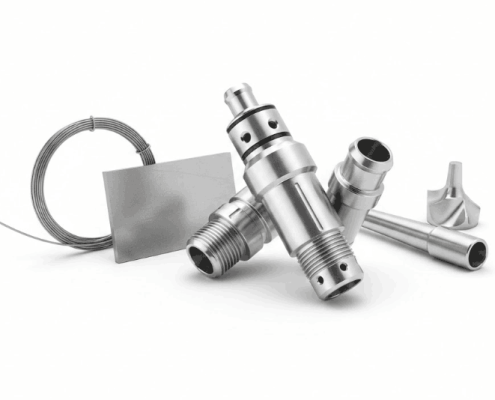
Austenitic Stainless Steel is the most widely used type among all stainless steel types. It features high corrosion resistance, excellent ductility, and stable performance during CNC machining. Its stainless steel composition of chromium and nickel allows for smooth cutting, precise tolerances, and clean surface finishes. These qualities make it ideal for medical, food, marine, optical, and high-precision industrial applications.
Austenitic stainless steel includes many stainless steel grades, each designed for specific corrosion resistance, weldability, and temperature requirements. The table below shows the most common common stainless steel alloys for reference.
| Grade | Key Features | Typical Uses |
| 301 / 301L | High strength after cold work, good fatigue resistance | Springs, clips, structural brackets |
| 302 | Similar to 304 but higher strength | Fasteners, washers, industrial connectors |
| 303 | Best machinability due to added sulfur | Screws, bushings, fittings, mass-production parts |
| 304 / 304L | Most common stainless steel alloy, strong corrosion resistance | Consumer housings, kitchen equipment, general structures |
| 305 | Very good cold formability | Deep-drawn shells, containers, enclosures |
| 309 | Improved high-temperature oxidation resistance | Heat shields, oven parts, thermal assemblies |
| 310 / 310S | High Cr-Ni, excellent heat resistance | Furnace parts, burners, high-temperature brackets |
| 316 / 316L | Molybdenum improves chloride resistance | Marine hardware, chemical processing, medical devices |
| 317 / 317L | Higher Mo, stronger pitting resistance | Pumps, valves, offshore systems |
| 321 | Titanium-stabilized for weld durability | Exhaust manifolds, welded thermal structures |
| 347 / 347H | Niobium-stabilized for high-temp strength | Aerospace manifolds, refinery components |
| 904L | Super austenitic, very high Ni and Mo | Acid-resistant parts, luxury hardware, process equipment |
| 254SMO | Extreme pitting and seawater resistance | Desalination, seawater cooling systems, offshore engineering |
Below is a detailed overview of the key characteristics for the most common Austenitic Stainless Steel Grades, including mechanical, thermal, and chemical properties relevant for CNC machining and industrial applications.
| Grade | Tensile Strength | Hardness (HRB) | Maximum Use Temp | Melting Point | Density (g/cm³) | Corrosion Resistance |
| 301 / 301L | 515 MPa | 70 | 871 °C | 1399–1421 °C | 7.9 | Excellent general corrosion, good oxidation resistance |
| 302 | 585 MPa | 75 | 870 °C | 1400–1420 °C | 7.9 | Excellent corrosion resistance |
| 303 | 515 MPa | 75 | 870 °C | 1400–1420 °C | 7.9 | Good corrosion, best machinability |
| 304 / 304L | 520–720 MPa | 70–80 | 870 °C | 1398–1440 °C | 8.0 | Excellent corrosion and oxidation resistance |
| 305 | 485 MPa | 70 | 870 °C | 1400–1420 °C | 7.9 | Good corrosion, very ductile |
| 309 | 515 MPa | 75 | 980 °C | 1400–1450 °C | 8.0 | Excellent high-temperature oxidation resistance |
| 310 / 310S | 515–620 MPa | 75 | 1050 °C | 1400–1450 °C | 8.0 | High temperature corrosion resistance |
| 316 / 316L | 515–690 MPa | 75–80 | 870 °C | 1398–1424 °C | 8.0 | Excellent resistance to chlorides |
| 317 / 317L | 620–700 MPa | 75–80 | 870 °C | 1400–1425 °C | 8.0 | Superior pitting resistance |
| 321 | 515 MPa | 75 | 900 °C | 1400–1450 °C | 8.0 | High temp corrosion resistance, weldable |
| 347 / 347H | 515–620 MPa | 75–80 | 900 °C | 1400–1450 °C | 8.0 | Excellent weld corrosion resistance |
| 904L | 620–760 MPa | 80 | 925 °C | 1398–1450 °C | 8.0 | Super austenitic, strong acid resistance |
| 254SMO | 620–760 MPa | 80 | 925 °C | 1398–1450 °C | 8.0 | Extremely high pitting & crevice resistance |
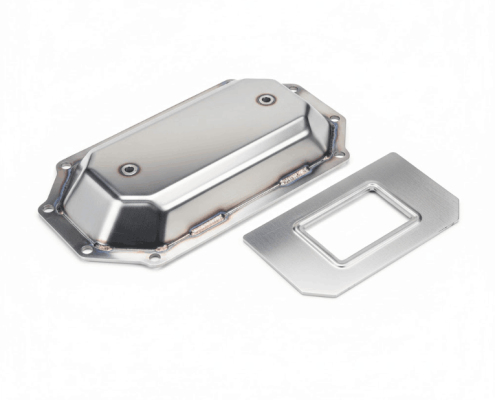
Ferritic Stainless Steel is a chromium-rich stainless steel alloy with low carbon content. Unlike austenitic types, ferritic steels are magnetic, offer moderate corrosion resistance, and resist stress corrosion cracking. They are dimensionally stable during CNC machining and easier to cut and grind than austenitic steels, making them suitable for automotive panels, kitchen equipment, and industrial components.
Ferritic stainless steels include many stainless steel grades, each optimized for corrosion resistance, weldability, or high-temperature performance. Engineers can select the exact grade depending on the application. Below is an expanded list of commonly used ferritic grades:
| Grade | Key Features | Typical Uses |
| 409 | Good corrosion resistance, mainly automotive exhaust, weldable | Automotive exhaust systems, mufflers, catalytic converter housings |
| 430 | Excellent corrosion resistance in mild environments, magnetic | Kitchen equipment, decorative panels, automotive trim |
| 434 | Improved corrosion resistance, good formability | Industrial panels, HVAC components |
| 436 | High chromium for superior oxidation resistance | High-temp furnace components, heat exchangers |
| 439 | Superior stress corrosion cracking resistance, weldable | Automotive exhaust, chemical processing equipment |
| 444 | High corrosion resistance, good weldability, dimensional stability | Chemical tanks, heat exchangers, piping systems |
| 446 | High temperature oxidation resistance, some chemical resistance | Furnace parts, high-temp ducting |
| 445 | Extra high chromium for harsh chemical environments | Aggressive chemical environments, offshore structures |
| 451 | Good scaling resistance at high temperatures, magnetic | Heat-resistant panels, industrial ovens |
| 409L | Low carbon version of 409, better weld performance | Automotive welded components, exhaust assemblies |
| 439L | Low carbon version of 439, improved weldability | Chemical tanks, welded piping, marine components |
Below is a detailed overview of key mechanical, thermal, and chemical characteristics for the most common Ferritic Stainless Steel Grades. These properties are important for CNC machining, fabrication, and industrial applications.
| Grade | Tensile Strength | Hardness (HRB) | Maximum Use Temp | Melting Point | Density (g/cm³) | Corrosion Resistance |
| 409 | 450 MPa | 60 | 815 °C | 1425–1440 °C | 7.7 | Good general corrosion, weldable |
| 430 | 505 MPa | 65 | 815 °C | 1425–1440 °C | 7.7 | Excellent corrosion resistance in mild environments |
| 434 | 520 MPa | 65 | 815 °C | 1425–1440 °C | 7.7 | Improved corrosion resistance, good formability |
| 436 | 530 MPa | 65 | 830 °C | 1425–1445 °C | 7.8 | High chromium, good oxidation resistance |
| 439 | 520 MPa | 65 | 815 °C | 1425–1440 °C | 7.7 | Superior stress corrosion cracking resistance |
| 444 | 550 MPa | 68 | 870 °C | 1420–1450 °C | 7.8 | High corrosion resistance, weldable, dimensionally stable |
| 446 | 620 MPa | 70 | 870 °C | 1420–1450 °C | 7.8 | High temperature oxidation resistance |
| 445 | 630 MPa | 70 | 870 °C | 1420–1450 °C | 7.8 | Extra high chromium for harsh chemical environments |
| 451 | 515 MPa | 65 | 880 °C | 1425–1450 °C | 7.8 | Good scaling resistance at high temperatures |
| 409L | 440 MPa | 60 | 815 °C | 1425–1440 °C | 7.7 | Low carbon, excellent weldability |
| 439L | 520 MPa | 65 | 815 °C | 1425–1440 °C | 7.7 | Low carbon, improved weldability, corrosion resistant |
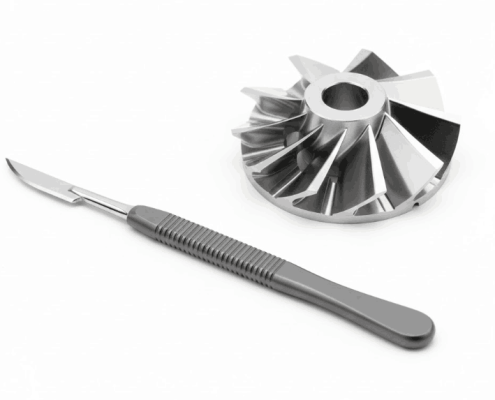
Martensitic Stainless Steel is a stainless steel alloy with higher carbon content compared to ferritic types. It is magnetic, can be hardened by heat treatment, and offers high strength and moderate corrosion resistance. These properties make it suitable for cutting tools, valves, turbine components, and wear-resistant parts.
The most commonly used Martensitic Stainless Steel Grades include:
| Grade | Key Features | Typical Uses |
| 410 | Moderate corrosion resistance, hardenable, magnetic | Cutlery, valves, pump shafts |
| 410S | Low carbon version of 410, better weldability | Industrial blades, moderate corrosion components |
| 420 | High carbon, good wear resistance, magnetic | Surgical instruments, knives, cutting tools |
| 420F | Free-machining version of 420 | Precision CNC components, blades |
| 431 | High strength, hardenable, good corrosion resistance | Aerospace fasteners, shafts, automotive parts |
| 440A | Good corrosion resistance, moderate hardness | Knives, industrial tools |
| 440B | Higher carbon than 440A, better wear resistance | Precision blades, industrial cutting tools |
| 440C | Maximum hardness, wear-resistant, magnetic | High-end knives, precision bearings, shafts |
| 630 / 17-4PH | Precipitation hardening capable, high strength, corrosion resistant | Aerospace fittings, pump shafts, valve components |
| 630F | Free-machining version of 17-4PH | Precision CNC fasteners, machined components |
| 431L | Low carbon version of 431, improved weldability | Shafts, fasteners, precision machined parts |
| 440F | Free-machining version of 440 | CNC cutting tools, precision components |
The following table highlights the key mechanical, thermal, and chemical properties of the most common Martensitic stainless steel grades. Understanding these characteristics helps engineers and CNC machinists select the right grade for strength, hardness, and corrosion requirements.
| Grade | Tensile Strength | Hardness (HRC) | Maximum Use Temp | Melting Point | Density (g/cm³) | Corrosion Resistance |
| 410 | 480 MPa | 50 HRC | 870 °C | 1425–1440 °C | 7.7 | Moderate corrosion resistance, magnetic |
| 410S | 450 MPa | 48 HRC | 870 °C | 1425–1440 °C | 7.7 | Improved weldability, moderate corrosion |
| 420 | 700 MPa | 55–60 HRC | 815 °C | 1425–1450 °C | 7.8 | Good corrosion, excellent wear resistance |
| 420F | 680 MPa | 52–57 HRC | 815 °C | 1425–1450 °C | 7.8 | Free-machining, wear-resistant |
| 431 | 850 MPa | 55–60 HRC | 870 °C | 1425–1450 °C | 7.8 | High strength, good corrosion resistance |
| 431L | 830 MPa | 53–58 HRC | 870 °C | 1425–1450 °C | 7.8 | Low carbon, better weldability |
| 440A | 760 MPa | 57 HRC | 815 °C | 1425–1450 °C | 7.8 | Moderate corrosion resistance, good wear |
| 440B | 820 MPa | 58–60 HRC | 815 °C | 1425–1450 °C | 7.8 | Higher wear resistance than 440A |
| 440C | 900 MPa | 60–65 HRC | 815 °C | 1425–1450 °C | 7.8 | Maximum hardness and wear resistance |
| 440F | 880 MPa | 58–63 HRC | 815 °C | 1425–1450 °C | 7.8 | Free-machining, wear-resistant |
| 630 / 17-4PH | 1000 MPa | 40–45 HRC | 315 °C | 1400–1450 °C | 7.8 | High strength, corrosion resistant, precipitation hardenable |
| 630F | 980 MPa | 38–43 HRC | 315 °C | 1400–1450 °C | 7.8 | Free-machining 17-4PH, corrosion resistant |
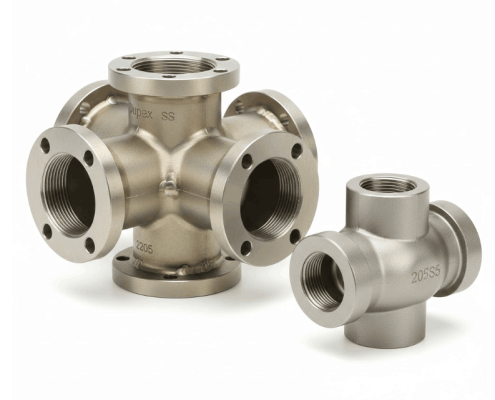
Duplex Stainless Steel combines the austenitic and ferritic microstructures, offering a balanced mix of high strength and excellent corrosion resistance. It is partially magnetic, resistant to stress corrosion cracking, and ideal for chemical processing, marine, and offshore applications.
The most commonly used Duplex Stainless Steel Grades include:
| Grade | Key Features | Typical Uses |
| 2205 | Balanced austenitic-ferritic, high strength, excellent corrosion resistance | Chemical tanks, piping, heat exchangers, marine structures |
| 2507 / Super Duplex | Very high chromium and molybdenum, superior pitting and crevice corrosion resistance | Offshore platforms, seawater equipment, aggressive chemical processing |
| 2304 | Good corrosion resistance, moderate strength | Pressure vessels, structural components |
| 2001 | Cost-effective lean duplex, good corrosion and strength | Industrial piping, tanks, general marine applications |
| 2101 | Lean duplex, moderate corrosion resistance, high strength | Automotive exhaust, general structural applications |
| 2201 | Balanced strength and corrosion resistance | Piping, welded assemblies in chemical plants |
The following table presents the key mechanical, thermal, and chemical properties of common Duplex stainless steel grades.
| Grade | Tensile Strength | Hardness (HRB) | Maximum Use Temp | Melting Point | Density (g/cm³) | Corrosion Resistance |
| 2205 | 620 MPa | 32 HRB | 300 °C | 1390–1430 °C | 7.8 | Excellent chloride and stress corrosion resistance |
| 2507 / Super Duplex | 850 MPa | 35 HRB | 300 °C | 1390–1430 °C | 7.9 | Superior pitting and crevice corrosion resistance |
| 2304 | 600 MPa | 30 HRB | 300 °C | 1385–1425 °C | 7.8 | Good general corrosion resistance |
| 2001 | 580 MPa | 30 HRB | 300 °C | 1385–1425 °C | 7.8 | Cost-effective, moderate corrosion resistance |
| 2101 | 600 MPa | 32 HRB | 300 °C | 1385–1425 °C | 7.8 | Lean duplex, moderate corrosion resistance |
| 2201 | 620 MPa | 33 HRB | 300 °C | 1390–1430 °C | 7.8 | Balanced strength and corrosion resistance |
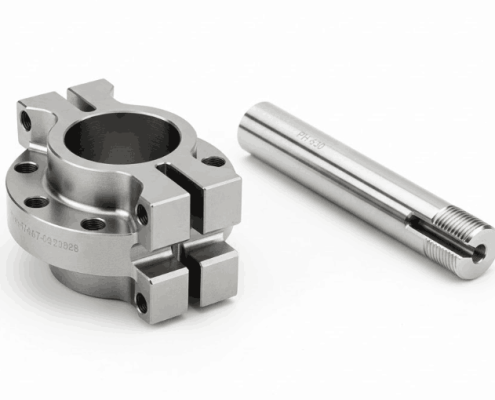
Precipitation Hardening Stainless Steel is a high-strength stainless steel alloy that gains exceptional hardness through precipitation heat treatment. It combines corrosion resistance with mechanical performance, making it ideal for aerospace, automotive, and high-precision CNC components.
The most commonly used PH stainless steel grades include:
| Grade | Key Features | Typical Uses |
| 17-4PH / 630 | High strength, corrosion resistant, precipitation hardenable | Aerospace fittings, pump shafts, valves, precision CNC components |
| 15-5PH / 651 | Excellent toughness and corrosion resistance | Aerospace fasteners, structural components, CNC machined parts |
| 13-8PH | High strength and hardness, moderate corrosion resistance | Aircraft landing gear, shafts, high-strength fasteners |
| 17-7PH | Good corrosion resistance, excellent fatigue strength | Springs, aerospace components, CNC precision parts |
| 17-4PH F | Free-machining version of 17-4PH | Precision fasteners, machined components |
The following table presents the mechanical, thermal, and chemical properties of common PH stainless steel grades.
| Grade | Tensile Strength | Hardness (HRC) | Maximum Use Temp | Melting Point | Density (g/cm³) | Corrosion Resistance |
| 17-4PH / 630 | 1000 MPa | 40–45 HRC | 315 °C | 1400–1450 °C | 7.8 | High strength, corrosion resistant, precipitation hardenable |
| 15-5PH / 651 | 1100 MPa | 42–46 HRC | 315 °C | 1400–1450 °C | 7.8 | Excellent toughness, corrosion resistant |
| 13-8PH | 1200 MPa | 44–48 HRC | 300 °C | 1400–1450 °C | 7.8 | High strength, moderate corrosion resistance |
| 17-7PH | 950 MPa | 38–42 HRC | 315 °C | 1400–1450 °C | 7.8 | Good corrosion resistance, excellent fatigue strength |
| 17-4PH F | 980 MPa | 38–43 HRC | 315 °C | 1400–1450 °C | 7.8 | Free-machining version, corrosion resistant |
All the stainless steel grades discussed earlier—including Austenitic, Ferritic, Martensitic, Duplex, and PH types—are based on AISI / ASTM standards. When sourcing or specifying materials internationally, engineers often need to cross-reference these grades with other national standards to ensure correct selection for CNC machining or industrial applications.
The table below shows common international standards and how they compare to the American Iron and Steel Institute (AISI) names:
| Standard | Example | Notes |
| European Standard (EN) | 1.4301 | Stainless steel names are identified numerically starting with 1.4, followed by three digits denoting the composition |
| Japanese International Standard (JIS) | SUS304 | Japan uses the AISI standard but adds the SUS prefix |
| British Standard (BS) | BS 970 | Britain has adopted the AISI standard as well |
| Chinese National Standard (GB) | — | Depends on the steel source and its composition |
| German Standard (DIN) | DIN X12CrNi17-7 | Governed by DIN17006, X indicates alloying elements content over 5% |
| International Organization for Standardization (ISO) | ISO15510 | ISO has adopted Germany’s DIN standard |
A client in the medical equipment industry in Germany required Austenitic stainless steel 304L parts with extremely tight tolerances and high-quality surface finishes. They had faced repeated issues with part failures, tool wear, and delayed delivery when working with standard suppliers.
VMT addressed these challenges by:
Over 500 precision parts were produced with consistent surface quality, dimensional accuracy, and corrosion resistance. The client reported significant improvements in assembly efficiency and product reliability, demonstrating how VMT transforms common stainless steel alloys into high-precision, high-performance components. If you need similar results for your CNC machined stainless steel parts, contact VMT to discuss your project and get expert guidance from material selection to final finishing.
Understanding the different types of stainless steel—Austenitic, Ferritic, Martensitic, Duplex, and Precipitation Hardening—is essential for selecting the right stainless steel grades. Each type has distinct stainless steel composition, mechanical properties, and corrosion resistance, which affect CNC machinability and application suitability. Comparing international equivalents ensures correct material selection across global standards.
 WhatsApp/WeChat/Mobile:
+86-15099911516
WhatsApp/WeChat/Mobile:
+86-15099911516
 Tel: 86-150-9991-1516
 QQ: 939020977
 E-Mail: service@vimetal.com.cn


How to get Types of stainless steel grades chart?
You can get a detailed stainless steel grades chart from VMT, which covers Austenitic, Ferritic, Martensitic, Duplex, and PH types. The chart includes properties, applications, and machinability guidance. Contact VMT to receive the full chart and expert advice for selecting the right stainless steel material for your project.
What is the cheapest stainless steel grade?
Among common stainless steels, Austenitic 304 / 304L and Ferritic 430 are usually the most cost-effective options. They offer decent corrosion resistance and good machinability, making them suitable for general industrial, automotive, and consumer applications without a high material cost.
What is the best quality of stainless steel?
The “best quality” depends on application requirements. Duplex 2507, 2205, and PH 17-4PH grades excel in corrosion resistance, strength, and durability. These stainless steel alloys perform well in harsh chemical, marine, and high-precision CNC applications where long-term reliability is critical.


 What is 304H stainless steel:The Ultimate Guide