4 Plastic Prototyping Ways: CNC, 3D Printing, Injection Molding, Vacuum Casting
By Luca Xie | Oct 31, 2025
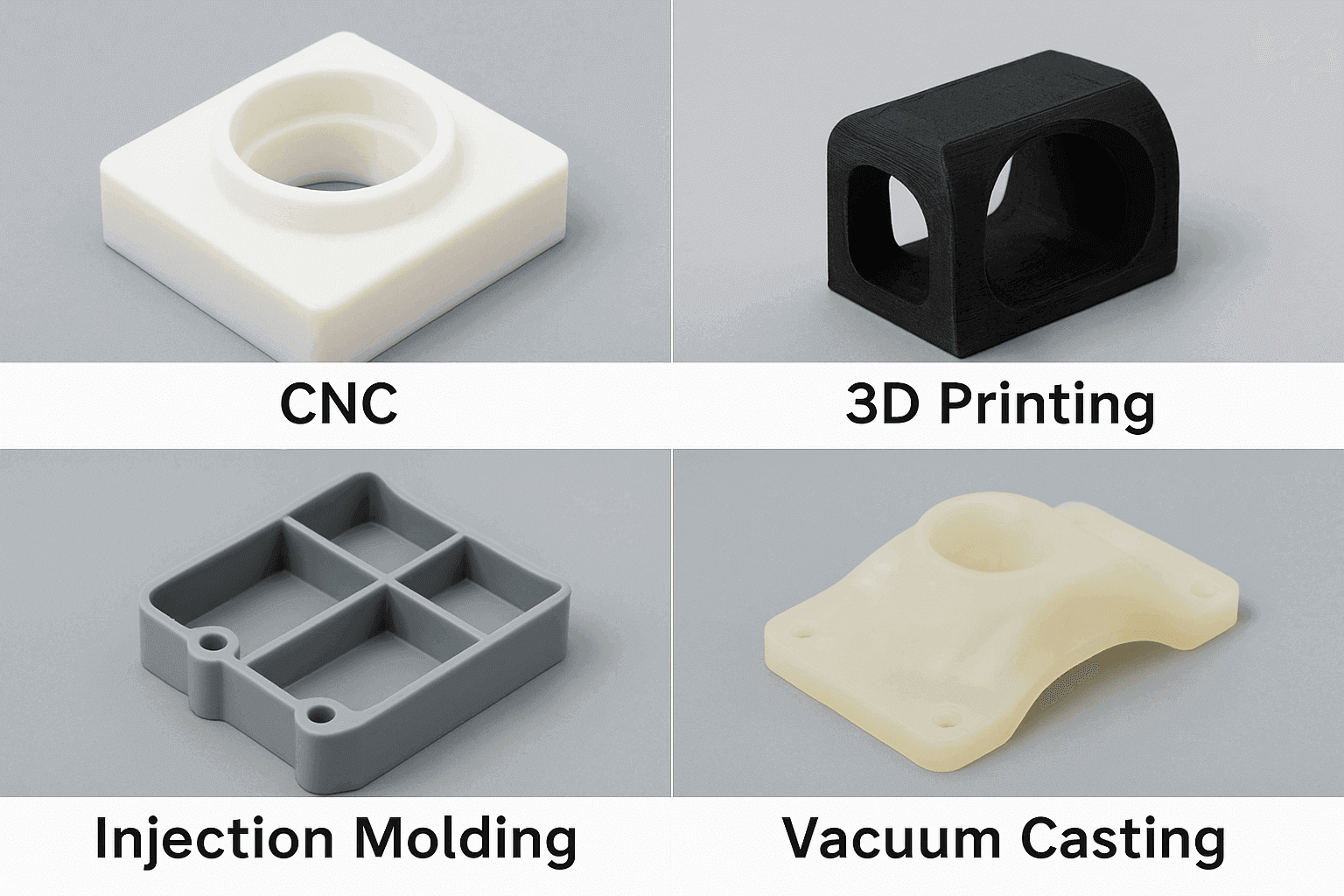

Choosing the right method for prototype plastic can be confusing. Using the wrong approach wastes time, increases costs, and affects your prototype parts quality. Explore CNC, 3D Printing, Injection Molding, and Vacuum Casting for effective rapid prototypes.
This guide explores 4 Plastic Prototyping Ways, including CNC machining,3D Printing, injection molding, and vacuum machining. Learn how each method differs in cost, precision, and speed to create accurate prototype plastic parts. Discover which process best fits your project needs for rapid prototyping and small-batch production with high-quality surface finishes.
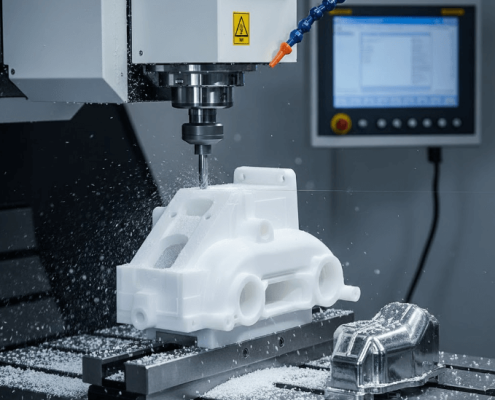
CNC is a computer-controlled machining process that precisely removes material from plastic blocks to create highly accurate prototype plastic parts. This method ensures extremely tight tolerances, consistent dimensions, and smooth surface finish, making it ideal for automotive, medical equipment, and electronics components.
Start with a detailed CAD model and select a suitable plastic such as ABS, POM, PC, or nylon. Generate precise tool paths, set the cutting parameters, and perform roughing and finishing passes. Multi-axis CNC machines allow complex geometries to be machined efficiently. After machining, parts may undergo polishing or coating to meet visual or functional requirements, producing reliable rapid prototypes.
CNC machining provides exceptional precision and extremely tight tolerances, ensuring that functional prototype parts perform exactly as designed. It delivers smooth, high-quality surface finishes suitable for both detailed visual inspection and rigorous functional testing. CNC also accommodates a wide range of materials, including engineering plastics like ABS, POM, PC, and specialty polymers, giving designers flexibility to choose the right material for each application. Additionally, the process guarantees stable quality and repeatability, which is especially valuable when producing small-batch rapid prototypes that must consistently meet specifications.
On the downside, CNC machining can be moderately to highly expensive, particularly when dealing with complex or multi-axis parts. Production speed can be slower for intricate geometries, and some designs may require multiple setups or tool changes, which further increases lead time and labor requirements. Complex shapes often need additional finishing or polishing to achieve the desired surface quality or functional performance, adding extra steps to the manufacturing process. These factors should be carefully considered when planning prototypes or small-batch production runs.
You should choose CNC when you need small-batch prototype parts with extremely high precision and tight tolerances, such as components for medical devices, automotive parts, or electronic housings. It is ideal when the surface finish must be smooth and consistent. CNC is best suited for functional testing, validating mechanical performance, or producing parts that will undergo stress or load. It also works well when you need rapid prototypes with engineering-grade plastics and repeatable quality.
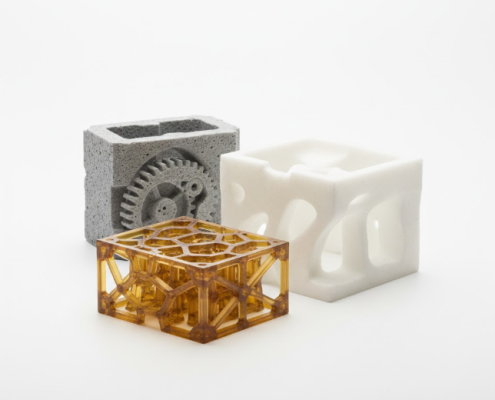
3D Printing is an additive manufacturing process that builds prototype plastic parts layer by layer from CAD models. Technologies like SLA, FDM, and SLS allow production of complex geometries without extensive tooling, enabling fast rapid prototypes.
Prepare a CAD model, select the 3D printing technology, and choose an appropriate material. SLA resins provide smooth surfaces, FDM filaments like PLA or ABS are cost-effective, and SLS nylon delivers durable functional parts. Post-processing such as sanding, support removal, or coating enhances surface finish and durability.
3D printing enables fast production, making it ideal for rapid iteration of prototype parts. It offers flexible material options, from cost-effective FDM filaments like PLA and ABS to smooth-surface SLA resins and durable SLS nylon, supporting both visual and functional testing. The technology can produce complex or hollow geometries that are impossible with traditional methods, providing designers with unmatched creative freedom. Additionally, 3D printing has low setup costs, making it highly suitable for low-volume rapid prototyping and early-stage design validation.
However, 3D printing generally provides lower precision compared to CNC machining or injection molding, which can be a limitation for tight-tolerance parts. Surface finish is often moderate, requiring post-processing such as sanding, support removal, or coating to meet aesthetic or functional requirements. Material strength is also limited, making it less suitable for functional, load-bearing components. Finally, while small parts can be produced quickly, production time increases significantly for larger batches, which can reduce efficiency for higher-volume prototyping.
Choose 3D Printing for low-volume rapid prototypes, early-stage design validation, and when complex geometries or fast iteration are required. It is particularly useful for lightweight structures, concept models, or parts with intricate internal features. 3D Printing is ideal when you want to experiment with different material options and test multiple design iterations quickly.
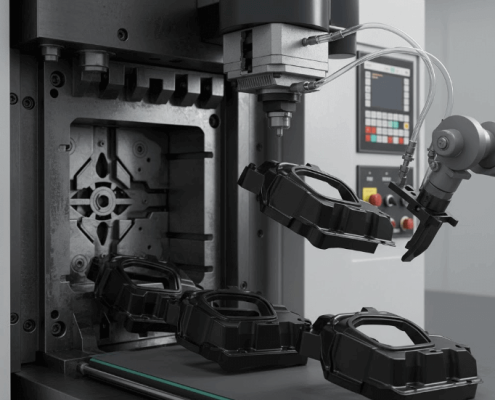
Injection Molding involves injecting molten plastic into a mold to produce prototype plastic parts. It provides consistent dimensions, high-quality surface finish, and excellent repeatability, making it suitable for mid-volume prototypes and pre-production validation.
Design and fabricate a mold from your CAD model. Heat the selected plastic until molten, inject it under high pressure, and allow it to cool. Remove the part and perform any finishing needed. Materials commonly used include ABS, PC, PP, and engineering-grade polymers. This produces consistent rapid prototypes with high dimensional accuracy.
Injection molding offers high production speed, making it suitable for mid-volume prototype parts. It delivers excellent precision and repeatability, ensuring functional testing is accurate and reliable. The process provides superior surface finish, capturing intricate details and complex geometries with ease. Additionally, injection molding supports a wide range of materials, including engineering plastics, allowing prototypes to meet both functional and aesthetic requirements.
On the downside, injection molding involves high upfront costs for mold fabrication, and designing and producing the mold requires a longer lead time. It is not economical for very small batches due to these tooling expenses. Once a mold is created, flexibility for design changes is limited, making it less suitable for iterative prototyping or projects that require frequent modifications.
Choose Injection Molding when you need mid-volume prototype parts with high precision and consistent quality. It is ideal for pre-production testing, functional assembly evaluation, and performance testing of end-use components. Injection Molding is suitable when you want to replicate final production conditions, test part assembly, or validate parts under actual operating stresses. It works best when batch size justifies mold investment and timeline allows for mold fabrication.
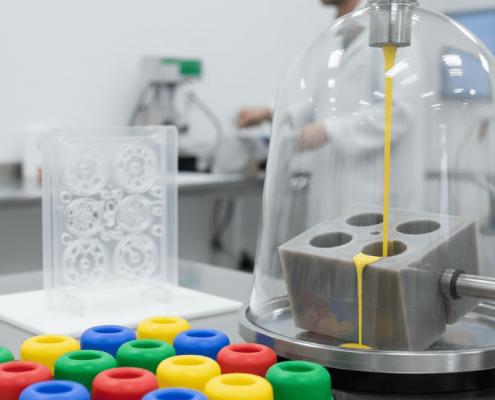
Vacuum Casting uses a master pattern to create a silicone mold, into which liquid plastic is poured under vacuum to form prototype plastic parts. This method produces high-detail parts with excellent surface finish and allows color and texture variations.
Start with a master model, create a silicone mold, and pour polyurethane or epoxy plastics under vacuum. After curing, remove the parts and perform surface finishing as needed. This produces medium-volume rapid prototypes suitable for both functional and visual evaluation.
Vacuum casting provides high precision, making it suitable for both functional and visual prototype parts. It delivers an excellent surface finish that closely mimics production-quality components. The process supports flexible material options, including colored, textured, or transparent plastics, and is efficient for small- to mid-volume batches while maintaining repeatable quality.
However, vacuum casting involves moderate costs due to mold preparation and specialized materials. Mechanical strength and heat resistance are limited compared to injection-molded or CNC parts, and mold durability restricts the maximum batch size. Additionally, careful handling is required to avoid defects such as air bubbles, which can compromise part quality.
Choose Vacuum Casting for small- to mid-volume prototype parts that need realistic appearance and surface finish. It is ideal for visual models, functional testing, or presentation samples where you require multiple copies with consistent quality. Vacuum Casting works well when testing different material options, simulating production plastics, or producing rapid prototypes for client demonstrations or market feedback.
The following table summarizes key aspects of CNC, 3D Printing, Injection Molding, and Vacuum Casting. It compares Cost, Speed, Precision, Surface Finish, and Material Options, helping you quickly identify which method suits your prototype plastic project best. Each method offers different advantages depending on your batch size, required accuracy, and visual or functional needs.
| Method | Cost | Speed | Precision | Surface Finish | Material Options |
| CNC | Moderate-High | Moderate | Excellent | Excellent | Wide range including ABS, POM, PC, Nylon |
| 3D Printing | Low | Fast | Moderate | Moderate | PLA, ABS, Nylon, SLA resins, SLS powders |
| Injection Molding | High upfront | High | Excellent | Excellent | ABS, PC, PP, Engineering plastics |
| Vacuum Casting | Moderate | Moderate | High | Excellent | Polyurethane, Epoxy, Colored/Transparent |
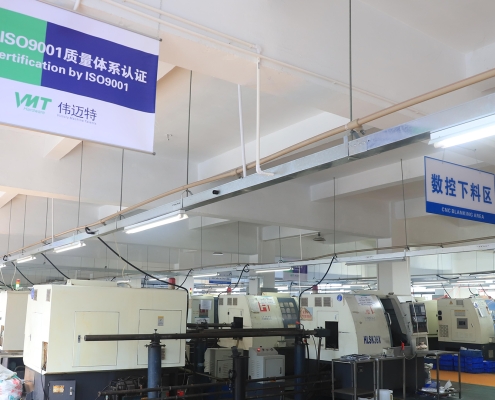
At VMT, you can start your prototype plastic project with confidence. We provide rapid prototyping services using CNC, 3D Printing, Injection Molding, and Vacuum Casting. Offering free design support, professional surface treatment, and ISO/IATF certifications guarantee quality and efficiency for every project.Contact us now to discuss your next CNC Machining Project.
Choosing the right method for prototype plastic depends on your project needs. CNC is ideal for small-batch, high-precision functional prototype parts. 3D Printing allows fast iteration and complex geometries for early-stage testing. Injection Molding provides consistent quality and excellent surface finish for mid-volume prototype parts, while Vacuum Casting is perfect for realistic visual models and small- to mid-volume functional testing. Consider precision, speed, cost, surface finish, and material options to select the best method for your rapid prototypes.
How does part size affect the choice of plastic prototyping method?
Larger parts are often more economical with Vacuum Casting or CNC machining, while 3D Printing is best suited for smaller or highly detailed designs. Injection Molding becomes more practical when the part size is standardized for future mass production.
How do I estimate the cost before starting rapid prototyping services?
The cost depends on three key factors: design complexity, material type, and production volume. Requesting a quote with 3D CAD files allows the manufacturer to quickly calculate machining time, material usage, and finishing requirements—ensuring accurate cost forecasting.
Can prototype plastic parts be assembled or tested like final production parts?
Absolutely. With high-quality rapid prototyping services, your parts can be assembled, mechanically tested, or even field-tested under real conditions. This helps validate function, fit, and durability before moving into mass production.

 ABS vs PLA vs PETG: Comparison and Star Rating