316 vs 316L Stainless Steel: Which Is Better
By Luca Xie | Nov 25, 2025
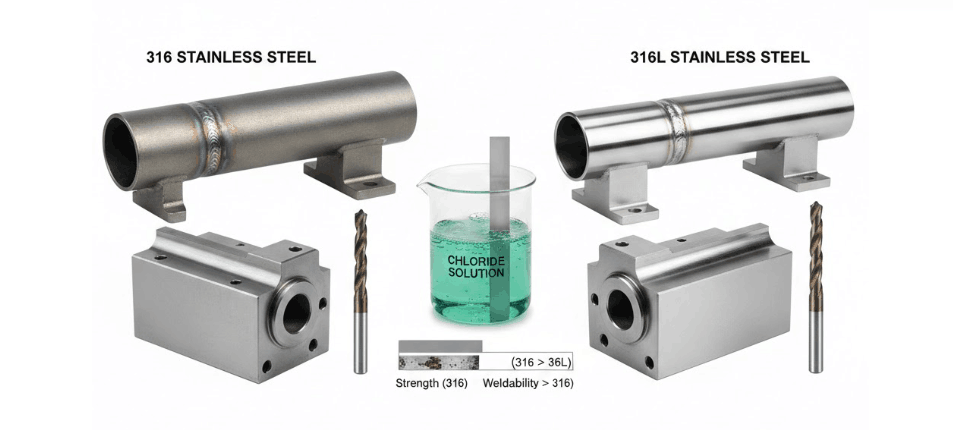

Confused about 316 vs 316L Stainless Steel? Choosing the wrong alloy can lead to corrosion, welding failures, or machining errors that compromise precision. Selecting the proper steel ensures smooth machining, reliable parts, and long-lasting performance. This guide explains key differences to help you make the right choice.
316 vs 316L Stainless Steel compares composition, chemical, mechanical, and physical properties, fabrication performance, applications, price, and standards. It helps you choose the right alloy for CNC machining and high-precision parts.
316 stainless steel is an austenitic alloy containing chromium, nickel, and molybdenum. It offers good corrosion resistance and general machining performance.
316L stainless steel is the low-carbon version of 316. The reduced carbon improves weldability and prevents carbide formation during welding.

316 stainless steel contains chromium, nickel, molybdenum, and small amounts of carbon, manganese, silicon, phosphorus, and sulfur. Its higher carbon content increases alloy strength but also encourages carbide precipitation during welding. These elements improve corrosion resistance and increase durability for general machining.

316L stainless steel also contains chromium, nickel, molybdenum, and small amounts of manganese, silicon, phosphorus, and sulfur, but it has much lower carbon than 316. The reduced carbon stops carbide precipitation during welding and preserves corrosion resistance in high-temperature or welded components. This makes 316L vs 316 a strong choice for welded parts and high-precision CNC.
| Alloy | Carbon | Chromium | Nickel | Molybdenum | Manganese | Silicon | Phosphorus | Sulfur |
| 316 | 0.08 | 16–18 | 10–14 | 2–3 | 2 | 1 | 0.045 | 0.03 |
| 316L | 0.03 | 16–18 | 10–14 | 2–3 | 2 | 1 | 0.045 | 0.03 |
316 stainless steel contains higher carbon. It resists corrosion in chloride-rich and moist environments. The alloy tolerates moderate acids and alkalis. It maintains oxidation resistance up to 870°F. These properties allow parts to last longer in industrial and marine CNC applications. Engineers use 316 for general components where moderate chemical exposure occurs, ensuring durability without specialized welding precautions.
316L stainless steel has lower carbon, which reduces carbide formation during welding. It provides better corrosion resistance and slightly improved acid and alkali tolerance. Oxidation resistance remains stable up to 870°F. These characteristics make 316L vs 316 ideal for welded parts, chemical equipment, and high-precision CNC components. Engineers can form complex shapes without cracking and maintain long-term performance in harsh environments.
| Property | 316 | 316L |
| Carbon Content | 0.08 | 0.03 |
| Corrosion Resistance | Good | Better |
| Oxidation Resistance | Up to 870°F | Up to 870°F |
| Acid Resistance | Moderate | Slightly Better |
| Alkali Resistance | Moderate | Slightly Better |
316 stainless steel has a 0.2% proof stress of 290 MPa and a tensile strength of 580 MPa. Elongation reaches 40 percent. Hardness measures 79 on the Rockwell B scale and 217 on the Brinell scale. These properties provide good strength and flexibility for CNC machining. Parts maintain shape under moderate loads and resist deformation during bending or forming. This makes 316 suitable for structural components and general CNC parts where both strength and machinability matter.
316L stainless steel has a 0.2% proof stress of 240 MPa and a tensile strength of 500 MPa. Elongation reaches 50 percent. Hardness measures 70 on the Rockwell B scale and 197 on the Brinell scale. Lower carbon content improves weldability and increases ductility. The higher elongation allows more complex shapes in CNC machining. Engineers prefer 316L vs 316 for high-precision components and welded parts requiring precise forming.
| Property | 316 | 316L |
| 0.2% Proof Stress (MPa) | 290 | 240 |
| Tensile Strength (MPa) | 580 | 500 |
| Elongation (%) | 40 | 50 |
| Hardness Rockwell B | 79 | 70 |
| Hardness Brinell | 217 | 197 |
316 stainless steel has a density of 8.0 g/cm³ and a melting point around 1375–1400°C. Its thermal conductivity is 16 W/m·K, and electrical resistivity is 0.74 μΩ·m. These properties make parts stable under heat and suitable for CNC machining where temperature control is essential. Engineers rely on 316 for components that must maintain shape and strength under thermal stress.
316L stainless steel shares similar density and melting point with 316. Thermal conductivity is slightly lower at 14–15 W/m·K, and electrical resistivity is 0.74 μΩ·m. Lower carbon content helps maintain mechanical integrity during heat exposure, especially in welded or precision CNC parts. Engineers choose 316L vs 316 when high dimensional stability and reduced warping are critical.
| Property | 316 | 316L |
| Density (g/cm³) | 8.0 | 8.0 |
| Melting Point (°C) | 1375–1400 | 1375–1400 |
| Thermal Conductivity (W/m·K) | 16 | 14–15 |
| Electrical Resistivity (μΩ·m) | 0.74 | 0.74 |
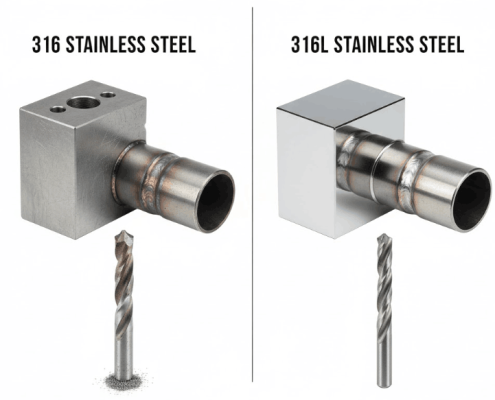
316 stainless steel has good machinability and formability, but its higher carbon content can cause more tool wear during CNC machining. Weldability is moderate and needs heat control to avoid carbide buildup. Engineers use 316 for parts where machining requirements are not extreme and welding is limited. Surface finishes are stable, but cosmetic surfaces may need additional polishing.
316L stainless steel offers better weldability due to lower carbon, which reduces carbide formation. Machinability is slightly easier, and it can be formed into complex shapes without cracking. Its stable structure also helps reduce rework and scrap rates in CNC machining, improving production efficiency and consistency.
| Property | 316 | 316L |
| Machinability | Moderate | Slightly Better |
| Weldability | Moderate | Good |
| Formability / Bending | Good | Better |
| Surface Finish | Good | Excellent |
Chemical Processing Equipment:Because 316 offers stable corrosion resistance in chloride-rich environments, it is often selected for valves, flanges, pump housings, and reaction tank components, where reliable sealing and moderate mechanical stress must be maintained without rapid wear.
Marine Hardware:In addition, thanks to its ability to withstand saltwater exposure, 316 is commonly used in propeller shafts, rudder parts, cable clamps, and fasteners, ensuring that these structural or load-bearing components do not suffer early corrosion in offshore conditions.
Food & Beverage Machinery:Since the alloy is easy to clean and resists contamination, components such as conveyor links, sanitary pipe connectors, processing blades, and washdown brackets frequently use 316 to maintain hygiene and equipment reliability.
High-Temperature Components:Moreover, with the ability to operate in elevated temperatures, 316 is chosen for exhaust flanges, furnace fixtures, and heat exchanger mounting brackets, delivering good structural stability even when exposed to thermal cycles.
Engineering Structural Parts:Finally, due to its balance of strength and machinability, machine brackets, automated equipment linkages, support frames, and general fabricated assemblies often use 316 where mechanical load and general machining performance are required.
Pharmaceutical & Bioprocessing Equipment:Because its low-carbon composition minimizes carbide precipitation during welding, 316L is preferred for reactor vessels, sanitary valves, pipeline fittings, and medical-grade housings, where weld cleanliness and process reliability are critical.
Chemical Processing Systems (High Corrosion Conditions):As a result of improved performance in strong acids and alkalis, 316L is widely applied in pump impellers, acid transfer mechanisms, sealing seats, and precision flow control parts, ensuring longer service life under aggressive chemical exposure.
Marine & Offshore Structures:Furthermore, given its enhanced weld integrity, subsea housing structures, welded pipe networks, and high-strength marine fittings benefit from 316L when assembled on site or exposed to continuous seawater immersion.
Food & Dairy Machinery:Since 316L meets both hygiene and weldability needs, it is applied to CIP/SIP fittings, mixer blades, sanitary connectors, and machine supports, helping manufacturers maintain sterilization standards and smooth surface finishing.
Semiconductor & Cleanroom Systems:Finally, because it produces smoother welds and fewer inclusions, 316L is used for high-purity gas manifolds, vacuum chamber parts, and ultra-clean precision fittings, ensuring contamination-free flow paths and minimal particle shedding.
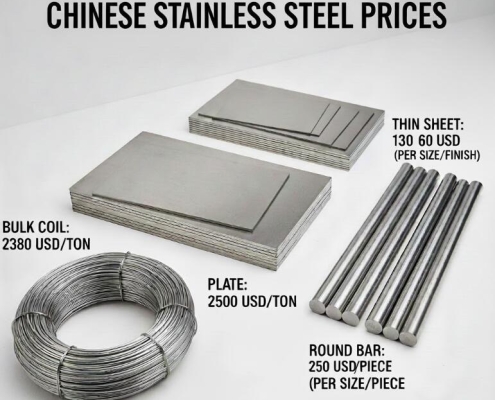
316 and 316L stainless steel usually cost almost the same. Their compositions stay very close, so buyers rarely see a major material price difference. In most markets, suppliers sell bulk coil or plate at 3,000 to 3,800 USD per ton, and both grades fall within this range. Many suppliers also offer dual-certified 316/316L, showing that pricing does not depend on grade selection.
Product form creates more variation than alloy choice. For example, suppliers may price a 316/316L round bar at 300 to 400 USD per piece, while thin 316 sheet may sell at around 18 to 90 USD depending on size and finish. Buyers usually see larger price differences due to stock levels, shipping distance, and machining allowances. CNC factories may pay slightly more for mill-certified, traceable material, but this applies equally to both grades and does not change procurement strategy. Engineers almost never choose between 316 and 316L based on cost alone.
Although initial prices look similar, long-term cost can still differ. 316L performs better during welding because lower carbon reduces carbide formation. Stronger welds reduce inspection rejections, cut rework, and save labor time. In chemical, marine, semiconductor, and pharmaceutical systems, improved weld performance also extends service life, decreases part replacement frequency, and reduces maintenance spending across the full product lifecycle.
316 and 316L stainless steel follow similar international standards. Both are defined under ASTM specifications for chemical composition, mechanical properties, and product form. Engineers can select material under the same document, but grade designation must match project requirements.
Manufacturers rely on these standards to ensure traceability, consistency, and machining predictability. CNC shops can check tensile strength, hardness, elongation, and chemistry before machining. Designers use the UNS code to guarantee compatibility across suppliers and certifications.
| Product Type | 316 ASTM Specification | 316L ASTM Specification | Recommended Latest Revision |
| Pipe | ASTM A312 | ASTM A312 | A312/A312M−24 |
| Tube | ASTM A213 | ASTM A213 | A213/A213M−24 |
| Sheet | ASTM A240 | ASTM A240 | A240/A240M−24 |
| Plate | ASTM A240 | ASTM A240 | A240/A240M−24 |
| Pipe Fittings (Butt Weld) | ASTM A403 | ASTM A403 | A403/A403M−24 |
| Tube Fittings (Machined) | ASTM A276 / A479 | ASTM A276 / A479 | A276−23 / A479−24 |
| Forged Fittings | ASTM A182 | ASTM A182 | A182/A182M−24 |
| Flanges | ASTM A182 | ASTM A182 | A182/A182M−24 |
| Fasteners | ASTM A193 | ASTM A193 | A193/A193M−23 |
| Forging Stock | ASTM A182 | ASTM A182 | A182/A182M−24 |
| Valves | ASTM A351 CF8M | ASTM A351 CF3M | A351/A351M−23 |
| Castings | ASTM A351 CF8M | ASTM A351 CF3M | A351/A351M−23 |
| Round Bar | ASTM A276 / A479 | ASTM A276 / A479 | A276−23 / A479−24 |
Choosing between 316 and 316L stainless steel represents not only a material decision but also a manufacturing and application decision. At VMT, we support customers through material selection, CNC machining feasibility analysis, production planning, and final inspection to ensure that every alloy choice delivers stable performance, manufacturable structures, and controlled production cost.
If your component must operate under higher load, structural stress, or mechanical fatigue, 316 often provides a small but meaningful edge in mechanical strength due to its higher carbon content. We typically recommend 316 when:
1.The part is not welded
2.High structural stiffness or hardness is needed
3.The working environment is corrosive but not continuously chloride-involved
If your product involves welding, polishing, cleanability, aseptic performance, or long-term corrosion exposure, 316L delivers far better stability thanks to its low carbon content. We recommend 316L when:
Welded joints must maintain corrosion resistance
2.The product is used in pharmaceutical, marine, semiconductor, or high-purity chemical systems
3.CNC machining efficiency and surface consistency matter
4.Dimensional accuracy and repeatability are critical
A European chemical equipment manufacturer needed valve bodies and flanges for a chloride-rich environment. They initially chose 316 stainless steel, but welding created failures and surface defects during prototyping. Dimensional inconsistencies also created assembly problems, and work hardening increased tool wear during CNC machining.
VMT engineers analyzed the material and design requirements and recommended switching to 316L to reduce carbide precipitation and improve weldability. Cutting parameters and tool paths were optimized to achieve the required surface finish. CNC machining was controlled to maintain dimensional accuracy within 0.01 mm, and the welded components met chemical exposure and assembly standards without defects.Are you still wondering whether 316 vs 316L is the right choice for your project? Contact us to get a free material selection guidance and quote!
Choosing between 316 vs 316L depends on the part’s function, manufacturing process, and environment. Use 316 when higher mechanical strength or load-bearing capacity is needed without welding. Choose 316L for welded assemblies, high-precision CNC parts, or components exposed to corrosive or chemically sensitive conditions. Understanding material properties, fabrication behavior, and cost ensures the right choice, reduces rework, and improves part reliability.
 WhatsApp/WeChat/Mobile:
+86-15099911516
WhatsApp/WeChat/Mobile:
+86-15099911516
 Tel: 86-150-9991-1516
 QQ: 939020977
 E-Mail: service@vimetal.com.cn


Is 316L stainless steel surgical grade?
Yes. 316L stainless steel is considered surgical grade because it offers excellent corrosion resistance, low carbon content to prevent carbide precipitation, and strong biocompatibility. It is commonly used in surgical instruments, implants, and medical devices where hygiene, durability, and material stability are critical.
What does the “L” stand for in 316L stainless steel?
The “L” in 316L stainless steel stands for low carbon. This reduced carbon content improves weldability, minimizes carbide formation during heat treatment, and enhances corrosion resistance.
Will stainless steel rust if it is 316?
316 stainless steel resists corrosion in most environments due to its high chromium, nickel, and molybdenum content. However, it can still rust or pit in chloride-rich or highly acidic conditions. Proper design, maintenance, and surface finish help maximize its corrosion resistance in demanding applications.

 10 Expert CNC Machining Tips for 904L Stainless Steel