304L vs 316Lstainless steel:how to choose
By Luca Xie | Dec .08, 2025
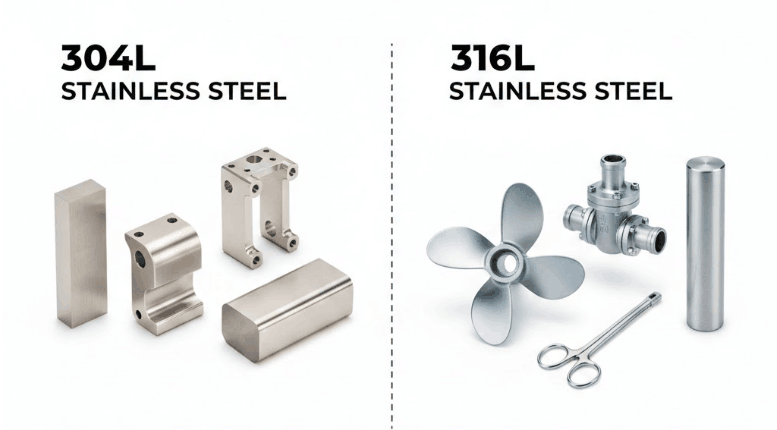

Engineers and buyers often struggle when choosing stainless steel. You compare options, yet 304L and 316L still feel confusing. Wrong choices lead to delayed production, machining problems, corrosion failures, and wasted money. Your CNC parts may deform, seize during machining, or fail in service. You need a clear way to select the right grade with confidence.
304l vs 316l stainless steel often raises questions. This guide explains the difference between 316l and 304 stainless steel through 316l vs 304l chemical composition, key properties, and 304l vs 316l Stainless Steel Price. You will gain clear selection rules and practical insights for your project.

304L is a low carbon stainless steel from the austenitic family. It contains chromium and nickel that provide stable corrosion resistance and good formability. The reduced carbon level limits carbide precipitation and keeps the microstructure clean during welding. This grade remains one of the most widely used ss grades due to its balanced performance and stable structure.
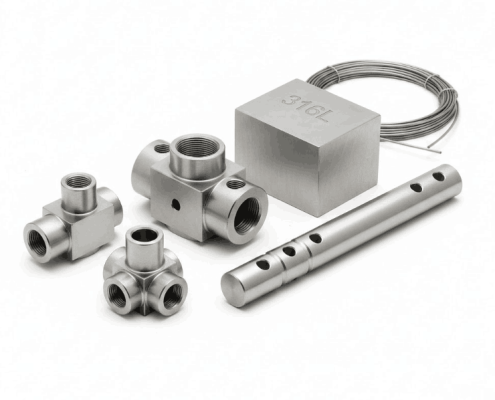
316L is a low carbon austenitic stainless steel designed for stronger corrosion resistance than 304-series grades. It contains chromium, nickel, and added molybdenum that improve stability in chloride, moisture, and chemical environments. The low carbon level helps maintain a clean microstructure during welding and supports long-term durability. This composition makes 316L one of the most reliable ss grades for demanding conditions.
Different regions use different standards, so comparing global equivalents helps ensure stable sourcing and consistent CNC machining performance. The table below includes major countries or regions for clarity.
| Standard System | Country / Region | Grade for 304L | Grade for 316L |
| AISI | United States | 304L | 316L |
| ASTM | United States | ASTM A240 304L / A276 304L | ASTM A240 316L / A276 316L |
| EN | European Union | EN 1.4307 | EN 1.4404 |
| DIN | Germany | X2CrNi18-9 | X2CrNiMo17-12-2 |
| JIS | Japan | SUS304L | SUS316L |
| UNS | International | S30403 | S31603 |
| GB | China | 022Cr19Ni10 | 022Cr17Ni12Mo2 |

The composition of each grade defines its corrosion behavior, strength balance, and machining response. 304L offers a universal mix of chromium and nickel for broad use, while 316L includes molybdenum that enhances performance in chloride-rich or chemical environments. These differences shape how each material performs in CNC machining, welding, polishing, and long-term service.The following table lists the key elemental ranges for both grades to show their essential chemical differences.
| Element | 304L | 316L |
| C | ≤ 0.03 | ≤ 0.03 |
| Cr | 18.0–20.0 | 16.0–18.0 |
| Ni | 8.0–12.0 | 10.0–14.0 |
| Mo | — | 2.00–3.00 |
| Mn | ≤ 2.00 | ≤ 2.00 |
| Si | ≤ 0.75 | ≤ 0.75 |
| P | ≤ 0.045 | ≤ 0.045 |
| S | ≤ 0.030 | ≤ 0.030 |
| N | ≤ 0.10 | ≤ 0.10 |
Mechanical strength directly affects CNC machining, part stability, and performance under load. 316L generally offers higher tensile strength, 485–620 MPa, and hardness, ~217 HB, compared with 304L at 485–515 MPa and ~201 HB. These higher values improve resistance to deformation, wear, and stress in demanding applications. 304L remains easier to form and machine, making it suitable for structural or decorative parts.
The following table compares 304L and 316L mechanical properties.
| Property | 304L | 316L |
| Tensile Strength | 485–515 MPa | 485–620 MPa |
| Yield Strength | 170–310 MPa | 170–310 MPa |
| Elongation | 40–50% | 40–50% |
| Hardness (Brinell) | ~201 HB | ~217 HB |
Physical properties determine how materials behave in temperature, density, and thermal expansion, which affects CNC machining, assembly, and long-term part stability. 316L has a slightly higher density, ~8.0 g/cm³, compared with 304L at ~7.93 g/cm³. Thermal conductivity for 316L is lower, ~16 W/m·K versus 304L’s ~16.2 W/m·K, and both have similar thermal expansion around 16–17 µm/m·K. These differences influence heat management during milling, turning, and welding.
The following table summarizes the key physical properties for both grades.
| Property | 304L | 316L |
| Density (g/cm³) | ~7.93 | ~8.0 |
| Thermal Conductivity (W/m·K) | ~16.2 | ~16.0 |
| Thermal Expansion (µm/m·K) | 16–17 | 16–17 |
| Melting Point (°C) | 1400–1450 | 1375–1400 |
316L outperforms 304L because of its molybdenum content, which enhances resistance to chlorides, pitting, and general chemical attack. This makes 316L ideal for marine hardware, chemical processing components, and medical equipment.304L resists general corrosion well in air and mild environments, but it may corrode under saltwater, acidic, or chloride-rich conditions.
This section explores how 304L and 316L behave during different fabrication processes, including CNC machining, cold and hot working, welding, forming, cutting, and annealing.
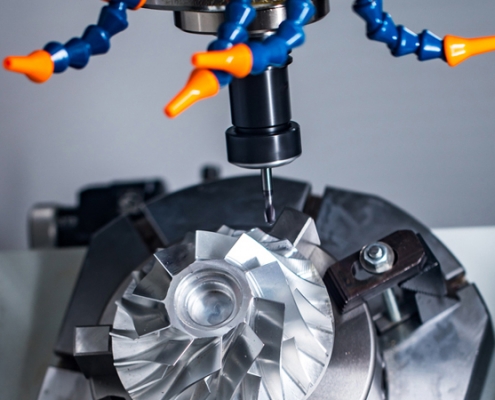
304L machines easily with sharp carbide tools and achieves smooth finishes. 316L is tougher and work-hardens faster, requiring optimized feeds and speeds to maintain tight tolerances. Both grades support precision CNC parts. At VMT, our advanced 4- and 5-axis CNC centers ensure both grades achieve tight tolerances, flawless surfaces, and consistent dimensional accuracy.
304L responds well to bending and forming at room temperature. 316L is slightly harder but can be cold-formed with careful control to avoid cracking. Cold working increases strength in both grades.
Both 304L and 316L can be hot-rolled or forged at 1050–1150°C. 316L requires slightly higher temperatures for optimal ductility. Hot working reduces residual stress and prepares parts for further machining.
Neither 304L nor 316L hardens by quenching; both are solution annealed to restore ductility. 316L may need more precise temperature control to prevent carbide precipitation.
Both grades weld well using TIG, MIG, or resistance welding. 304L is more forgiving during welding. 316L welds require care to preserve corrosion resistance in chloride environments.
304L offers excellent forming for panels, brackets, and housings. 316L is slightly stiffer but still suitable for complex shapes if proper tooling is used.
Shearing and punching are easier on 304L due to lower work-hardening. 316L requires sharper tools and reduced feed rates to avoid edge distortion.
Both grades benefit from annealing at 1010–1120°C to restore softness after cold or hot working. Proper annealing ensures dimensional stability and optimal surface finish for CNC parts.
Application selection depends heavily on environment, corrosion level, hygiene demands, and long-term performance requirements. This section explains where each alloy performs best.
304L is selected for environments where corrosion levels are moderate and cost efficiency matters. Its balanced strength and good machinability make it suitable for a wide range of general-purpose components.
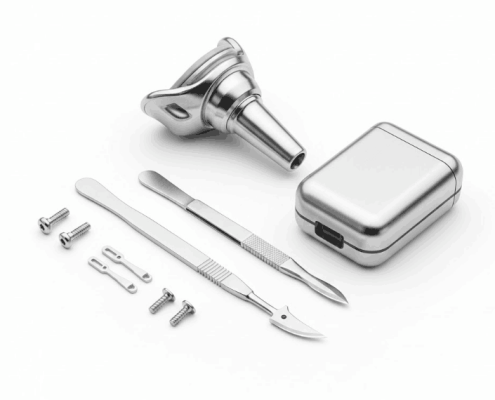
316L is chosen for aggressive or chloride-rich conditions where long-term corrosion resistance is critical. Molybdenum enhances durability, making it reliable for demanding industrial, marine, and medical use.
316L typically costs more than 304L because of its higher nickel and molybdenum content, which improves corrosion resistance but increases alloying cost.304L is the economical choice for general environments, decorative parts, and structural components where extreme corrosion resistance is not required.316L becomes cost-effective when long service life, reduced maintenance, or harsh-environment durability outweigh the initial material price.
The table below shows typical 304L and 316L stainless steel prices across major regions.The table data is updated as of November 2025. Due to market fluctuations, 304L vs 316L Stainless Steel price difference may vary. Contact VMT to get the latest quote.
| Region | 304L Price (USD/ton) | 316L Price (USD/ton) |
| China | 1,700 – 2,200 | 2,300 – 3,000 |
| Europe | 2,100 – 2,800 | 3,000 – 3,400 |
| United States | 2,300 – 3,500 | 3,000 – 3,800 |
| India / South Asia | 1,900 – 2,400 | 2,400 – 3,000 |
Choose 304L when you need a cost-effective stainless steel with reliable strength and good general corrosion resistance. It performs well in indoor environments, mild industrial settings, and applications that do not involve high chloride or acidic exposure.
304L is ideal for:
Choose 316L when your parts need superior corrosion resistance, long service life, or exposure to chlorides, salts, or aggressive chemicals. Its molybdenum content gives it a clear advantage in harsh environments and high-purity industries.
316L is ideal for:
A client from Germany in the optical equipment industry faced a persistent issue. Their indoor components required tight tolerances and stable machining performance, while the outdoor module suffered corrosion from moisture and frequent chemical cleaning. Using a single stainless steel grade for both environments caused premature failures and unnecessary cost increases.
The German customer saw a sharp drop in surface failures, extended outdoor module lifespan, and improved stability in the indoor assembly. Production costs decreased because material usage matched environmental demands. The optimized dual-material approach delivered higher reliability across the device.If you need engineering-driven CNC machining and the right material selection for each application, contact us to start your next project.
Choosing between 304L and 316L stainless steel depends on the application environment, corrosion exposure, and machining requirements. 304L offers cost-effective strength and excellent machinability for indoor or mild conditions, while 316L provides superior corrosion resistance and durability for harsh or chloride-rich environments. Proper material selection enhances CNC machining efficiency, reduces maintenance, and extends the service life of parts.
 WhatsApp/WeChat/Mobile:
+86-15099911516
WhatsApp/WeChat/Mobile:
+86-15099911516
 Tel: 86-150-9991-1516
 QQ: 939020977
 E-Mail: service@vimetal.com.cn


What makes 316L stainless steel alloy more expensive than 304L?
316L contains higher amounts of nickel and molybdenum. These alloying elements improve corrosion resistance, especially against chlorides and harsh chemicals, but increase raw material cost compared with 304L.
Can 304L and 316L be welded easily?
Yes. Both grades have excellent weldability. 304L is more forgiving during welding, while 316L requires careful control to preserve corrosion resistance at the weld joint.
Can I use 304L stainless steel alloy in marine environments?
It is possible for short-term or low-chloride exposure, but 304L is not ideal for prolonged contact with saltwater. 316L is recommended for marine applications due to its superior resistance to pitting and crevice corrosion.


 5 types of stainless steel:grades and characteristics