What is 304 Stainless Steel: Grades, Properties and Uses
By Luca Xie | Nov 24, 2025


Wrong material choices often result in failed machining, extra cost, and lost production time. A clear understanding of 304 stainless steel helps avoid these problems by matching the right alloy to the right application.
Stainless steel 304 is an austenitic chromium nickel alloy, The following sections explain what is 304 stainless steel, its grades, performance profile, pricing trends, and how it compares with 304 stainless steel vs 316, helping engineers and machining professionals select materials with greater confidence.
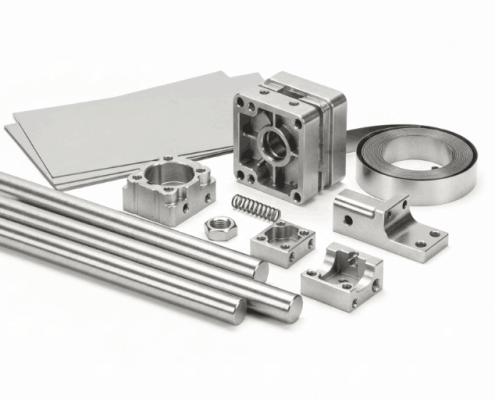
304 stainless steel is an austenitic stainless steel grade defined by the AISI 304 stainless steel standard. 304 Stainless Steel Meaning refers to a widely recognized material specification used globally, identifying stainless steel 304 or ss 304 as the most common general-purpose stainless steel grade. It serves as a standard reference material in industry, engineering, and manufacturing documentation due to its clear and unified definition.
1. 304 stainless steel combines corrosion resistance, strength, and good formability.
2. Its chromium and nickel content provides stable protection against rust and staining.
3. Manufacturers can mill, turn, drill, grind, weld, and CNC machine it with ease,supporting high-precision CNC machining requirements.
4. These machining properties support precise production of structural parts, fasteners, and decorative components.
5. The material maintains toughness and dimensional stability at both high and low temperatures.
6. ss 304 offers competitive cost and stable global availability for different production scales.
1. 304 stainless steel is sensitive to chloride attack.
2. It may experience pitting or crevice corrosion in marine or saline environments.
3. Its corrosion resistance is lower than 316 stainless steel in aggressive chemical exposure.
4. High temperatures can slightly reduce its mechanical strength.
5. Welding without low-carbon grades can cause sensitization and weaken corrosion resistance.
6. Manufacturers often select 304L or 304H to reduce these issues depending on the application.

304 stainless steel has three primary commercial grades: 304, 304L, and 304H. The standard 304 is the most commonly used grade in general applications. 304L is a low-carbon version designed to reduce the risk of sensitization during welding. 304H has higher carbon content, providing slightly higher strength at elevated temperatures. All three grades fall under the aisi 304 stainless steel specification and are recognized as grade 304 stainless steel in engineering standards, with the main differences relating to carbon content and specific processing considerations.
| Grade | Carbon Content | Key Feature | Typical Use |
| 304 | Standard | General-purpose austenitic stainless steel | Most standard industrial applications |
| 304L | Low | Reduced risk of sensitization during welding | Welded structures, pressure vessels |
| 304H | High | Higher strength at elevated temperatures | High-temperature equipment, heat-exposed parts |

304 stainless steel composition refers to the standardized formulation defined under aisi 304 stainless steel. SS 304 is an austenitic stainless steel primarily made of iron with 18–20% chromium and 8–11% nickel. Key trace elements include up to 0.08% carbon, 2% manganese, 1% silicon, 0.045% phosphorus, and 0.03% sulfur. These controlled ranges define stainless steel 304 and ss 304 as a consistent material that meets the 304 grade stainless steel specification.
| Element | Typical Range | Purpose |
| Chromium (Cr) | 18–20% | Provides corrosion resistance |
| Nickel (Ni) | 8–11% | Stabilizes austenitic structure |
| Carbon (C) | ≤0.08% | Controls welding behavior |
| Manganese (Mn) | ≤2.0% | Improves toughness and strength |
| Silicon (Si) | ≤1.0% | Enhances oxidation resistance |
| Phosphorus (P) | ≤0.045% | Reduces brittleness |
| Sulfur (S) | ≤0.03% | Improves machinability |
| Iron (Fe) | Balance | Base metal |
This section summarizes the key characteristics of 304 stainless steel across four dimensions: mechanical, physical, corrosion, and thermal properties. Understanding these properties helps engineers and manufacturers select the right material for CNC machining, industrial components, and precision parts while ensuring reliable performance in various environments.
Mechanical properties of 304 stainless steel describe how it responds to applied forces and deformation. These properties include tensile strength, yield strength, elongation, hardness, elasticity, and magnetic response. The values vary slightly depending on the grade, such as 304, 304L, or 304H. They also depend on product form, including sheet, plate, or bar. Sheets often show higher tensile strength and hardness because cold working increases strength. Bars and plates usually maintain stable and predictable mechanical behavior.
| Property | Sheet | Plate | Bar |
| Ultimate Tensile Strength | 520–720 MPa | 520–720 MPa | 520–720 MPa |
| Yield Strength (0.2% Proof) | 205–215 MPa | 205–215 MPa | 205–215 MPa |
| Elongation at Break | 40–50% | 45–55% | 45–55% |
| Hardness (Brinell) | 120–180 HB | 120–150 HB | 120–150 HB |
| Modulus of Elasticity | 193 GPa | 193 GPa | 193 GPa |
| Magnetic Response | Slightly magnetic | Low | Low |
304 stainless steel has several material characteristics that affect its use and processing. Its austenitic structure provides high toughness and stable temperature performance. Excellent processing properties make it easy to form, weld, and CNC machine, and it is not prone to cracking. Surface finish depends on product shape; thin sheets usually have a smooth surface, while thicker sheets or bars may have a slightly textured surface. High formability allows bending, stamping, and deep drawing, but cold working may slightly reduce flexibility. Its density is stable at 8.0 g/cm³, providing strength without excessive weight. Its resistivity makes it suitable for applications needing controlled conductivity or insulation.
| Property | Value / Description |
| Structure | Austenitic, face-centered cubic (FCC) |
| Workability | Excellent, easy to form, weld, and machine |
| Surface Finish | Smooth for thin sheets, textured for plates/bars |
| Formability | High, suitable for bending, stamping, deep drawing |
| Density | 8.0 g/cm³ |
| Electrical Resistivity | 720 nΩ·m |
304 stainless steel corrosion properties provide excellent resistance to rust, staining, and general environmental degradation. Its high chromium content forms a passive oxide layer that protects the surface in moist or chemically exposed environments. While stainless steel 304 resists general corrosion effectively, it can be vulnerable to pitting corrosion and crevice corrosion in high-chloride conditions, such as seawater. Weldability is another key feature: standard 304 ss can be welded using TIG, MIG, or stick welding, although carbon content may cause sensitization or weld cracking. Low-carbon 304L reduces these welding risks, while high-carbon 304H maintains strength at elevated temperatures, making it suitable for heat-exposed applications.
304 stainless steel thermal properties describe how the material behaves under heat, including melting point, thermal conductivity, expansion, and oxidation resistance. These properties ensure ss 304 performs reliably in high-temperature CNC machining and industrial applications.
| Property | Value / Description |
| Melting Point | ~1400°C (2552°F) |
| Thermal Conductivity | 16.2 W/m·K |
| Thermal Expansion | 17.2 x 10^-6 /K |
| Oxidation Resistance | Forms self-healing passive oxide layer |
| High-Temperature Use | Suitable for heat-exposed parts and industrial equipment |
304 stainless steel applications cover a wide range of industries, including kitchenware, appliances, industrial equipment, construction, medical, automotive, and aerospace. This section explains where ss 304 is used and highlights specific CNC-machined parts, structural components.
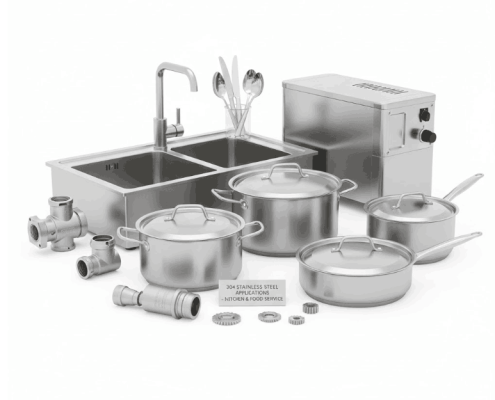
304 stainless steel is widely used in sinks, cookware, flatware, and food processing equipment. CNC-machined parts include precision fittings, valve components, and food-grade machinery housings in breweries, dairies, and commercial kitchens. Its corrosion resistance and smooth finish make it ideal for hygiene-sensitive applications.
SS 304 is commonly found in refrigerators, dishwashers, ovens, and other consumer appliances. CNC-machined brackets, fasteners, and structural panels ensure durability and precise assembly. Its formability allows intricate shapes for appliance interiors and panels.
In industrial machinery, 304 stainless steel is used for springs, screws, nuts, bolts, and CNC-machined components like pump housings, motor mounts, and chemical processing valves. Its mechanical stability and corrosion resistance make it suitable for manufacturing and chemical environments.
304 stainless steel is employed in building panels, structural supports, handrails, and decorative trim. CNC-milled brackets, cladding panels, and custom connectors provide both aesthetic appeal and structural reliability in architectural applications.
Surgical instruments, implants, laboratory equipment, and CNC-machined medical housings often use 304 ss. Its biocompatibility, sterilizability, and corrosion resistance ensure safety and precision in medical and pharmaceutical applications.
304 stainless steel is used in exhaust systems, trim pieces, brackets, and CNC-machined engine components. Its ability to resist heat and corrosion ensures long-lasting performance in vehicles.
In aerospace, stainless steel 304 is applied to aircraft structural elements, engine components, and rocket parts. CNC-machined fasteners, brackets, and housings provide high strength and reliable dimensional accuracy under extreme conditions.
304 stainless steel price depends on market conditions, material form, and thickness. Sheets, plates, and bars have different costs due to production processes and CNC machining requirements. Stainless steel 304 generally maintains a competitive price compared with other corrosion-resistant alloys, making it a cost-effective choice for industrial components, consumer products, and precision-machined parts. Prices fluctuate based on raw material supply, global demand, and order quantity.
| Product Form | Typical Price Range (USD/kg) | Notes / Examples |
| Sheet (cold-rolled, 2B finish) | 3.20–3.85 | Smooth surface for CNC-machined panels |
| Round Bar (Ø12–50 mm) | 3.85–4.35 | Used for shafts, fasteners, and structural parts |
| Plate (domestic China) | ~1,700/ton | Thick plates for structural and industrial equipment |
| Sheet (No.4 finish) | 3.50–4.20 | Kitchen, appliance, and decorative parts |
| Country / Region | Typical 304 Stainless Steel Price | Source / Notes |
| China | ~ US$ 2,065 / ton (for 304/2B) | Based on weekly average in Chinese domestic market ( |
| Europe | US$ 2,100–2,800 / ton for 304L / plate | Indicative mill prices for European mills. |
| United States | US$ 2,300–3,500 / ton for 304 plate | Higher cost for small or cut to size orders. |
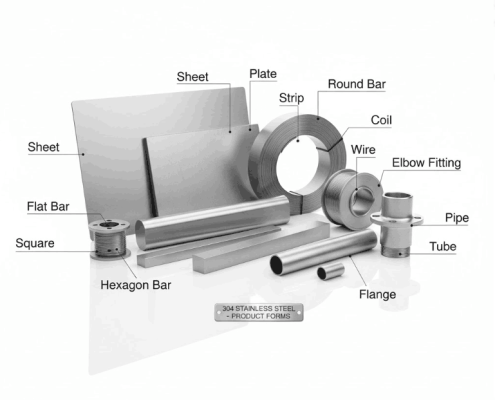
304 stainless steel is available in multiple product forms, including sheet, plate, strip, coil, round bar, flat bar, square bar, hexagon bar, wire, pipes, tubes, and fittings.
| Product Form | Examples of Applications |
| Sheet / Plate | Architectural panels, sinks, food processing equipment |
| Strip / Coil | High-volume stamping, deep-drawn parts |
| Round Bar / Flat Bar / Square Bar / Hexagon Bar | Structural components, fasteners, general fabrication |
| Wire | Springs, nuts, bolts, screens |
| Pipes / Tubes | Food and beverage systems, chemical processing, medical applications |
| Fittings | Elbows, tees, couplings for piping and assemblies |
304 stainless steel contains 18–20% chromium and 8–11% nickel. This composition gives it excellent corrosion resistance, good formability, and reliable mechanical properties. Manufacturers can machine, weld, and polish it easily. This makes it ideal for CNC-machined parts, kitchen equipment, household appliances, and architectural components. Its cost-effectiveness and stable supply make ss 304 suitable for most industrial and consumer applications where exposure to chlorides or harsh chemicals is limited.
316 stainless steel includes 2–3% molybdenum along with 16–18% chromium and 10–14% nickel. This addition significantly improves resistance to pitting, crevice corrosion, and chloride attack. It performs well in marine, chemical processing, and medical environments. Machining and formability are similar to 304 stainless steel. However, 316 ss provides higher corrosion resistance and slightly better high-temperature strength. The trade-off is a higher price, making it more suitable for demanding environments rather than general-purpose use.
| Property | 304 Stainless Steel | 316 Stainless Steel |
| Chromium | 18–20% | 16–18% |
| Nickel | 8–11% | 10–14% |
| Molybdenum | None | 2–3% |
| Corrosion Resistance | Excellent general corrosion resistance | Superior pitting and chloride resistance |
| Machinability | Excellent | Good |
| Weldability | Excellent | Good, low carbon grades preferred |
| High-Temperature Strength | Good | Slightly higher |
| Typical Applications | Kitchen, appliances, CNC parts, architectural | Chemical, marine, medical, harsh environments |
| Price | Lower | Higher |
A medical equipment manufacturer faced recurring issues with their stainless steel housings. Parts made from standard materials deformed slightly during sterilization and showed early corrosion. The client struggled to maintain dimensional accuracy and surface quality for CNC-machined components.
VMT analyzed the problem and recommended 304L stainless steel for stable mechanical properties and corrosion resistance. Our engineers optimized the machining strategy and applied precise 5-axis CNC processing. We also controlled surface finishing to sub-0.01 mm tolerance. These optimizations helped the housings maintain shape, resist corrosion, and meet aesthetic standards. VMT’s intervention enabled the client to solve production issues and deliver reliable, high-quality equipment. If you have any questions about machining 304 stainless steel, please contact us immediately for free engineering technical guidance and a quote!
304 stainless steel is a versatile, corrosion-resistant, and easily machinable alloy. Many industries widely use this material for different applications. Its balanced properties, multiple grades, and product forms make it ideal for CNC-machined components and consumer products. It is also suitable for industrial equipment and structural applications. By understanding its composition and mechanical and thermal characteristics, engineers and manufacturers can choose the right material. Comparing it with 316 stainless steel also helps ensure durability, precision, and cost-effective production.
 WhatsApp/WeChat/Mobile:
+86-15099911516
WhatsApp/WeChat/Mobile:
+86-15099911516
 Tel: 86-150-9991-1516
 QQ: 939020977
 E-Mail: service@vimetal.com.cn


How long does a 304 stainless steel last?
304 stainless steel can last for decades under normal conditions. Its high chromium and nickel content provides excellent corrosion resistance, making it suitable for indoor and mild outdoor environments. With proper maintenance and protection from harsh chemicals or chlorides, 304 ss components can easily exceed 20–30 years of reliable service.
Will 304 stainless steel rust?
304 stainless steel is highly resistant to rust, but it is not completely immune. Exposure to high chloride environments, like seawater, can cause pitting or surface corrosion over time. Routine cleaning and avoiding aggressive chemicals help maintain its corrosion resistance and prevent rust formation.
Is 304 stainless steel ok for outdoor use?
Yes, 304 stainless steel is generally suitable for outdoor use in non-marine environments. It withstands rain, humidity, and normal weather conditions. However, in coastal or highly saline areas, corrosion may occur, and 316 stainless steel is preferred for superior outdoor durability.


 316 vs 316L Stainless Steel: Which Is Better