904L vs 316L stainless steel:Which is Better
By Luca Xie | Nov 28, 2025
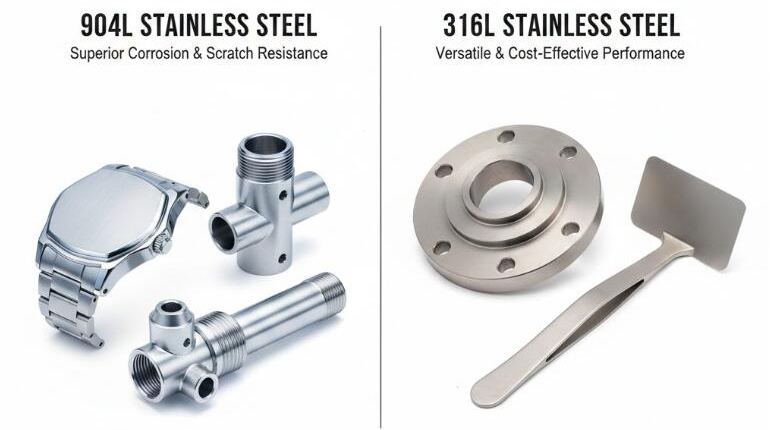

Many engineers struggle when choosing between 904l stainless steel vs 316l. Wrong selection leads to corrosion failures, higher machining cost, unstable surface quality, and short service life. Problems grow in marine, chemical, or high-precision CNC projects. These issues waste money, delay production, and damage product stability.
This article explains the difference between 316l and 904l steel and shows how 316l vs 904l behave in composition, properties, machining, welding, applications, and cost. It helps engineers, buyers, and manufacturing teams choose the right alloy for durable parts, better finishes, and stable CNC machining performance. You will also learn why some industries prefer 904l steel, how 904l vs 316l price affects budgets.
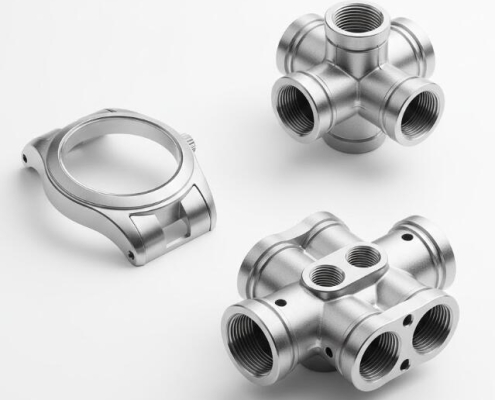
904L is a high-alloy austenitic stainless steel with very low carbon and high nickel and molybdenum content. It appears in standards such as ASTM B625 and is often referenced as AISI 904L, UNS N08904, or WNR 1.4539. Many suppliers also call it 904l steel. Its design targets aggressive environments that attack common stainless steels.
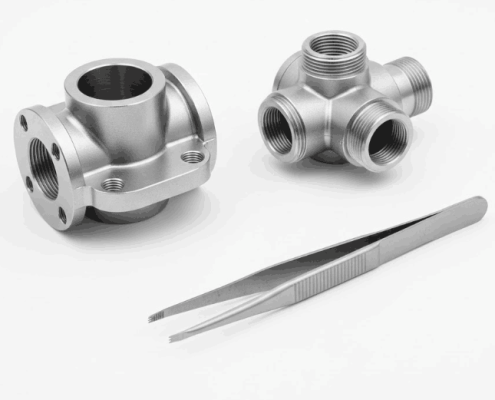
316L is a low-carbon austenitic stainless steel designed to provide stable corrosion resistance and excellent weldability. It belongs to the AISI 300 series and is listed in standards such as ASTM A240 and ASTM A276. Many manufacturers also refer to it as UNS S31603. The low carbon content reduces carbide precipitation and improves performance in welded structures.
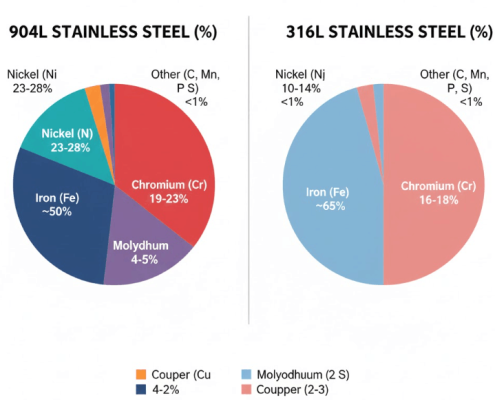
904L Stainless Steel contains high nickel, chromium, and molybdenum. The elevated nickel and molybdenum enhance corrosion resistance in acidic and chloride-rich environments. Copper in 904L further improves stability in strong acids. These features make 904l steel ideal for premium products, marine components, and chemical processing equipment where long-term durability matters.
316L Stainless Steel has lower nickel and molybdenum content, making it easier to machine and weld. It offers good corrosion resistance in general chloride environments but is less resistant to pitting corrosion and crevice corrosion than stainless steel 904l. 316L is cost-effective and widely available, making it suitable for industrial applications where extreme corrosion resistance is not critical.
Here is a detailed comparison of their chemical composition:
| Element | 904L Stainless Steel (%) | 316L Stainless Steel (%) |
| Carbon (C) | 0.02 max | 0.03 max |
| Chromium (Cr) | 19–23 | 16–18 |
| Nickel (Ni) | 23–28 | 10–14 |
| Molybdenum (Mo) | 4–5 | 2–3 |
| Copper (Cu) | 1–2 | 0–0.75 |
| Manganese (Mn) | 2 max | 2 max |
| Phosphorus (P) | 0.045 max | 0.045 max |
| Sulfur (S) | 0.03 max | 0.03 max |
This section compares the key properties of 904l stainless steel vs 316l, including mechanical strength, hardness, ductility, and physical characteristics. Understanding these differences helps engineers and buyers select the right material for CNC machining, surface finishing, and long-term durability.
904L Stainless Steel offers higher strength and hardness than 316L, making it suitable for parts that need long-term wear resistance and surface durability. Its tensile and yield strength allow for stable performance in high-stress environments. However, the higher alloy content increases hardness, which can affect CNC machining tool life. Engineers working with 904l ss vs 316l ss must optimize cutting speed and feed to maintain surface finish.
316L Stainless Steel provides good ductility and moderate strength. Its lower hardness makes it easier to machine and form, which is beneficial for complex CNC components. While its tensile and yield strength are lower than 904l stainless steel, 316L still meets requirements for most industrial applications. Its balance of machinability, corrosion resistance, and cost makes it a popular choice.
Here is a mechanical properties comparison:
| Property | 904L Stainless Steel | 316L Stainless Steel |
| Tensile Strength (MPa) | 550–750 | 485–620 |
| Yield Strength (MPa) | 250–450 | 170–290 |
| Brinell Hardness | 150–190 | 140–160 |
| Vickers Hardness | 160–200 | 150–170 |
| Rockwell Hardness | B85–B95 | B70–B85 |
| Elongation (%) | 40–50 | 40–50 |
| Elastic Modulus (GPa) | 193 | 193 |
904L Stainless Steel has a slightly higher density due to its high nickel and molybdenum content. Its melting point is higher than 316L, which supports stability in high-temperature processes. 904L is essentially non-magnetic in the annealed condition and offers moderate thermal conductivity. Its thermal expansion is lower than 316L, helping maintain dimensional stability under temperature changes. These physical traits make 904l steel suitable for precise CNC components and premium products.
316L Stainless Steel is lighter and easier to process, with slightly lower melting point and higher thermal expansion. It is also non-magnetic in the annealed state and has good thermal conductivity for general industrial applications. While its physical properties are not as extreme as stainless steel 904l, 316L provides reliable performance for most chemical, marine, and industrial equipment at lower cost.
Here is a comparison of key physical properties:
| Property | 904L Stainless Steel | 316L Stainless Steel |
| Density (g/cm³) | 8.03 | 8.00 |
| Melting Point (°C) | 1390–1425 | 1375–1400 |
| Magnetic | Non-magnetic | Non-magnetic |
| Thermal Conductivity (W/m·K) | 12–14 | 16 |
| Thermal Expansion (10⁻⁶/K) | 16 | 16.5 |
| Resistivity (μΩ·cm) | 70 | 74 |
| Specific Heat (J/kg·K) | 500 | 500 |
This section reviews key fabrication aspects of 904l stainless steel vs 316l, including CNC machining, welding, formability, heat treatment, and surface finishing.
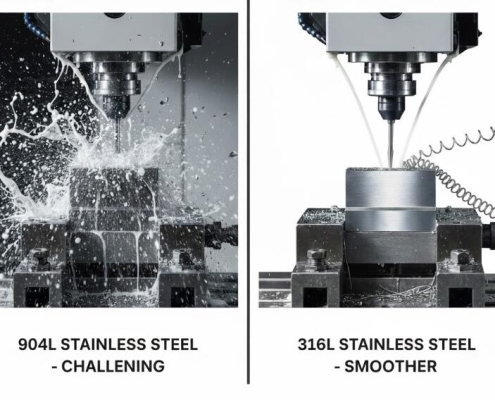
904L Stainless Steel is harder and more alloyed, making it challenging to machine. It increases tool wear and requires lower cutting speeds, optimized feeds, and high-quality coolants. At VMT, a Shenzhen-based CNC machining factory specializing in high-precision metal parts, our engineers carefully plan tool paths and monitor cutting parameters to maintain surface finish and tolerance. Using 904l vs 316l scratch resistance as a guide ensures durable, precise components for demanding applications.
316L Stainless Steel is easier to machine with stable chip formation. It allows faster cutting speeds and smoother surface finishes, making it ideal for high-precision CNC components while keeping tool wear moderate. VMT leverages this machinability to deliver consistent quality parts quickly, meeting both tight tolerances and aesthetic requirements.
904L requires controlled heat input to maintain corrosion resistance. Special filler metals may be necessary for chemical or marine applications. Improper welding can reduce pitting resistance and surface quality.
316L welds easily with standard techniques. Its low carbon content prevents carbide precipitation, making it suitable for welded CNC parts in general industrial applications.
904L has lower ductility due to high alloy content, which can complicate bending, deep drawing, or forming intricate shapes. Careful planning is required to prevent cracking or spring-back.
316L offers excellent formability, allowing complex geometries and tight tolerances in CNC-machined parts. It is easier to shape without compromising structural integrity.
Both 904L and 316L are primarily austenitic and typically supplied solution-annealed.
904L may require precise solution annealing to optimize corrosion resistance. Post-heat treatment is critical for premium components with strict performance requirements.
316L benefits from solution annealing but is less sensitive. Its heat treatment is simpler and more forgiving, which reduces production complexity.
904L responds well to electro-polishing, passivation, and other finishing methods. This enhances 904l stainless steel vs 316l scratch resistance and long-term durability, especially in harsh environments.
316L also accepts polishing and passivation but achieves lower scratch resistance and surface longevity compared with 904L. Proper finishing ensures high-quality CNC components in both alloys.
Both 904L stainless steel and 316L stainless steel have equivalent grades across multiple international standards. These designations ensure consistent composition, mechanical properties, and corrosion resistance for CNC machining and industrial applications. The main equivalent grades are summarized in the table below:
| Standard / Country | 316L (Standard Austenitic) Equivalent Grades | 904L (Super Austenitic) Equivalent Grades |
| UNS (Unified Numbering System) | S31603 | N08904 |
| ASTM / ASME | ASTM A240 / A312 / A213 Type 316L | ASTM A240 / A312 / A213 Type 904L |
| EN / DIN (Europe / Germany) | EN 1.4404 / X2CrNiMo17-12-2 | EN 1.4539 / X1NiCrMoCu25-20-5 |
| JIS (Japan) | SUS 316L | SUS 904L |
| GB (China) | 022Cr17Ni12Mo2 | 00Cr20Ni25Mo4.5Cu |
| BS (United Kingdom) | 316S11 / 316S12 | 904S13 |
| ISO | 316L | 904L |
| AFNOR (France) | Z2CND17-12 | Z2NCDU25-20-5 |
| GOST (Russia) | 03Х17Н14М3 | 03Х22Н26М2Д2Т |
904L Stainless Steel is more expensive due to its high nickel, molybdenum, and copper content. Material prices typically range from $8–12 per kg, depending on market conditions and form (sheet, plate, or bar). CNC machining costs are also higher because of increased tool wear and slower cutting speeds required to maintain 904l vs 316l scratch resistance and surface finish.
316L Stainless Steel is more cost-effective, usually priced around $3–6 per kg. Its lower hardness and alloy content reduce CNC machining difficulty and allow faster production cycles. For general industrial applications where extreme corrosion resistance is not required, 316L vs 904L offers significant savings in both material and processing costs.
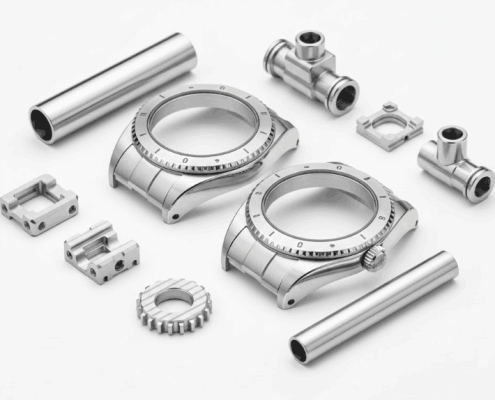
Chemical Processing: tanks, piping, heat exchangers
Offshore & Marine: seawater cooling systems, ballast piping, firewater networks
Pharmaceutical: WFI systems, product contact vessels
Luxury CNC Parts: high-end watch cases, precision components
Food & Beverage: storage vessels, distribution systems, product contact surfaces
Architecture & Construction: facades, structural elements, decorative features
Medical Devices: surgical instruments, implants, hospital equipment
General CNC Components: flanges, valves, plates, custom-machined parts
At VMT, we help clients select the right stainless steel grade for CNC-machined components, balancing corrosion resistance, machinability, surface finish, and cost efficiency. Our advanced 4- and 5-axis CNC centers and expert engineers ensure atomic-clock-level tolerances and iPhone-level surface quality.
A European chemical equipment manufacturer faced a challenge with CNC-machined valve bodies exposed to chloride-rich acids. Their previous 316L components suffered corrosion and surface degradation, threatening performance and durability. They needed a material and process solution that could withstand aggressive chemical environments while maintaining tight tolerances.
VMT recommended 904L stainless steel for its superior corrosion resistance and scratch durability. Using our 5-axis CNC centers and precision tooling, we produced the valve bodies with 0.01 mm tolerance and polished surfaces. Tool wear and cutting parameters were optimized to maintain 904l vs 316l scratch resistance, and post-machining passivation ensured long-term reliability in the chemical environment.
Our engineering approach combines high-precision CNC machining, controlled surface treatment, and quality management to deliver reliable, high-performance components. Are you also wondering whether 904L or 316L is better for your project? Contact VMT now to get a free material assessment and project quote.
Choosing between 904L stainless steel vs 316L depends on your application environment, corrosion demands, and surface finish requirements. 904L excels in highly corrosive, chloride-rich, or acid-exposed conditions, offering superior scratch resistance and long-term durability. 316L is ideal for general industrial, medical, food, and architectural applications, balancing machinability, cost, and reliable corrosion performance.
 WhatsApp/WeChat/Mobile:
+86-15099911516
WhatsApp/WeChat/Mobile:
+86-15099911516
 Tel: 86-150-9991-1516
 QQ: 939020977
 E-Mail: service@vimetal.com.cn


Is 904L steel better than 316L?
904L stainless steel is not inherently “better” than 316L, but it offers superior corrosion resistance, making it ideal for extremely acidic or chloride-rich environments. 316L is more widely used, easier to machine, and cost-effective for general CNC-machined components in industries like food processing, medical devices, and marine equipment.
Is 316L stainless steel good for watches?
Yes, 316L stainless steel is commonly used in watchmaking for its corrosion resistance, smooth surface finish, and machinability. It provides durable, polished surfaces suitable for CNC-machined watch cases and bracelets, while keeping production cost moderate compared with super austenitic grades like 904L.
Which is more suitable for corrosive environments, 316L or 904L?
904L stainless steel is more suitable for aggressive corrosive environments, including sulfuric and phosphoric acids or seawater exposure. 316L performs well in general chemical, marine, and food-grade applications but may degrade faster under extreme chloride or acid conditions. CNC precision and surface finishing enhance performance for both grades.

 304L Stainless Steel 1.4307: The Ultimate Guide